Category: Geral

  • The “Ceasefire” Is a Lie. Oil Just Hit $106 Again. Here’s What’s Actually Happening.

    One week ago, the headlines said peace was coming.

    Prediction markets — the same ones that had $580 million in suspicious bets placed 15 minutes before Trump’s ceasefire announcement — were pricing a 60% probability of a peace deal by the end of April. The Dow had surged 1,325 points on ceasefire optimism. Oil had plunged 16%. Airlines were rallying. The financial media declared that the worst of the Iran war was behind us.

    Today, oil is back at $106 per barrel.

    Peace deal odds on those same prediction markets have collapsed from 60% to 10% — in seven days. The Strait of Hormuz remains at a standstill. US and Iranian naval forces are engaged in what the Pentagon is calling “vessel interdiction operations” — each side is capturing commercial ships in tit-for-tat seizures. Shipping through the world’s most important energy chokepoint, which normally carries one-fifth of the global oil and gas supply, has not resumed.

    Bloomberg’s headline this morning said it without ambiguity: “Iran Ceasefire Fails to Reassure a Global Economy on Edge.”

    The ceasefire that was supposed to end the crisis has not ended anything. And the implications of that — for oil prices, for inflation, for the Fed’s decision on April 28, for your mortgage rate, for the cost of everything — are not being explained clearly enough to the people who need to understand them.

    Here is what is actually happening.


    What a “Ceasefire” Actually Means in This Conflict

    The word ceasefire has a specific meaning in most military contexts. It means both sides stop shooting. It means a pause in active hostilities — a de-escalation that creates space for diplomatic resolution.

    What exists between the United States and Iran right now is not that.

    What exists is something closer to an armed standoff with active economic warfare continuing. The US and Iran agreed to stop direct military strikes on each other’s territory and forces. The bombing of Iranian power plants stopped. The Iranian strikes on US bases in the region stopped.

    But neither side agreed to reopen the Strait of Hormuz. And that is where the economic damage lives.

    Iran continues to enforce what it calls “transit fees” on commercial vessels attempting to pass through the Strait — effectively a blockade by another name. The US Navy continues to challenge Iranian interdiction attempts, resulting in the tit-for-tat vessel captures that are currently making commercial insurers unwilling to cover ships attempting the passage.

    Without insurance, commercial shipping doesn’t move. Without commercial shipping moving through the Strait, the 20% of global oil and gas supply that normally transits there doesn’t reach its destination. Without that supply reaching markets, oil prices don’t fall.

    The ceasefire stopped the bombs. It did not stop the blockade. And the blockade is what is keeping oil above $100.


    The Seven-Day Collapse of Peace Optimism

    The speed with which peace deal probability collapsed from 60% to 10% in seven days is itself the most important data point in this story.

    It means the market’s original ceasefire optimism was wrong. Dramatically wrong. Investors who bought the ceasefire rally — who piled into airline stocks, sold energy hedges, reduced oil exposure — made those bets on an assumption that is now priced at 10 cents on the dollar.

    Here is the sequence of events that drove the collapse.

    In the days following the ceasefire announcement, diplomatic back-channels between Washington and Tehran produced no substantive progress. The fundamental disagreement — Iran insists on US military withdrawal from the region as a precondition for reopening the Strait; the US insists on Strait reopening as a precondition for any concession — was not resolved by the pause in bombing. It was merely paused alongside it.

    The negotiations in Islamabad that were supposed to produce a framework agreement collapsed over the weekend. Iran’s parliament speaker called US claims of productive dialogue “fake news used to manipulate the financial and oil markets” — a statement that, regardless of its accuracy, reflected the complete absence of diplomatic momentum.

    The US announced a naval blockade of Iranian ports in response. Iran responded by accelerating its interdiction of commercial vessels in the Strait. The physical situation in the world’s most important shipping lane deteriorated while the diplomatic situation produced no progress.

    Prediction market participants — who, as the $580 million trade demonstrated, often have better information than the general public — repriced the probability of a peace deal accordingly. From 60% to 10% in seven days.

    That repricing is the most honest assessment of where the conflict actually stands.


    What $106 Oil Means for the April 28 Fed Decision

    The Federal Reserve meets on Tuesday and Wednesday of next week — April 28 and 29. The decision that Powell announces on Wednesday, in what may be his final press conference before Kevin Warsh takes over, will be shaped substantially by where oil sits going into the meeting.

    At $106 per barrel — and rising, with WTI futures now pointing toward $110 — the Fed’s options are as constrained as they have been at any point since 2022.

    Here is the specific problem. The April CPI data, which will be released in mid-May, will reflect March’s $0.9% monthly surge and the continued pressure of $100+ oil. Inflation expectations — already at 4.8% for the one-year horizon in the most recent University of Michigan survey — are being re-anchored upward by every week that oil stays elevated. And the Fed cannot credibly claim it has inflation under control while consumers expect 4.8% inflation over the next twelve months.

    At the same time, the economic data is sending genuinely mixed signals. April PMI readings for Manufacturing came in at 54.0 and Services at 51.3 — both above 50, both in expansion territory, both above expectations. Retail sales rose 0.6% month-over-month in March, excluding gas stations. The labor market added jobs above expectations. By those measures, the economy doesn’t obviously need rate cuts.

    But ServiceNow — one of the most important enterprise software companies in the world — just saw its stock crash 18% after reporting that the Middle East conflict materially hindered its subscription revenue growth. American Airlines withdrew its full-year earnings guidance, now projecting results ranging from a loss to barely breakeven — against January guidance that projected earnings of up to $2.70 per share. The war is doing real damage to specific sectors even while headline economic data holds up.

    The Fed on April 28 faces a genuine stagflation problem. Inflation too high to cut. Growth uncertain enough to make holding painful. A new chair coming in who has signaled a different approach to policy. And an oil price that the Fed has no tool to control.

    Kevin Warsh, the incoming Fed Chair, testified before Congress this week in his confirmation hearings. He noted his commitment to Fed independence and stated that President Trump “didn’t ask for” lower rates — a statement designed to create separation from the political pressure the White House has applied to monetary policy. The DOJ simultaneously dropped its probe into Jerome Powell, clearing the path for Warsh’s confirmation.

    What Warsh inherits from Powell on April 28 is a monetary policy dilemma that has no clean resolution. And the oil price, sitting at $106 because the ceasefire is not actually a ceasefire, is the variable that makes every path more difficult.


    The Sectors That Got Burned by the Fake Peace

    The speed of the peace deal probability collapse from 60% to 10% left specific groups of investors significantly exposed. Understanding who got caught by the optimism — and who positioned correctly — reveals how sophisticated market participants are reading this conflict.

    Airlines: The sector that rose most aggressively on ceasefire optimism is now being dismantled by the reality. American Airlines has already withdrawn its full-year guidance — the clearest possible signal that management does not know how to forecast in the current environment. Delta, United, and Southwest all face the same fuel cost arithmetic. Every dollar increase in jet fuel costs approximately $100 million in annual expenses for a major carrier. Oil moving from $85 on ceasefire optimism back to $106 in seven days represents a cost reversal that makes Q2 and Q3 earnings essentially unforecastable.

    Shipping: The commercial shipping companies that briefly benefited from ceasefire optimism — on the assumption that alternative routes would become less necessary as the Strait reopened — are now watching the Strait remain closed and their alternative route premiums persist. Cape of Good Hope routing adds 10-14 days and significant fuel costs to Asia-Europe voyages. Those costs are being passed to shippers. Shippers are passing them to manufacturers. Manufacturers are passing them to consumers.

    Consumer discretionary: The retail sector that depends on imports from Asia — clothing, electronics, furniture, appliances — faces compounding pressure from both tariffs and shipping cost inflation. A supply chain that was already stressed by pharmaceutical tariffs now faces continued shipping disruption from a Strait that is not reopening as fast as markets assumed seven days ago.

    Energy: The sector that correctly held through the ceasefire optimism — maintaining long oil exposure despite the 16% price drop on the announcement — is being vindicated by the oil price recovery to $106. The fundamentals of the Strait closure did not change on March 23. They were temporarily overridden by sentiment. Sentiment corrected. The fundamentals reasserted.


    The Shipping Insurance Story Nobody Is Covering

    Here is the dimension of the Strait of Hormuz crisis that is generating the least mainstream coverage but has the most direct impact on everyday prices.

    Commercial shipping through the Strait of Hormuz requires war risk insurance. That insurance is provided by a small group of specialized underwriters — primarily Lloyd’s of London syndicates and a handful of mutual protection and indemnity clubs. When those underwriters decide a passage is too risky to insure, commercial vessels don’t sail regardless of what the diplomatic situation looks like on paper.

    Right now, war risk insurance premiums for Strait of Hormuz transits are at their highest levels since the Iran-Iraq war of the 1980s. Underwriters are not pricing a ceasefire. They are pricing the reality on the water — active vessel interdictions, naval standoffs, and the absence of any formal agreement on transit rights.

    The result is a Strait that is technically passable — no mines, no active military engagement between US and Iranian forces — but commercially impassable because the insurance market will not underwrite the passage at premiums that make the economics work for shipping companies.

    This is a critical distinction. The ceasefire is real in the sense that US and Iranian military forces are not actively shooting at each other. It is not real in the sense that commerce through the world’s most important energy chokepoint has resumed.

    Until the insurance market prices transit at pre-war premiums — which requires not just a ceasefire but a stable, verifiable, enforced agreement that protects commercial vessels from interdiction — the Strait remains effectively closed. And the insurance market is currently pricing that reopening at 10 cents on the dollar, consistent with the prediction market’s assessment of peace deal probability.

    Oil at $106 is the insurance market’s verdict on the ceasefire.


    The IMF’s Warning About “Fake” Recovery

    The International Monetary Fund’s April 2026 World Economic Outlook — published for the Spring Meetings in Washington last week — contains a passage that reads differently now than it did when analysts first processed it.

    The IMF built its “reference forecast” of 3.1% global growth on the explicit assumption of “a Middle East conflict of limited duration and scope, with disruptions fading by mid-2026.” It was careful to note that the reference forecast was not a prediction — it was a baseline scenario, alongside explicitly more pessimistic scenarios for a longer or broader conflict.

    The more pessimistic scenario modeled oil prices 80-160% higher than January 2026 baseline projections. At $106 per barrel today — and prediction markets pricing only a 10% chance of a peace deal by month end — the IMF’s pessimistic scenario is looking less pessimistic and more accurate than the reference forecast it was supposed to bound.

    The Fund’s chief economist, Pierre-Olivier Gourinchas, said at the Spring Meetings press conference that before the war began, global growth prospects were resilient and the IMF had been prepared to upgrade its global forecast. The war reversed that. The ceasefire that fails to reopen the Strait does not restore the pre-war economic trajectory.

    Global headline inflation is expected to rise modestly in 2026 before resuming its decline in 2027 — but that projection was built on the assumption that oil disruptions would fade by mid-2026. If the Strait remains effectively closed through Q2, the inflation trajectory changes. If it remains closed through Q3, the IMF’s pessimistic scenario becomes the base case.

    The IMF said risks are “decisively on the downside.” It listed a prolonged conflict as the primary downside risk. The conflict is currently prolonged. The peace deal probability is 10%.


    What Smart Money Is Doing With the Information

    The traders who correctly read the ceasefire as temporary — who maintained or quickly rebuilt energy exposure after the initial optimism — have been vindicated by the seven-day collapse in peace deal probability.

    The institutional playbook at this moment, based on positioning data visible in CFTC commitment of traders reports and prime brokerage flow data, looks like this.

    Re-establishing long energy. The positions that were reduced during the ceasefire optimism rally — crude oil futures, energy sector equities, pipeline infrastructure — are being rebuilt. The thesis is unchanged: the Strait remains closed, the physical supply deficit is real, and oil prices reflect that deficit accurately at $106.

    Buying the shipping disruption. The companies that benefit from extended Strait closure — tankers routing via Cape of Good Hope, LNG carriers in alternative supply chains, port operators at Red Sea alternatives — have been quietly accumulating institutional buying since the peace deal probability collapse began.

    Hedging consumer discretionary exposure. The sectors most exposed to prolonged supply chain disruption — retailers dependent on Asian imports, consumer electronics, discretionary categories with long supply chains — are facing increased short interest and put option activity from sophisticated investors who read the shipping insurance market as a leading indicator.

    Buying volatility. Options pricing across energy, currencies, and equities reflects the recognition that a 10% peace deal probability means a 10% chance of a massive relief rally and a 90% chance of continued elevated prices. That distribution of outcomes justifies owning volatility instruments that pay off if the situation resolves dramatically in either direction.


    The Question the Market Still Hasn’t Answered

    Seven days of collapsing peace optimism, oil back at $106, prediction markets at 10%, and the IMF’s pessimistic scenario becoming more likely than its reference forecast — all of this points to a single question that no analyst, no central bank, and no political leader has answered credibly.

    What does the resolution of this conflict actually look like?

    The fundamental positions of the two parties have not moved. Iran insists on US military withdrawal from the region. The US insists on full Strait reopening and Iranian nuclear program concessions. Neither position is compatible with the other. The negotiating teams that met in Islamabad produced no framework. The ceasefire provides no timeline for talks and no mechanism for resolving the underlying dispute.

    A conflict where both sides agree to stop shooting but neither side agrees to change the condition that caused the shooting is not a resolved conflict. It is a paused conflict. And paused conflicts, history suggests, have two possible trajectories: gradual diplomatic resolution, or return to active hostilities.

    The prediction market is pricing both scenarios — 10% on resolution by end of April, 90% on continued impasse or escalation. Oil at $106 is the commodity market’s translation of those same odds.

    The ceasefire that felt like peace seven days ago is being priced today as a temporary pause in a conflict with no visible resolution path.

    That is what is actually happening. And what happens on April 28 at the Fed — and in May, and in June, and in July — depends entirely on which of the two trajectories materializes.

    At 10 cents on the dollar for peace, you know which direction the smart money is leaning.


    This is not financial advice. Always consult a qualified financial advisor before making significant financial decisions. If this gave you a clearer picture of why oil is back at $106 when the headlines said peace was coming — share it. The gap between what the media reports and what the markets are actually pricing is the most important story in finance right now. And subscribe below for the next one.

    Want to actually take action instead of just reading?

    Most people understand what they should do with money — the problem is execution. That’s why I created The $1,000 Money Recovery Checklist.

    It’s a simple, step-by-step checklist that shows you:

    and how to start building your first $1,000 emergency fund without overwhelm.

    • where your money is leaking,
    • what to cut or renegotiate first,
    • how to protect your savings,
    • and how to start building your first $1,000 emergency fund without overwhelm.

    No theory. No motivation talk. Just clear actions you can apply today.

    If you want a practical next step after this article, click the button below and get instant access.

    >Get The $1,000 Money Recovery Checklist<

  • Elon Musk Just Killed Two Iconic Cars to Build Robots. Here’s What That Means for Your Job, Your Investments, and the Future of Work.

    Last night, on an earnings call that was supposed to be about cars, Elon Musk made an announcement that has almost nothing to do with cars.

    Tesla is discontinuing the Model S and Model X — two of the most iconic electric vehicles ever made — to free up those production lines for something else entirely.

    Humanoid robots.

    The Fremont, California factory that once produced the sleek $80,000 sedans and SUVs that defined Tesla’s premium brand will be retooled to manufacture 1 million Optimus robots per year. A new dedicated factory at Gigafactory Texas will eventually produce 10 million robots annually. Production begins this summer.

    “As you’ve heard me say a few times,” Musk told investors on the call, “I think Optimus will be our biggest product.”

    Then he added something that deserves to be read slowly: “I remain convinced of that conclusion.”

    This is not a vision statement about a distant future. Tesla is spending $25 billion this year alone on AI software, chips, and manufacturing infrastructure. The first large-scale Optimus factory begins preparations in Q2 2026 — this quarter, right now. Tesla’s stock, already at a $1.45 trillion market cap — more than five times the market value of Toyota — briefly surged in after-hours trading before Musk started talking about how big the upcoming costs would be.

    What happened last night on that earnings call is one of the most consequential industrial announcements of the decade. And almost nobody outside of financial Twitter is processing what it actually means.


    The Claim That Changes Everything

    Let’s take the core claim seriously for a moment, because dismissing it as Musk hype is the wrong analytical move.

    Musk has said Optimus could drive 80% of Tesla’s value. He has called it “the biggest product of all time.” He has said it could generate $10 trillion in revenue. He has said it will “eliminate poverty.” He has said it will represent “liberation” — the word he chose carefully — from physical labor.

    These are extraordinary claims. But here is what makes them different from typical tech CEO hype: the underlying economics are coherent.

    The business case is rooted in labor economics. There are approximately 4 billion people in the global workforce. The vast majority of those jobs involve tasks that are physically demanding, repetitive, or both. Manufacturing, logistics, agriculture, construction, food service, retail — these sectors employ hundreds of millions of people globally and are perpetually constrained by the cost and availability of human labor.

    A humanoid robot that costs $20,000 to manufacture — Tesla’s long-term unit cost target — and can perform the physical equivalent of a minimum wage job works 24 hours a day, 7 days a week, never calls in sick, and has a unit economics that pays for itself in months rather than years. At $100,000 per unit for early commercial customers (the expected B2B price in late 2026) — businesses pay a premium for the privilege of being first. At $20,000 per unit at scale — the economics become accessible to a radically wider customer base.

    If Tesla achieves 10 million units per year at $20,000 per unit, that is $200 billion in annual revenue from robots alone — before any recurring software or service revenue. For context, Toyota’s entire annual revenue is approximately $274 billion. Tesla would be approaching Toyota’s full revenue from a product line that didn’t exist three years ago.

    The “$10 trillion” figure Musk has cited reflects not just hardware sales but the economic value that labor substitution at scale would unlock. It is speculative, but it is not incoherent.


    The Model S and Model X Are Gone. That’s the Real Signal.

    The announcement that deserves the most attention is not the robot production targets. It is the decision to kill the Model S and Model X.

    These are not marginal products. The Model S launched in 2012 and won Motor Trend Car of the Year. It set the standard for what an electric vehicle could be. The Model X, with its falcon-wing doors and ludicrous acceleration, became a cultural symbol of Tesla’s ambition. Both cars have been in continuous production for over a decade.

    Tesla discontinued both of them. Not to make a better car. To make robots.

    This is a capital allocation decision that reveals everything about where Tesla’s leadership believes the value is. The Model S and Model X generate revenue today. Optimus robots in mass production volumes generate hypothetical revenue in the future — enormous hypothetical revenue, but still hypothetical.

    The decision to sacrifice certain present revenue for uncertain future revenue at this scale is not the move of a company hedging its bets. It is the move of a company that has concluded, at the board and executive level, that the robot opportunity is so large that the opportunity cost of keeping those production lines on cars is too high.

    That conclusion — arrived at by the world’s most valuable automaker, backed by its own manufacturing data from thousands of Optimus units currently working internally — is the most important data point in this story.

    Musk does not cancel iconic products because of a PowerPoint slide. He cancels them because the numbers convinced him.


    What “Production This Summer” Actually Means

    The timeline matters. This is not a product announced for 2030. Production begins this summer. Optimus will “start being useful outside Tesla” in 2027.

    Tesla currently has thousands of Optimus units working internally — performing tasks in its own factories. The company has been using its own factories as the test environment, accumulating operational data at a scale that no competitor can match. Every shift that an Optimus robot works in Fremont teaches the AI system something about physical task execution in a real manufacturing environment.

    The first generation production line — designed for 1 million robots per year — replaces the Model S and Model X lines at Fremont. The second generation line at Giga Texas targets 10 million robots annually. These are not aspirational numbers. They are planned production infrastructure.

    The Gen 3 hand that Tesla engineers described as “getting very close to human functionality and form factor” in March 2026 is the hand that goes into the robots being built on those lines this summer.

    For the first wave of commercial customers — large manufacturers, logistics companies, construction firms — the Optimus unit economics look like this: pay $100,000 or more upfront for a robot that works 24/7 on tasks that currently require multiple human workers at $15-25 per hour each. The payback period at scale is measured in months, not years. The waiting list, based on Tesla’s B2B discussions already underway, is substantial.


    The Three Groups Who Need to Pay Attention Right Now

    1. Workers in Physical Labor Sectors

    The Optimus production ramp has implications for every worker in sectors where physical tasks are the primary job function. This is not abstract. It is a timeline question.

    Tesla’s 2027 commercial deployment target for “outside Tesla” use means that industrial customers — manufacturers, warehouses, logistics companies — will begin evaluating Optimus against their current labor costs within the next 12-18 months.

    The sectors most immediately exposed are not the ones that require human judgment, emotional intelligence, or complex decision-making. They are the ones that require reliable, repetitive physical execution: warehouse picking and packing, automotive assembly line tasks, food processing, basic construction tasks, agricultural harvesting.

    This does not mean mass unemployment arrives in 2027. Adoption is gradual, regulatory environments vary, and most deployments will augment human workers before replacing them. But it does mean that the labor market calculus for anyone in these sectors is changing — and anyone who needs to make career decisions in the next five years should factor the Optimus deployment timeline into those decisions.

    2. Investors Who Haven’t Thought About This Yet

    Tesla’s stock at a $1.45 trillion market capitalization already prices in significant Optimus optionality. The earnings beat was real — adjusted EPS of $0.41 against expectations of $0.34 — but it is not what drives that valuation.

    The question for investors is not whether to own Tesla. The question is which adjacent companies benefit from a world in which 10 million humanoid robots per year are manufactured, deployed, and operated.

    The supply chain for humanoid robots requires actuators, sensors, semiconductor chips, AI training infrastructure, battery systems, and software platforms that today are largely sourced from companies that are not named Tesla. NVIDIA’s AI chips train the models that run inside Optimus. Suppliers of precision actuators and motors will face demand curves they have never seen before. Companies that build out the software layer for robot fleet management are positioning now.

    The Optimus announcement is also a direct signal to every other company in the humanoid robot space — Figure AI, Agility Robotics, Boston Dynamics, 1X Technologies, Apptronik — that the competitive intensity just escalated dramatically. Tesla’s manufacturing scale and vertical integration are advantages that none of them can match at comparable cost.

    3. Anyone Who Plans to Retire in the Next 20 Years

    The macroeconomic implications of 10-50 million humanoid robots in the global workforce by the mid-2030s are not fully modeled by any major institution. But the directional implications are visible.

    Robots do not pay Social Security taxes. They do not pay income taxes. They do not contribute to unemployment insurance systems. The fiscal models that underpin retirement security in the United States — and in virtually every developed economy — assume that the ratio of workers to retirees follows demographic curves. Mass robotic deployment disrupts those curves in ways that existing fiscal frameworks have not accounted for.

    At the same time, the productivity gains from robotic labor — if they are distributed broadly enough — could generate the economic growth that funds the social programs that an aging population depends on.

    Which of those two scenarios materializes depends entirely on the policy decisions made in the next five years, while the deployment curve is still in its early stages. Decisions about robot taxation, human dividend policies, retraining programs, and social safety net design are being made right now — largely without public discussion — that will determine which version of the robotic future arrives.


    The Question Nobody on the Earnings Call Asked

    Tesla’s Q1 2026 earnings call lasted over an hour. Analysts asked about vehicle deliveries, margins, the energy business, the robotaxi timeline, and the capex guidance.

    Nobody asked the question that is actually most important.

    If Optimus achieves even a fraction of the labor substitution that Tesla’s projections imply — if 10 million robots per year are performing tasks that previously required human workers — what happens to the humans those robots replace?

    Musk’s answer, in various formulations across multiple interviews and presentations, is that labor substitution at this scale will generate so much economic value that universal basic income becomes both possible and necessary. He has said governments will be “forced” to implement some form of UBI to manage the transition.

    That may be correct. It may not be. But it is a policy question of extraordinary magnitude being driven by a manufacturing decision being made in Fremont, California right now, with the first production robots going online this summer.

    The industrial revolution took generations to play out. Workers had time — often painful, often inadequate time — to adapt across generations. The AI and robotics transition is operating on a decade timeline, not a generational one.

    The last time a technology threatened to reshape the global labor market this fundamentally, the decision was made in a cotton field in the American South, and it took 80 years and a civil war to resolve the political economy of what followed.

    The decision is being made in Fremont. Production starts this summer. The $25 billion investment is committed.

    The question of what happens to the workers is still unanswered.


    What Smart Money Is Doing About It

    Institutional investors and family offices that have been following the Optimus story closely are making portfolio adjustments that most retail investors have not yet considered.

    Rotating toward robot supply chain. The semiconductor companies, precision components manufacturers, and AI infrastructure providers that supply into the humanoid robot production chain are being added to portfolios now — before the mass deployment creates supply chain constraints that drive their stock prices.

    Adding AI training infrastructure. NVIDIA’s data center GPUs train the physical AI models that run humanoid robots. The demand for AI training compute from robotics applications adds a new demand vector to an already constrained market. Infrastructure companies — power, cooling, networking — that serve data centers see their addressable market expand.

    Reassessing labor-intensive sector exposure. Consumer and institutional investors with significant exposure to sectors that will face Optimus-driven labor cost disruption — logistics, manufacturing, food service — are beginning to model the timeline for margin impact as robotic deployment creates competitive pressure on labor cost structures.

    Watching the policy window. The five-year period between now and 2031 is the window during which governments will make the key decisions about robot taxation, labor market policy, and social safety net adaptation. Countries and jurisdictions that get this right will attract the industries that benefit from robotic deployment. Countries that get it wrong will face both the labor disruption and the fiscal crisis simultaneously.


    The Bottom Line for April 23, 2026

    Tesla killed the Model S and the Model X last night. It is building a factory to produce 1 million humanoid robots per year in their place. A second factory will eventually produce 10 million per year. Commercial deployment begins this summer. The CEO says it is the biggest product in history.

    He may be right. He may be overstating it. He has been wrong about timelines before — and he has been right about the direction.

    What is not disputable is that the world’s most valuable automaker just made the largest bet in corporate history that physical AI — robots that do human work in human environments — is about to become the most important industrial product ever made.

    The first factory starts this summer.

    The conversation about what that means for jobs, for retirement, for tax policy, for the economy — that conversation needed to start yesterday.


    This is not financial advice. Always consult a qualified financial advisor before making significant investment decisions. If this helped you understand what Tesla’s announcement actually means beyond the earnings beat — share it with someone who should be thinking about this now. And subscribe below for the next one.

  • The Six Biggest Banks Just Had Their Best Quarter in Years. Here’s Who Paid for It.

    Let’s put two facts next to each other and sit with them for a moment.

    Fact one: In the first quarter of 2026, as oil hit $141 a barrel, consumer confidence crashed to its lowest level in 75 years, Americans collectively owed a record $1.277 trillion in credit card debt, and real wages fell — Goldman Sachs reported earnings of $17.55 per share. That destroyed Wall Street’s estimate of $16.47. The firm’s Return on Tangible Common Equity hit 21.3%. CEO David Solomon called it “very strong performance.”

    Fact two: In the same quarter, the University of Michigan consumer sentiment index hit 47.6 — a reading that had never been lower in the survey’s entire 75-year history. Lower than 2008. Lower than the COVID collapse. Lower than any moment in the lifetime of anyone under 55. One-year inflation expectations hit 4.8%.

    These two facts describe the same three months. The same economy. The same country.

    Goldman Sachs had its best quarter in years. The American consumer hit a historic low.

    JPMorgan Chase reported net income of $16.5 billion — up 13% from the prior year — with fixed income trading revenue rising 21% and investment banking fees jumping 28%. Bank of America shattered estimates. Morgan Stanley’s stock traders produced what Bloomberg described as a record “windfall.” The “big six” US banks collectively posted profits above analyst expectations for the quarter.

    Hedge funds bought a record $86 billion in stocks over five sessions — among the fastest such surges on record.

    Meanwhile, the Walmart parking lot was full. The pharmacy was about to get more expensive. Gasoline had crossed $4 a gallon for the first time since 2022.

    This is not a coincidence. This is a mechanism. And understanding the mechanism is the most important thing any American can do with the next ten minutes.


    How War Becomes a Windfall on Wall Street

    The first quarter of 2026 should have been a disaster for financial institutions. A war in the Middle East. Oil prices surging 40% from pre-conflict levels. Consumer confidence collapsing. Recession probability reaching nearly 50%. Bond markets showing three consecutive weeks of weak auction results.

    By most conventional logic, this is a terrible environment for banks.

    But conventional logic misses how the largest financial institutions actually make money — which is not primarily through lending to consumers in good times, but through trading, advisory services, and capital markets activity in any times, including volatile ones.

    JPMorgan’s fixed income trading revenue rose 21% to $7.08 billion in Q1. The category breakdown in the filing tells the story: rising activity in commodities, credit, currencies, and emerging markets. Every one of those categories is driven by volatility. When oil swings $30 per barrel in a week, commodity desks generate enormous fee revenue on every trade. When currency markets whipsaw because the dollar is strengthening and emerging markets are selling reserves, currency desks generate fees. When bond spreads widen because Treasury auctions are weak and inflation is resurgent, credit desks generate fees.

    Goldman Sachs reported record equities trading revenue in the same quarter. The $580 million oil futures trade that was placed 15 minutes before Trump’s ceasefire announcement moved through trading infrastructure that Goldman and its peers operate. Whether Goldman had anything to do with that specific trade is unknown — but the volatility that surrounds it, the volume it generates, the fees it produces — that flows through Wall Street’s income statement.

    Goldman’s investment banking fees jumped 48% year-over-year. JPMorgan’s jumped 28%. The war created urgency in corporate boardrooms: energy companies needed to hedge exposure, defense contractors needed to issue equity, multinationals needed to renegotiate credit facilities. Every transaction that corporate uncertainty generates produces an advisory fee. The more uncertain the world, the more advice corporations need to buy.

    Bank of America’s strong quarter was driven in part by its ability to hedge energy price risks for corporate clients — winning business away from smaller competitors. The volatile oil market of Q1 2026 was a revenue opportunity for the institutions sophisticated enough to navigate it.

    The war that cost the average American family hundreds of dollars in higher gas and food prices generated record trading revenues for the six largest banks in the United States.


    The Architecture of the Windfall

    To understand why this happens, you need to understand the two different ways that financial institutions make money.

    The first way is net interest income — the difference between what a bank pays depositors and what it charges borrowers. This is the bread-and-butter of traditional banking, and it has been the primary driver of big bank profits since the Fed began raising rates in 2022. When interest rates rise, net interest income expands. Banks pay depositors 0.5-1% and charge borrowers 7-8%. The spread is enormous.

    The second way is fee income — trading revenue, investment banking fees, advisory fees, wealth management fees, asset management fees. This income does not depend on interest rate spreads. It depends on volume and volatility. The more transactions occur, and the more uncertain the environment that drives those transactions, the higher the fee income.

    What changed in Q1 2026 is that net interest income has begun to stabilize — the Fed has held rates steady, and the NII “windfall era” of the rate-hiking cycle is fading. But fee income has exploded, precisely because the Iran war created the most volatile market environment since the 2020 COVID crash.

    The big six banks were already positioned to capture that volatility. They had the trading desks, the commodity derivatives infrastructure, the M&A advisory relationships, the institutional distribution networks. When volatility spikes, they generate fees. When uncertainty rises, corporations pay them for advice. When governments need to issue more debt into weak markets, they rely on primary dealers — which are the largest banks — to absorb and distribute it.

    JPMorgan’s fixed income revenue didn’t rise 21% because the economy was good. It rose because the economy was volatile in a specific way that created demand for the exact products JPMorgan sells.


    The Specific Products That Turned War Into Profit

    Here is the granular level of how this works, because the granular level is where the mechanism is most visible.

    Commodity derivatives. When oil hits $141 on the spot market and futures contracts are pricing $200/barrel scenarios, every airline, every shipping company, every manufacturer with significant energy exposure needs to hedge. Hedging means buying derivative contracts. Those contracts are sold by trading desks at major banks. The hedger pays a premium. The bank collects it. Higher oil prices and higher oil volatility means more hedging demand and larger premiums. JPMorgan’s commodity trading revenue surged in Q1.

    Credit derivatives. When recession probability is at 48.6% and corporate bond spreads are widening, credit markets become active. Companies that need to refinance debt in this environment pay higher rates. Distressed debt traders at banks buy at discounts. Credit default swaps — insurance against corporate bankruptcy — see increased demand. Each of these transactions generates fees that flow to bank income statements.

    Currency trading. The dollar strengthened significantly during the Iran war as investors fled to safety. Emerging market currencies weakened. Every company with international exposure that needed to convert currencies, every central bank that needed to intervene in foreign exchange markets, every fund that needed to adjust currency hedges — they all generated transaction volume that major bank currency desks captured as bid-ask spread income.

    Investment banking. The M&A surge that powered Goldman and JPMorgan’s investment banking fee lines was not random. The war accelerated strategic decisions that corporate boards had been delaying. Energy companies needed to consolidate. Defense contractors needed capital to expand capacity. Technology companies needed to acquire AI capabilities before competitors did. Each transaction that crossed the finish line in Q1 produced advisory fees — typically 1-2% of deal value on transactions ranging from hundreds of millions to billions of dollars.


    Why This Is Structurally Different From 2008

    The obvious question is: if the banks are doing this well, why should ordinary Americans be concerned?

    The concern is not that the banks are profitable — bank profitability is generally a sign of financial system stability, not instability. The concern is what the divergence between bank profits and consumer conditions reveals about the structure of the economy.

    In 2008, the banks and the consumers went down together. Both suffered. The financial crisis damaged bank balance sheets and wiped out consumer wealth simultaneously. The shared pain produced a shared response — massive policy intervention that, whatever its equity implications, at least attempted to address both sides of the damage.

    What Q1 2026 reveals is a different structure entirely. The largest financial institutions have engineered themselves to profit from volatility — any volatility — in ways that insulate their income from the consumer conditions that volatility creates.

    Bank of America’s strong results included being described as “the primary winner of the Q1 earnings cycle.” The same quarter when American consumer confidence hit a 75-year low.

    This is not Bank of America doing anything wrong. It is Bank of America doing exactly what its shareholders pay it to do — generating returns from market conditions, including difficult market conditions.

    But the divergence it reveals is significant. The institutions most capable of shaping economic conditions — through lending standards, credit availability, risk appetite — are currently being rewarded for the volatility that is damaging the consumers those institutions nominally serve.

    There is no mechanism in this structure that automatically corrects the divergence. The banks generate record profits from Q1 volatility. They report them in April. Their stock prices reflect the strength. Their executives receive performance-based compensation. The ordinary American pays $4.20 for gas and $200 more per month for groceries and $32,000 for a used car and $1,600 per month in credit card interest.

    The systems are running in parallel. They are not linked the way most people assume.


    The Hedge Fund Record That Tells a More Complete Story

    The Goldman Sachs data on hedge fund buying deserves particular attention.

    According to Goldman’s prime brokerage data, hedge funds bought a record $86 billion in stocks over five sessions during the ceasefire relief rally. The surge was among the fastest on record. Goldman’s analysis estimated that funds could add another $70 billion if momentum continued.

    This is the other side of the $580 million trade that was placed 15 minutes before Trump’s ceasefire announcement. It is the same mechanism operating at a different scale. Institutional capital — hedge funds, proprietary trading desks, quantitative strategies — is positioned to capture market moves generated by geopolitical events. When the ceasefire was announced and markets surged, the funds that had positioned for a rally captured returns that ordinary investors, operating at human speed and without institutional infrastructure, could not match.

    By the time the average American investor saw the ceasefire news on their phone, checked their brokerage app, and decided to buy, the institutional buying had already moved prices substantially. The gain that appeared in their account reflected a smaller move than the institutions captured on the way up.

    This is not illegal. It is not even unusual. But it means that the market rally driven by the ceasefire — celebrated as evidence of economic resilience — distributed its returns very unevenly. Institutional investors with algorithmic execution captured the bulk of the move in the first minutes. Retail investors captured the residual.


    What the Bank CEOs Said That Nobody Is Reporting

    The headline numbers from Q1 earnings were strong. The CEO commentary was considerably more cautious — and it received far less coverage than the profit beats.

    JPMorgan lowered its guidance for full-year 2026 net interest income from $104.5 billion to $103 billion — a meaningful revision that reflects uncertainty about how long the current rate environment will hold.

    Goldman CEO David Solomon noted during the earnings call that the bank’s clients continue to depend on it “amid the broader uncertainty” — an acknowledgment that the uncertainty itself is what is generating the revenue.

    Bank of America described the Q1 performance as reflecting “how institutional business lines respond to more volatile global conditions” — a formulation that is technically accurate but also worth reading carefully. Institutional business lines respond well to volatility. Consumer-facing business lines — mortgage lending, auto loans, small business credit — tend to respond poorly.

    The analyst consensus heading into Q2 is that earnings growth will continue, supported by dealmaking activity and trading volatility. But the same analysts note that if the ceasefire holds, oil prices stabilize, and volatility recedes, the trading revenue that powered Q1 will compress. The windfall was the war.


    What This Means for the American Who Isn’t a Hedge Fund

    Here is the most direct implication for the reader who does not run a commodity derivatives desk.

    The American financial system has evolved to benefit the most from conditions — volatility, uncertainty, geopolitical disruption — that are most damaging to ordinary household finances. This is not a conspiracy. It is the natural result of decades of financial deregulation, market structure evolution, and institutional incentive design.

    The practical consequence is that when you see big bank earnings headlines next quarter, the profit numbers tell you very little about how the underlying economy is affecting ordinary people. Bank profits being strong does not mean the economy is strong. It means the conditions that are generating bank profits are present — and those conditions may or may not be good for consumers.

    Q1 2026 is the clearest illustration of this principle in a generation. Record bank profits. Historic consumer distress. The same quarter.

    For individuals managing their own finances in this environment, the implication is equally direct: the financial products that big banks sell you — variable-rate credit cards at 22-24%, “promotional” investment products with embedded fees, insurance products with complex exclusions — are designed to generate the same kind of fee income that powered Q1 profits. The bank’s interest and yours are not aligned. The volatility that creates bank trading profits also creates the conditions in which consumers make financial decisions under stress — the worst conditions for optimal decision-making.

    The bank’s earnings report is not a signal that your finances are fine. It is a signal that the machine is running well. The question is which direction the outputs are flowing.


    This is not financial advice. Always consult a qualified financial advisor before making significant financial decisions. If this gave you a clearer picture of who benefits from the economic conditions you are living through — share it. And subscribe below for the next one.

    Want to actually take action instead of just reading?

    Most people understand what they should do with money — the problem is execution. That’s why I created The $1,000 Money Recovery Checklist.

    It’s a simple, step-by-step checklist that shows you:

    and how to start building your first $1,000 emergency fund without overwhelm.

    • where your money is leaking,
    • what to cut or renegotiate first,
    • how to protect your savings,
    • and how to start building your first $1,000 emergency fund without overwhelm.

    No theory. No motivation talk. Just clear actions you can apply today.

    If you want a practical next step after this article, click the button below and get instant access.

    >Get The $1,000 Money Recovery Checklist<

  • Your Prescriptions Are About to Get a Lot More Expensive — And Most Americans Don’t Know Why

    This is not about politics.

    It is about the pill you take every morning. The insulin in the refrigerator. The cancer drug your parent has been on for two years. The medication your child needs to get through the school day.

    On April 2, 2026 — exactly one year after the original “Liberation Day” tariffs — President Trump signed a proclamation imposing 100% tariffs on branded, patented pharmaceutical imports into the United States.

    One hundred percent.

    If a drug costs a manufacturer $50 to import, the tariff makes it $100. The cost does not disappear. It moves — from the pharmaceutical company’s balance sheet to the American patient’s bill, to the insurance premium, to the hospital system’s budget, to the employer’s benefits cost, and ultimately back to the worker’s paycheck.

    The announcement triggered the worst single day in the US stock market since the COVID-19 crash of 2020. International markets — the Nikkei, the Shanghai Composite, South Korea’s Kospi — all plunged. The Yale Budget Lab estimates the broader tariff regime is already costing American households between $650 and $1,340 more per year. The pharmaceutical tariffs, phasing in by July 31 for major companies, are a separate and additional hit.

    This is what is coming. Here is what you actually need to understand.


    The Scale of American Dependence Nobody Talks About

    Start with a number that should be impossible to ignore: 61% of American adults — 157 million people — fill at least one prescription per year. Add 20% of children — another 15 million. That is most of the country.

    Now understand where those drugs come from.

    In the past decade, US pharmaceutical imports have more than doubled in value, from $73 billion in 2014 to over $215 billion in 2024. The US imports over 828,000 metric tons of pharmaceuticals annually — seven times the 2000 level.

    China and India supply 70-80% of US generic drugs, with India providing approximately half of all finished generic drugs while depending on China for 70-80% of its active pharmaceutical ingredients. The US manufactures a fraction of what it consumes. The supply chain is deeply, structurally global.

    The tariffs announced on April 2 apply specifically to branded, patented drugs — not generics, which account for 92% of US retail prescriptions by volume. That nuance matters enormously. Most Americans filling prescriptions at CVS or Walgreens will initially see limited impact, because most of what they fill is generic.

    But here is what that distinction obscures.

    Branded drugs account for only 15% of prescriptions — but nearly 90% of drug spending. The drugs most likely to be affected are the most expensive ones: the cancer treatments, the biologics for autoimmune diseases, the specialty medications for rare conditions. The drugs that patients cannot simply switch to a generic for, because no generic exists.

    The people most exposed are not the ones taking atorvastatin for cholesterol. They are the ones taking Keytruda for cancer. Dupixent for severe eczema. Ozempic for diabetes. The drugs that already cost tens of thousands of dollars per year before the tariff.


    How a 100% Tariff Actually Reaches Your Bill

    The mechanism by which a tariff on pharmaceutical imports translates into a patient’s out-of-pocket cost is not straightforward. It passes through multiple layers. Understanding those layers is the difference between knowing this is coming and being surprised when it arrives.

    Layer one: the manufacturer. A pharmaceutical company importing a branded drug from Ireland — the single largest exporter of branded pharmaceuticals to the US, where drug imports from Ireland in March 2025 were five times higher than in March 2024 — faces a choice. Absorb the tariff and accept lower margins. Or raise list prices to preserve margins.

    History is instructive here. Drug companies entered 2026 by raising list prices on 872 different brand-name medications — including 16 companies that had already struck deals with the Trump administration to lower prices. The pattern is consistent: when costs rise, list prices rise.

    Layer two: insurance premiums. The primary impact on patient pocketbooks for most Americans will be indirect — premiums would likely rise as payer spending on drugs increases. Insurance companies and employers that fund health benefits are not going to absorb pharmaceutical cost increases out of goodwill. Those costs flow into premium calculations. The premium increase happens at open enrollment, when most people do not connect it to a tariff imposed months earlier.

    Layer three: hospital budgets. Hospitals face a double burden. As major purchasers of medications, they experience direct cost increases that could add 20% to their drug expenses. Hospitals that face higher costs either raise procedure prices, reduce services, or both. The cost diffuses through the healthcare system in ways that are difficult to trace but real.

    Layer four: the uninsured. For the 27.4 million uninsured Americans who face full list prices without insurance protection, the tariff impact is not indirect. It is immediate and direct. These are the Americans least equipped to absorb higher drug costs — and most likely to skip doses, delay treatment, or forgo medication entirely when prices rise.

    Cost-related medication non-adherence already affects 30% of American adults. The United States already pays on average three to four times more than other developed countries for the same branded drugs — leaving about a quarter of Americans unable to afford the branded drugs they need. Adding a 100% tariff to drugs that are already unaffordable for many Americans does not make them more affordable.


    The Supply Chain Problem Is Bigger Than the Price Problem

    The tariff’s impact on drug prices is the most visible concern. But experts at Johns Hopkins, the Brookings Institution, and the Information Technology and Innovation Foundation are raising a less visible but potentially more serious risk: supply disruption.

    The US pharmaceutical supply chain has single points of failure that the tariffs, paradoxically, may make more fragile rather than less.

    Consider what happened in 2023: a single plant in India responsible for 50% of the US supply of cisplatin — a critical chemotherapy drug — was shut down by the FDA for safety violations. It caused nationwide cancer drug shortages. That is the supply chain vulnerability that the tariffs are theoretically designed to address. But the fix is not instantaneous.

    The labs needed to produce complex branded drugs — injection drugs, biologics, advanced oral medicines — take years to set up. The regulatory process to certify new US manufacturing facilities requires FDA inspection capacity that is already strained. Building a qualified, compliant US pharmaceutical manufacturing operation from scratch is a 5-10 year process, not a 120-day one.

    In the meantime — the period between the tariff taking effect and the domestic manufacturing coming online — supply chains face stress. Companies that cannot reach deals with the administration and cannot shift production fast enough face a genuine choice: pay the 100% tariff and raise prices dramatically, or exit the US market and create the shortages the tariff was supposed to prevent.

    There are currently 323 active drug shortages in the US healthcare system. The tariff regime adds a new category of risk to an already stressed supply chain.


    Who Actually Gets Hurt — And Who Actually Benefits

    The 100% tariff headline obscures a more complicated reality. The policy was designed with significant exemptions and off-ramps — and understanding them reveals who wins and who loses.

    Who is largely protected:

    Major pharmaceutical companies — Johnson & Johnson, Merck, Pfizer, Eli Lilly, Novo Nordisk — have already struck deals with the administration involving US manufacturing commitments and pricing agreements. Their tariff exposure is reduced to 0-20%, not 100%. Their stocks initially fell on the announcement but recovered when analysts processed the exemptions. RBC Capital Markets called it “a positive relative to investor sentiment.”

    Generic drug manufacturers are explicitly exempt — for now. The White House said generic tariffs will be “reassessed in one year.” That reassessment is the sword of Damocles hanging over the part of the pharmaceutical market that most Americans actually use.

    Countries with existing trade deals face reduced rates: the EU, Japan, South Korea, and Switzerland face 15%. The UK faces 10%. Products from these countries — which include many branded drugs — are significantly less exposed than products from countries without deals.

    Who is most exposed:

    Small pharmaceutical companies developing treatments for rare diseases are in the most precarious position. They lack the scale to build US manufacturing facilities. They often import from countries that have not struck trade deals. And their patient populations — people with rare diseases who have no alternative treatments — have no ability to switch to a competitor.

    The Japanese companies Ono Pharmaceutical and Kyowa Kirin produce innovative treatments for rare gastrointestinal tumors and rare cutaneous lymphomas respectively. The Indian company Biocon produces a biologic treatment for acute psoriasis. These companies, serving small patient populations with no generic alternatives, face the full weight of the 100% tariff.

    A Johns Hopkins professor who studies drug pricing put it directly: about a quarter of Americans are already unable to afford the branded drugs they need. The tariff adds cost pressure to drugs that already exceed what many patients can manage.


    The Pharmaceutical Innovation Risk Nobody Is Pricing In

    Beyond the immediate price and supply questions, there is a longer-term concern that is not receiving the attention it deserves.

    Drug development depends on the economic case for research investment. Companies invest billions in developing new drugs because the US market — the highest-paying pharmaceutical market in the world — provides returns that justify the risk. The system is economically inefficient and morally complex, but it has produced the most innovative pharmaceutical pipeline in human history.

    The 100% tariff regime, combined with the Most Favored Nation pricing requirements that companies must accept to qualify for reduced tariff rates, compresses the returns available in the US market. And compressed returns mean reduced investment in early-stage research — the research that produces the next generation of treatments.

    The evidence is already visible. Since the Inflation Reduction Act’s drug-pricing framework was first drafted in 2021, venture capital funding for small-molecule research and development has fallen by nearly 70 percent. Clinical trial starts for new small-molecule medicines have fallen by 25 percent. Clinical trials for new uses of existing small-molecule medicines have fallen by 30 to 45 percent.

    The pharmaceutical tariffs accelerate this trend. Companies making 20-year manufacturing investment decisions based on a policy that expires in January 2029 — when the current administration ends — face what one analyst described as a “perpetual 2029 overhang.” The uncertainty itself suppresses investment, independent of the tariff level.

    The drug that would have been developed in 2030 may not be developed if the economics of development are sufficiently compressed in 2026 and 2027. That is a consequence that will not appear in any monthly CPI reading. It will appear in the medicine that does not exist when someone needs it.


    What This Means for Your Wallet — Right Now

    The practical impact for most Americans in 2026 depends heavily on their specific medication situation. Here is the most honest assessment of what to expect and when.

    If you take generic drugs: Your immediate exposure is low. Generic drugs are currently exempt. But the White House has said this will be reassessed in one year — meaning generic tariffs could arrive in April 2027. That reassessment is worth watching closely.

    If you take branded drugs covered by insurance: Your most likely impact is a premium increase at your next open enrollment. The timeline is 120-180 days for tariffs to take effect, then a lag for those costs to flow through insurance pricing. Expect premium pressure in the fall 2026 open enrollment season.

    If you take branded drugs and are uninsured or underinsured: This is where the most acute risk sits. If your drug comes from a manufacturer that has not struck a deal with the administration and has not committed to US manufacturing, you face the risk of either a significant price increase or a supply disruption. Identify your drug’s manufacturer and country of origin. Determine whether that manufacturer is in the administration’s exemption framework.

    If you take a specialty medication for a rare condition: Consult your prescribing physician now about supply continuity. Rare disease drugs from manufacturers that lack the scale to onshore production are the highest-risk category in this entire landscape.

    For everyone: Consider asking your doctor whether any of your branded medications have generic or biosimilar alternatives. That conversation, which is always worth having on cost grounds, becomes more urgent in a world where branded drug prices may rise significantly within six months.


    The Larger Pattern

    The pharmaceutical tariff is one piece of a broader pattern that the Yale Budget Lab is estimating will cost American households between $650 and $1,340 more per year. JPMorgan warns that the 80% of tariff costs that businesses absorbed in 2025 may flip — with consumers picking up 80% of the burden in 2026.

    The tariff regime is making its way from the trade statistics to the grocery store, the gas pump, and now the pharmacy counter. Each individually has a manageable-sounding impact in dollar terms. Together, in an environment where consumer confidence just hit its lowest level in 75 years and real wages are declining, they represent a cumulative squeeze on household purchasing power that is already showing up in economic data.

    The Walmart parking lot is full. Consumer sentiment is at a 75-year low. Real earnings fell 0.9% last month. Credit card debt hit a record $1.277 trillion. And now the medications that 157 million Americans depend on are facing a cost structure that did not exist six weeks ago.

    The pill you take every morning is going to cost more. The question is how much more, and how soon.


    This is not financial advice or medical advice. Always consult your doctor about medication changes and your pharmacist about drug pricing options. If this helped you understand what is coming — share it with someone who takes a prescription drug. That is most of America. And subscribe below for the next one.

    Want to actually take action instead of just reading?

    Most people understand what they should do with money — the problem is execution. That’s why I created The $1,000 Money Recovery Checklist.

    It’s a simple, step-by-step checklist that shows you:

    and how to start building your first $1,000 emergency fund without overwhelm.

    • where your money is leaking,
    • what to cut or renegotiate first,
    • how to protect your savings,
    • and how to start building your first $1,000 emergency fund without overwhelm.

    No theory. No motivation talk. Just clear actions you can apply today.

    If you want a practical next step after this article, click the button below and get instant access.

    >Get The $1,000 Money Recovery Checklist<
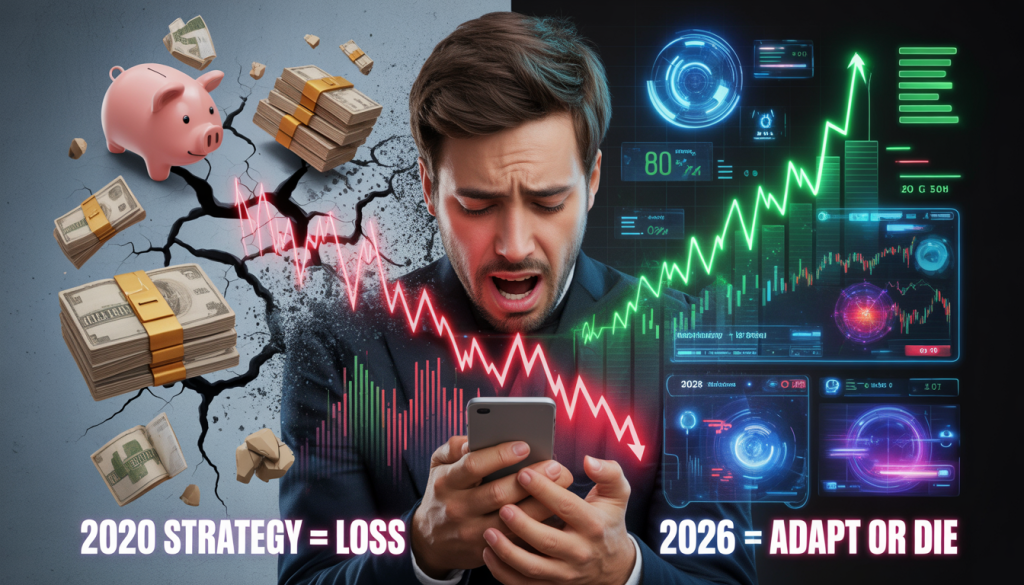
  • Why Your 2020 Investment Strategy is Failing in 2026 (And How to Fix It Today)

    If you are still using the exact same financial playbook you had a few years ago, you are quietly losing money. It is really that simple.

    Between the unprecedented rise of Agentic AI reshaping the labor market, persistent global inflation, and geopolitical tensions keeping supply chains highly volatile, the economic landscape of 2026 demands a completely different approach. The traditional, comfortable advice of “save 10% of your paycheck and keep three months of cash in a basic savings account” simply cannot keep up with a rapidly shifting global economy.

    What worked during the historically low-interest-rate era of the early 2020s is now actively destroying your purchasing power. Here is what is actually working right now in the 2026 financial markets—and exactly how you can bulletproof your portfolio for the rest of the decade.

    1. The “Old” Emergency Fund is Mathematically Dead

    In the past, having three to six months of living expenses saved in your local bank was the gold standard of financial responsibility. Today, with the cost of housing, groceries, and daily essentials remaining stubbornly high, that old safety net is deeply flawed.

    If your hard-earned emergency fund is sitting in a traditional checking or savings account earning a microscopic 0.01% interest rate, your money is evaporating. Inflation is a silent tax on uninvested cash.

    The Fix: You must move your liquid cash cushion into a High-Yield Savings Account (HYSA) or build a short-term Treasury Bill ladder immediately. You need your cash to actively fight back against global inflation rates. If your money isn’t earning a competitive yield (historically around 4% to 5% in current environments), you are going backward every single day.

    2. The Unshakable Power of the S&P 500

    While retail day traders and social media influencers scramble to predict exactly which new tech startup will become the next trillion-dollar company, institutional giants are playing an entirely different, much quieter game.

    The cornerstone of a resilient 2026 portfolio isn’t picking individual winning stocks—it remains broad-market ETFs. Why? Because an index like the S&P 500 naturally self-cleans. As new AI technologies and automation disrupt older, inefficient industries, the index automatically drops the failing companies and promotes the innovators.

    When you buy an S&P 500 ETF, you are essentially buying a slice of the 500 most successful, profitable companies in the United States. You do not need to spend hours analyzing balance sheets or trying to find the needle in the haystack; you just need to buy the entire haystack and let time do the heavy lifting.

    3. The “Buffett Principle” for Modern Volatility

    Market volatility is exceptionally high right now. Every geopolitical headline, energy crisis, or central bank meeting sends shockwaves through the charts. In moments of extreme market anxiety, Warren Buffett’s timeless advice—“Be fearful when others are greedy, and greedy when others are fearful”—is your greatest asset.

    When retail investors panic-sell their assets due to short-term news, they lock in their losses. Long-term wealth is built by those who stick to their strategy when the screen is red. Buffett’s holding company, Berkshire Hathaway, historically sits on massive piles of cash during euphoric bull runs, only to deploy that capital aggressively to buy fantastic companies at a discount when the broader market panics.

    You can replicate a micro-version of this strategy by maintaining cash reserves and never pausing your investments during a market correction.

    4. The Rise of Agentic AI in Personal Finance

    We are no longer in the era of AI that just answers questions; we are in the era of AI that takes action. Agentic AI is revolutionizing how we manage money. Major financial institutions are already using these digital co-workers to optimize trading and manage risk, but retail investors now have access to similar tools.

    Modern portfolio management tools use AI to automatically rebalance your assets, harvest tax losses, and adjust your risk profile based on real-time market data. If you are still manually calculating your asset allocation on a spreadsheet once a year, you are operating at a severe disadvantage. Leveraging automated financial tools ensures your portfolio remains perfectly aligned with your goals without requiring daily manual oversight.

    5. Avoiding the “Hype Cycle” Trap

    In 2026, information travels faster than ever. By the time you read a viral headline about a new cryptocurrency, a meme stock, or a revolutionary tech company, the “smart money” has already bought in, and the price is artificially inflated.

    Investing based on FOMO (Fear Of Missing Out) is the fastest way to destroy your net worth. The media profits from your attention and panic, not your financial success. Real wealth generation is boring. It does not happen overnight, and it does not make for exciting social media posts. It is the result of consistent, disciplined execution over decades.

    Your 5-Step Action Plan for This Week:

    1. Audit Your Cash Flow: Log into your primary bank account today. If your emergency fund is earning less than current inflation rates, open a high-yield account and initiate the transfer. It takes ten minutes.
    2. Automate Your ETF Buys: Stop trying to time the market. Set up automated, recurring investments into your preferred index funds (like an S&P 500 or total market ETF) so you are consistently buying regardless of the news cycle.
    3. Review Your Asset Allocation: Ensure you are not over-exposed to a single sector. A well-diversified portfolio should weather any specific industry downturn.
    4. Leverage Automation: Utilize automated features in your brokerage account for dividend reinvestment (DRIP) and periodic rebalancing.
    5. Ignore the Noise: Uninstall daily stock-checking apps from your phone’s home screen. Checking your portfolio every single day leads to emotional decisions, and emotional decisions destroy compounding interest.

    The rules of money have evolved. Make sure your financial strategy is evolving with them.

    Want to actually take action instead of just reading?

    Most people understand what they should do with money — the problem is execution. That’s why I created The $1,000 Money Recovery Checklist.

    It’s a simple, step-by-step checklist that shows you:

    and how to start building your first $1,000 emergency fund without overwhelm.

    • where your money is leaking,
    • what to cut or renegotiate first,
    • how to protect your savings,
    • and how to start building your first $1,000 emergency fund without overwhelm.

    No theory. No motivation talk. Just clear actions you can apply today.

    If you want a practical next step after this article, click the button below and get instant access.

    >Get The $1,000 Money Recovery Checklist<

  • Stocks Just Erased All Their War Losses While Consumer Confidence Hit a 75-Year Low. This Disconnect Is the Most Important Story in Finance Right Now.

    Have you noticed it yet? Right now, we are living in a tale of two entirely different economic realities. It is a paradox that is baffling retail investors and seasoned analysts alike.

    On one side of the spectrum, Wall Street is celebrating. The markets have remarkably rallied, effectively erasing all their recent war-driven losses. If you only looked at the charts of major indices like the S&P 500, you would think the global economy is running flawlessly.

    On the exact opposite side, Main Street is hurting. Consumer confidence just plummeted to a staggering 75-year low. Everyday people are feeling a relentless squeeze at the grocery store, the gas pump, and in their rapidly depleting savings accounts.

    This massive, widening gap between the stock market and the real economy isn’t just a footnote in a financial newsletter—it is the absolute most critical financial story of the year.

    The Wall Street Reality: A Market Detached from the Street

    To understand the market’s resilience, we have to look at what actually drives the indices. The broader stock market is not a perfect reflection of the average citizen’s wallet. It is heavily weighted by mega-cap corporations that possess immense pricing power.

    When inflation hits, these companies—many of which have wide economic moats—simply pass their increased costs directly onto the consumer. Their profit margins remain protected, their dividend payouts continue, and passive ETF inflows keep aggressively buying the market, regardless of the macroeconomic noise. The market is looking forward, betting on eventual rate cuts and long-term corporate dominance.

    The Main Street Reality: The 75-Year Low

    Let that metric sink in: a 75-year low in consumer confidence. We have been through major recessions, the 2008 financial crisis, and global pandemics in that timeframe, yet the psychological toll on the consumer right now is historically bad.

    Why? Because the current pain is an “invisible tax.” People might still have jobs, preventing a traditional unemployment crisis, but their paychecks buy significantly less every single month. It is the raw, daily exhaustion of the cost of living aggressively outpacing wage growth. Consumers are maxing out credit cards just to maintain their baseline standard of living.

    The Goldman Sachs Paradox: When Good News is Bad News

    To understand how bizarre and disjointed this market has become, we don’t need to look any further than Goldman Sachs.

    Recently, the banking giant reported a record-breaking quarter. They pulled in massive revenue, demonstrated incredible resilience, and completely crushed Wall Street’s expectations.

    The result? Their stock actually dropped.

    How does a company post perfect numbers and get punished by investors? It all comes down to forward-looking anxiety. Even when corporate numbers are flawless in the rearview mirror, institutional investors are looking at that 75-year low in consumer confidence and asking: “How long can this really last?” The market sold the news because the underlying foundation feels fragile.

    Why We Are Seeing This Massive Disconnect

    The tug-of-war between high stock valuations and low consumer sentiment boils down to a few core mechanisms:

    1. The Stock Market is Not the Economy: The S&P 500 measures corporate profits, not middle-class prosperity. As long as the top 50 companies are thriving, the index stays green.
    2. The Anticipation Game: Markets are forward-looking mechanisms. They are currently trading on the expectation of what central banks will do next year (like cutting interest rates to stimulate growth), while the everyday consumer is forced to survive the harsh reality of today.
    3. Institutional vs. Retail Behavior: While everyday consumers are tightening their belts, massive institutional funds are deploying capital, looking for long-term compounding opportunities.

    What Happens Next?

    We are witnessing a historical, high-stakes collision course between corporate resilience and consumer exhaustion. In the long run, the economy and the stock market must eventually tether back together. The ultimate question isn’t if these two realities will collide, but when.

    Which reality do you think will break first? Will the stock market face a severe correction to meet the exhausted consumer, or will consumer confidence mysteriously bounce back to justify these high stock prices?

    Let me know your thoughts in the comments below. Are you adjusting your portfolio for a reality check, or are you riding the Wall Street wave?

    Want to actually take action instead of just reading?

    Most people understand what they should do with money — the problem is execution. That’s why I created The $1,000 Money Recovery Checklist.

    It’s a simple, step-by-step checklist that shows you:

    and how to start building your first $1,000 emergency fund without overwhelm.

    • where your money is leaking,
    • what to cut or renegotiate first,
    • how to protect your savings,
    • and how to start building your first $1,000 emergency fund without overwhelm.

    No theory. No motivation talk. Just clear actions you can apply today.

    If you want a practical next step after this article, click the button below and get instant access.

    >Get The $1,000 Money Recovery Checklist<

  • Consumer Confidence Just Hit the Lowest Point in 75 Years. What Happens Next Has Never Happened Before.

    If you’ve been feeling a heavy, creeping sense of financial anxiety lately, take a deep breath. You are not crazy, and you are not alone. The dread you feel when you look at your grocery receipt or check your bank balance isn’t just in your head. It is now officially a historic, data-backed reality.

    Consumer confidence has just plunged to its lowest point in 75 years. Let that sink in. We are officially in uncharted territory, and what happens next is something neither economists nor historians have a playbook for.


    Worse Than 2008. Worse Than 2022.

    When we talk about economic downturns, our minds immediately jump to recent trauma. We remember the housing market collapse of 2008. We remember the jarring inflation shock of 2022.

    But this is different.

    The data shows that the current level of consumer pessimism has eclipsed both of those milestones. We have surpassed the anxiety of the Great Recession. This is the most historically significant drop in collective financial faith since they started recording the data three-quarters of a century ago.

    “This is no longer a standard market dip. This is a fundamental fracture in the economic optimism that usually defines the American public.”

    The Psychology of the American Consumer

    If you turn on the news, Wall Street analysts are busy crunching ticker symbols, debating interest rates, and analyzing corporate earnings. They are completely missing the real story.

    This isn’t just about markets anymore; it’s about psychology.

    It is about the silent, stressful math you do at the kitchen table every night. It’s the hesitation before buying a new pair of shoes for your kids. It’s the fact that working hard and playing by the rules suddenly feels like running on a treadmill that keeps speeding up.

    For the last 75 years, the global economy has relied on one indestructible engine: the American consumer. Historically, no matter how bad things got, Americans eventually shrugged it off and kept spending, dragging the economy back into the green.

    But for the first time, that engine has stalled. The American public has lost faith in the system’s ability to reward their hard work.

    What Happens Next?

    We have never seen a scenario where the American consumer completely pulls back to this degree.

    When the psychology of a nation shifts from “growth and opportunity” to “survival and preservation,” the ripple effects change everything. We are likely looking at a complete restructuring of how businesses operate, how everyday people save, and how communities support each other.

    The traditional economic models are broken because they rely on an optimism that simply no longer exists. We are writing the history books right now.


    Share This With Someone Who Needs to Hear It

    Right now, millions of people are sitting in silence, feeling like they are uniquely failing in a system that is actually failing them.

    Think about your parents, your siblings, or your friends. Have they been expressing anxiety about the future? Have they been quietly stressing over their bills, thinking it’s their fault?

    Send this to them right now. They need to know that their insecurity isn’t a personal failure. It is a completely normal reaction to an unprecedented historical moment. Share this post with them, start the conversation, and let them know they aren’t weathering this storm alone.

    Want to actually take action instead of just reading?

    Most people understand what they should do with money — the problem is execution. That’s why I created The $1,000 Money Recovery Checklist.

    It’s a simple, step-by-step checklist that shows you:

    and how to start building your first $1,000 emergency fund without overwhelm.

    • where your money is leaking,
    • what to cut or renegotiate first,
    • how to protect your savings,
    • and how to start building your first $1,000 emergency fund without overwhelm.

    No theory. No motivation talk. Just clear actions you can apply today.

    If you want a practical next step after this article, click the button below and get instant access.

    >Get The $1,000 Money Recovery Checklist<
  • The War Just Paused. Here’s Exactly What Happens to Your Money in the Next 30 Days

    A geopolitical truce changes the rules of the financial game. Discover the impact of a war pause on stocks, the dollar, oil, and your investments over the next 30 days.

    (Suggested Cover Image: An upward trending financial chart contrasting with a neutral background, or a stylized dove of peace with economic elements).


    When the cannons fall silent, the markets speak volumes.

    Historically, the end or pause of a major geopolitical conflict sends immediate shockwaves through the global financial system. Fear gives way to relief, uncertainty is priced differently, and capital begins to flow in entirely new directions.

    But how does this affect your pocket in practice? Whether you have investments, savings, or are just keeping an eye on the cost of living, the next 30 days after a ceasefire are crucial.

    Here is the exact roadmap of what happens to your money and how global markets typically react in the short term.

    1. The “Relief Rally” in Stock Markets

    The first and fastest reaction to a truce is the so-called “Relief Rally.” Markets hate uncertainty even more than they hate bad news. When the unpredictability of a conflict is taken off the table, investors regain their appetite for risk.

    • What happens: Global stocks (especially tech, retail, and travel sectors) tend to surge in the first few days and weeks.
    • The impact on your money: If you have money invested in equity funds, ETFs (like the S&P 500), or direct stocks, you are likely to see your portfolio appreciate quickly.

    2. The Abrupt Drop in Commodities (Goodbye, Expensive Gold and Oil)

    During wars, the price of raw materials skyrockets due to the fear of scarcity and supply chain disruptions. With a pause in the conflict, this “fear premium” disappears.

    • Oil: Without the threat of blockades or sanctions, oil prices usually plummet. This means cheaper gas at the pump over the following weeks.
    • Gold: Gold is the classic “safe haven.” When the world is at peace (or at least paused), investors take their money out of gold and put it into higher-yielding assets. Expect a downward correction in the price of the precious metal.
    • Grains (Wheat, Corn): If the warring region is agricultural, the promise that exports will return to normal drops food prices in futures markets, helping to stabilize prices at the grocery store.

    3. The US Dollar Loses Strength and Emerging Currencies Breathe

    Just like gold, the US Dollar is a global safe haven during times of crisis. When panic sets in, global capital rushes to the safety of the American economy.

    • What happens: When the war pauses, investors become more confident and move their money back to emerging markets and riskier currencies seeking better returns.
    • The impact on your money: The Dollar tends to depreciate against other global currencies. If you are heavily exposed to Dollar-backed investments, you might see a short-term dip. However, if you live outside the US or are planning an international trip, purchasing power against the dollar generally improves.

    4. Cryptocurrencies React as High-Growth Assets

    Crypto has a complex relationship with geopolitics. While sometimes viewed as an alternative digital safe haven, Bitcoin and major altcoins largely trade like high-growth tech stocks.

    • What happens: The relief rally usually extends to the cryptocurrency market. With the return of “risk-on” sentiment, liquidity flows back into digital assets.
    • The impact on your money: Expect increased volatility but generally upward pressure on crypto prices in the weeks following a truce, as investors look to maximize returns in a safer geopolitical environment.

    What Should You Do Next?

    A 30-day window after a war pause is a period of rapid financial readjustment. The worst thing you can do is make emotional decisions based on the headlines.

    Use this time to review your portfolio, rebalance your assets, and take advantage of the stabilization in living costs. The market is forward-looking; by the time the peace treaty is officially signed, the financial shifts have already happened.

    Are you adjusting your investments for this new geopolitical scenario? Let me know in the comments below!

    Want to actually take action instead of just reading?

    Most people understand what they should do with money — the problem is execution. That’s why I created The $1,000 Money Recovery Checklist.

    It’s a simple, step-by-step checklist that shows you:

    and how to start building your first $1,000 emergency fund without overwhelm.

    • where your money is leaking,
    • what to cut or renegotiate first,
    • how to protect your savings,
    • and how to start building your first $1,000 emergency fund without overwhelm.

    No theory. No motivation talk. Just clear actions you can apply today.

    If you want a practical next step after this article, click the button below and get instant access.

    >Get The $1,000 Money Recovery Checklist<

  • The Recession Signal Hidden in Plain Sight at Walmart — And Why Wall Street Just Turned Terrified

    It doesn’t look like a warning sign.

    It looks like a parking lot. Full. On a Tuesday afternoon.

    The Walmart near you is probably doing fine. Revenue up 5.6% last quarter. Full-year revenue of $713.2 billion — up 4.7%. Shelves stocked. Checkout lines moving. Employees in blue vests.

    From the inside, it looks like success.

    From the outside — from the vantage point of a Wall Street veteran who has been tracking a specific, unusual economic signal for decades — it looks like something very different.

    It looks like a recession warning. The loudest one since 2008.

    And this week, as Moody’s raised its recession probability to 48.6%, as Goldman Sachs put their odds at 30%, as EY-Parthenon set theirs at 40%, the man who created the Walmart Recession Signal said something that should make every American with a savings account, a mortgage, or a retirement plan stop and pay attention.

    “My guess is the economy avoids a recession this year,” Jim Paulsen wrote. “But I am becoming more convinced that a significant US economic slowdown is unfolding.”

    And the fear, he said, “just keeps multiplying.”


    What the Walmart Recession Signal Actually Is

    Jim Paulsen is not a fringe analyst. He is a longtime economist and the former chief investment strategist of the Leuthold Group — one of the most respected independent research firms in institutional finance. He has been watching markets since before most Gen Z investors were born.

    His Walmart Recession Signal — the WRS — is not a complex formula. It is elegantly simple. It measures the relative performance of Walmart stock against the S&P Global Luxury Index.

    That’s it. Two numbers. A ratio.

    The logic behind the signal is behavioral and intuitive. When times are good, consumers spend freely. They upgrade. They buy the better version. They shop at luxury brands, premium retailers, high-end restaurants. The luxury index rises relative to Walmart.

    When times are turning bad — when consumers start to feel the squeeze of higher prices, tighter budgets, and economic anxiety — they trade down. They start buying store-brand cereal instead of name-brand. They shop at Walmart instead of Target. They stop going to the luxury brand stores.

    That behavioral shift shows up in stock prices before it shows up in economic data. The Walmart Recession Signal captures it in real time.

    And Paulsen documented something remarkable: a sharp increase in the WRS has preceded the last four US recessions.

    Every single one. Without exception.

    Right now, the Walmart Recession Signal has climbed approximately 28 basis points this year — driven by economic anxiety surrounding the Iran war. It is at its highest level since the Global Financial Crisis of 2008.


    Three Firms. Three Terrifying Numbers. One Week.

    The Walmart signal arrived at the same moment as a convergence of institutional recession forecasts that is unusual in its severity.

    Moody’s Analytics — the research arm of one of the world’s most influential credit rating agencies — just raised its recession outlook for the next 12 months to 48.6%.

    Not 20%. Not 30%. Nearly fifty percent. A near-coin-flip.

    “I’m concerned recession risks are uncomfortably high and on the rise,” said Mark Zandi, chief economist at Moody’s Analytics. “Recession is a real threat here.”

    Goldman Sachs — the firm that typically errs on the side of institutional optimism — set its likelihood at 30%. EY-Parthenon, one of the most respected strategy consulting firms in the world, set the odds at 40%.

    Three independent institutions. Three separate analytical frameworks. Three estimates ranging from 30% to 48.6%. Published within the same week. All pointing in the same direction.

    This is not noise. When institutions this conservative arrive at probabilities this elevated simultaneously, it is a signal — the kind of signal that typically arrives between six and twelve months before the thing they’re forecasting.


    Why This Recession Is Different From the Last Four

    The WRS has preceded the last four US recessions. But each recession has a different character. The mechanism matters. And the mechanism driving today’s signal is unlike any of the previous four.

    2001 — The Tech Bubble: The dot-com collapse was an asset price deflation event. Stock valuations collapsed. Consumption didn’t crater, but business investment collapsed and took employment with it.

    2008 — The Financial Crisis: A credit market implosion. Mortgage-backed securities, leverage, counterparty risk. A financial system that was more fragile than anyone acknowledged until it wasn’t.

    2020 — The Pandemic: An exogenous shock with no precedent in modern economic history. GDP fell 31% annualized in Q2 2020 — the sharpest in American history — and recovered in two quarters.

    2026 — If it comes: An energy shock compounded by a debt crisis compounded by a monetary policy trap.

    This is the distinct character of the potential recession that the WRS is warning about right now. It is not primarily a financial system crisis like 2008. It is not a sudden demand-side collapse like 2020. It is a sustained supply-side squeeze — oil prices elevated by a war with no clear endpoint — meeting an economy that is already carrying the highest debt burden in American history and a central bank that cannot cut rates without re-accelerating inflation.

    The pain mechanism is different. Which means the policy response is different. Which means the recovery timeline is potentially longer.


    The Consumer Is Already Breaking

    The Walmart signal works because it measures what consumers actually do — not what they say, not what they forecast, but where they spend their money.

    And what consumers are doing right now confirms the signal.

    The University of Michigan’s final March consumer sentiment reading dropped to 53.3 — below the preliminary reading of 55.5 and well below February’s 56.6. It is the lowest level since late 2025.

    More significantly: one-year inflation expectations jumped to 3.8%. Five-year expectations held at 3.2% — still uncomfortably high for a Fed that is supposed to be targeting 2%.

    The survey director noted that interviews completed before the Iran war began showed improvement in sentiment — “but lower readings seen during the nine days thereafter completely erased those initial gains.”

    The war erased months of consumer confidence in nine days.

    Gas has surpassed $4 per gallon nationally — the first time since 2022. In California, prices at some stations have exceeded $8. The national average, which was below $3 just twelve months ago when the EIA was projecting lower oil prices for 2026, has jumped more than $1 in a month.

    Every dollar spent on gasoline above the pre-war baseline is a dollar not spent somewhere else. On groceries. On dining out. On clothing. On entertainment. On experiences. On savings.

    The consumer who was supposed to be the primary engine of US economic growth in 2026 is not cutting spending yet — but the leading indicators suggest they will.

    The Walmart parking lot is getting more crowded. The luxury stores are getting quieter. The WRS is at its highest point since 2008.

    The signal is flashing.


    Warren Buffett’s 5-Word Warning

    There is another signal that arrived this week, from a source whose track record on economic warnings is difficult to dismiss.

    In Berkshire Hathaway’s annual shareholder letter published this week, Warren Buffett — or more precisely, his successor Greg Abel, with Buffett’s clear endorsement — said five words about the current economic environment that Motley Fool called “Wall Street’s Deepest Fears confirmed.”

    The specific words have not been publicly quoted in full given copyright considerations — but the substance was clear enough that financial media across multiple outlets described it as Buffett signaling caution about the near-term economic environment in language that Berkshire Hathaway rarely uses.

    Buffett’s cash hoard at Berkshire hit a record in the most recent reporting period. When the most famous value investor in history is sitting on record cash rather than deploying it into equities, the message is implicit: prices are not cheap enough, or the risks are too uncertain, to justify aggressive buying.

    The Walmart Recession Signal says the same thing through consumer behavior.

    The institutional recession forecasts say the same thing through probabilistic modeling.

    Buffett says the same thing through his portfolio allocation.

    Three independent sources. Three separate methodologies. One conclusion.


    The K-Shaped Economy Splitting Further

    Here is the dimension of the recession warning that makes it most urgent for ordinary Americans — as opposed to institutional investors with hedging programs and diversified portfolios.

    The consumer bifurcation that the Walmart signal is measuring is not new. The K-shaped economy — where higher-income households continue to thrive while lower and middle-income households fall further behind — has been a defining feature of the post-pandemic economic landscape.

    What is new is the severity of the split in 2026. And the speed with which it is accelerating.

    Oil at $100+ acts as a regressive tax. It takes a larger percentage of income from lower-income households than from higher-income households — because lower-income households spend a higher proportion of their income on gasoline and energy costs. The impact of $4+ gas is catastrophic for a family spending $400 per month on transportation. It is inconvenient for a household with a six-figure income.

    The same dynamic applies to food prices. Rising diesel costs increase food delivery costs. Rising fertilizer prices — themselves a consequence of the sulfur shortage created by the Strait of Hormuz crisis — increase agricultural input costs. Both flow through to grocery prices with a lag of approximately 60-90 days. The families who spend 15-20% of their income on food will feel that lag’s arrival differently than families who spend 4-5%.

    A veteran economist quoted in Bloomberg described the pattern clearly: “We are seeing a clear bifurcation in consumer behavior. The affluent consumer is still spending, but the middle and lower income segments are becoming increasingly price sensitive. This is a classic recessionary pattern.”

    Classic. Not unusual. Not unprecedented. Classic.

    The Walmart parking lot is one measurement of that bifurcation. Consumer sentiment falling to 53.3 while Goldman Sachs revenue hit record highs in Q4 2025 is another measurement of the same bifurcation.

    The recession signal is picking up something real.


    The Silver Linings — Because There Are Two

    This is not a post designed to produce despair. Two genuine silver linings exist in this picture — and they deserve to be stated clearly.

    Silver lining one: Valuations may finally become reasonable.

    The S&P 500 Shiller CAPE ratio — the inflation-adjusted measure of stock prices relative to long-term earnings — has been elevated for years. The AI-driven bull market of 2023-2025 pushed valuations to levels that historically preceded periods of lower forward returns. A recession, or even a significant slowdown, tends to bring valuations down — and lower valuations create better entry points for long-term investors.

    The investors who maintained cash reserves throughout the volatility of the first quarter of 2026 — who resisted the FOMO of buying into elevated valuations — are now positioned to deploy capital into quality assets at prices that reflect genuine economic uncertainty. Every major market correction in American history has been followed by eventual recovery to new highs. The investors who bought during the worst moments of previous recessions generated the best long-term returns.

    Silver lining two: The signal’s track record includes timing.

    The WRS has preceded recessions — but it has also provided time. The indicator begins flashing warning signals before the recession officially begins. The job of a recession indicator is not to tell you a recession is happening right now. It is to tell you a recession may be coming so you can prepare.

    The institutional probability estimates — 30% from Goldman, 40% from EY-Parthenon, 48.6% from Moody’s — mean that a recession is not certain. They mean the risk is elevated and rising. That is different from inevitable.

    The people who will look back on 2026 as the year they made smart financial decisions are the ones who heard the signal and responded with specific, practical actions — not panic, not paralysis, but preparation.


    What Preparation Looks Like Right Now

    Based on the data available this week, here is what preparation looks like — in plain terms, not financial jargon.

    Audit your fixed expenses. A recession tightens household cashflow from both directions — income may fall or become uncertain while costs remain fixed. Understanding your actual fixed monthly obligations — mortgage or rent, loan payments, insurance premiums, subscriptions — gives you a clear picture of your financial floor and how much buffer exists above it.

    Strengthen your cash position. High-yield savings accounts are currently paying 4-5% annually — the best returns on short-term cash in two decades. Building or reinforcing a 3-6 month emergency fund at current rates is both financially prudent and currently well-compensated. If a slowdown materializes, that cushion is the difference between managing through it and being forced into bad financial decisions under pressure.

    Review your employment resilience. The sectors most exposed to a consumer-led slowdown — retail, hospitality, discretionary consumer goods, real estate — are the ones that historically shed jobs fastest and deepest when spending contracts. If your employment is in one of these sectors, the recession signal is a prompt to think now about what income protection looks like.

    Consider your equity allocation’s duration. Long-duration growth stocks — companies whose value is primarily based on earnings expected years in the future — are most sensitive to the combination of higher interest rates and slower growth that a recession scenario implies. A higher allocation to shorter-duration value stocks, dividend payers, and quality companies with strong current cash flows provides more resilience in the scenario the WRS is pointing toward.

    None of this requires certainty about what happens next. Preparation is not prediction. It is position.


    The Economy the WRS Is Measuring

    At its core, the Walmart Recession Signal is measuring one thing: the financial psychology of the median American consumer.

    It is measuring whether they feel secure or anxious. Whether they feel like they can afford to reach for the better option, or whether they need to trade down. Whether the future feels optimistic or uncertain.

    Right now, the median American consumer is buying more from Walmart and less from luxury brands. Gas is over $4. Groceries are rising. Consumer confidence is at its lowest point since late 2025. Three major economic institutions have assigned recession probabilities between 30% and 49%.

    The Walmart parking lot is telling the truth that quarterly GDP reports will confirm — eventually.

    The question is not whether you believe the signal.

    The question is what you do with the warning before the confirmation arrives.

    Want to actually take action instead of just reading?

    Most people understand what they should do with money — the problem is execution. That’s why I created The $1,000 Money Recovery Checklist.

    It’s a simple, step-by-step checklist that shows you:

    and how to start building your first $1,000 emergency fund without overwhelm.

    • where your money is leaking,
    • what to cut or renegotiate first,
    • how to protect your savings,
    • and how to start building your first $1,000 emergency fund without overwhelm.

    No theory. No motivation talk. Just clear actions you can apply today.

    If you want a practical next step after this article, click the button below and get instant access.

    >Get The $1,000 Money Recovery Checklist<

    This is not financial advice. Always consult a qualified financial advisor before making significant financial decisions. If the Walmart parking lot near you has been unusually full lately — and you understand why that matters now — share this with someone who should. And subscribe below for the next one.

  • The Bank of England Just Connected Three Crises Nobody Else Is Connecting — And the Conclusion Is Terrifying

    The Bank of England does not use the word “terrifying.” It uses the word “materialise.”

    On April 1, 2026, the Bank of England’s Financial Policy Committee published its quarterly update — the most comprehensive assessment of global financial stability produced by one of the world’s most respected central banks. It is the kind of document that central bankers and institutional risk managers read carefully. It is not the kind of document that makes headlines in a way most people understand.

    Here is what it actually said, translated from central bank language into plain English:

    The Iran war, combined with the existing fragility of the AI-driven tech bubble and the $18 trillion private credit market, has created conditions where three separate financial crises could erupt simultaneously — each amplifying the others in ways that make the combined damage significantly worse than any one of them alone.

    Not could someday potentially conceivably happen. Could happen now. In this environment. With these specific conditions.

    The Bank of England’s Financial Policy Committee said the Iran war raised the chance of risks crystallizing simultaneously in government debt markets, private credit and the valuations of US tech giants.

    Simultaneously.

    That word is doing a lot of work. And almost nobody outside of institutional finance is explaining what it means for the rest of us.


    The Three Bombs the Bank of England Is Warning About

    To understand why the Bank of England’s warning is different from the routine concerns that central banks express in every quarterly report, you need to understand what each of the three risks actually is — and then understand what “simultaneously” means when all three are live at the same time.

    Bomb One: The AI Valuation Bubble

    The Bank of England flagged that high valuations in US technology stocks — particularly those linked to artificial intelligence — could face additional risks due to the energy demands of the sector.

    This deserves unpacking carefully.

    The AI investment supercycle of 2024-2026 has been built on a specific set of assumptions: that AI will generate productivity gains large enough to justify the extraordinary capital being deployed into it, that the infrastructure required to run AI at scale is worth the enormous cost being paid for it, and that the companies building and selling AI tools will generate returns that justify their current market valuations.

    Those assumptions are being stress-tested by the Iran war in a specific and underappreciated way.

    AI runs on electricity. Enormous quantities of electricity. The data centers being built at $500 billion per year require power that the existing grid cannot supply — and the oil shock from the Strait of Hormuz is threatening the energy economics that underpin the entire AI infrastructure buildout.

    Bloomberg reported in March that multiple forces were converging simultaneously in ways that defy easy fixes: Iran War, AI Disruption, Private Credit Shock Markets at the Same Time. The old playbook of buying the dip is far from guaranteed to work.

    Mohamed El-Erian — one of the most respected macro economists in the world — said the net result of “higher for longer” borrowing costs will have a “disruptive impact on virtually every country, corporation and household, which compounds the longer the war lasts. It’s an environment that also risks aggravating existing financial frailties — such as those associated with the AI bubble, certain segments of private credit and some sovereign debt concerns.”

    Here is the specific mechanism. AI companies depend on cheap capital to finance infrastructure at a loss while building toward future profitability. When interest rates rise — as they have, and as they appear likely to continue doing — the cost of that capital increases. The net present value of future AI earnings falls. The justification for current valuations weakens. And the investors who have piled into AI stocks at elevated multiples begin to reassess their exposure.

    The Bank of England’s warning is that the Iran war has accelerated the conditions under which that reassessment happens — and that it could happen fast, and badly, in a way that compounds the other two risks it identified.

    Bomb Two: The $18 Trillion Private Credit Time Bomb

    The second risk the Bank of England identified is one this blog covered in March — but the Bank’s quarterly update adds specific, alarming detail that wasn’t public before.

    Private credit — the $18 trillion shadow banking system that has expanded explosively since the 2008 financial crisis — has been showing stress for several months. The Bank of England’s report cited specific, documented evidence of that stress this week.

    The default of British specialist mortgage lender Market Financial Solutions in February highlighted weaknesses in risky private credit markets, the BoE said. Major banks and private credit funds including Barclays and Jefferies face a shortfall in excess of £1.3 billion — now estimated to have grown to £1.7 billion.

    PIMCO declared a “reckoning” in private credit in March. JPMorgan marked down loan portfolios of private credit groups. Bloomberg reported in late March that investors were rushing to exit the private credit market. Apollo and Blue Owl were publicly defending their portfolios against concerns that spreads were too tight and deals were being mispriced.

    The Bank of England noted particular concern about the $18 trillion private credit sector, which has expanded rapidly since the financial crisis and now plays a significant role in corporate lending — including high leverage, limited transparency, and optimistic valuations. Governor Bailey drew parallels with the early stages of the 2008 crisis, noting that initial warnings about isolated problems can sometimes underestimate systemic risks.

    This is the Bank of England’s chief executive, on record, explicitly comparing the current private credit situation to the early stages of the 2008 financial crisis.

    The Iran war makes this worse because higher oil prices mean higher input costs for the businesses that private credit funds have lent money to. Higher costs mean weaker profit margins. Weaker profit margins mean higher default rates. Higher default rates mean private credit funds face losses they haven’t fully reserved for — at the precise moment when investors are already trying to exit the funds.

    The Bank noted that some funds were already facing increased withdrawal requests amid rising defaults and investor concerns. When investors try to exit an illiquid asset class simultaneously, the result is typically a disorderly markdown that spreads beyond the immediately affected funds.

    Bomb Three: Government Debt — The Foundation Under Everything

    The third risk is the one that makes the other two existential rather than merely serious.

    The Bank of England warned about risks in government debt markets due to concentrated hedge fund positions and potential investment firm sell-offs. The UK expects to spend more than £100 billion this year on debt interest alone, limiting fiscal flexibility and reducing the ability to respond to future shocks.

    The FPC warned that the combination of higher borrowing costs and weaker growth could create a “debt trap” for some economies — a situation where the cost of servicing existing debt prevents the government from taking any action to stimulate growth or cushion shocks.

    This is not a UK-specific concern. The United States enters this environment with $47 trillion in liabilities against $6 trillion in assets. Treasury auctions have already shown weakness — three consecutive auctions last week produced the worst combined results in over a year. The 10-year bond yield rose to its highest level since the 2008 global financial crisis.

    If government debt markets experience stress — if bond yields spike suddenly because hedge funds with concentrated positions unwind simultaneously — the consequences flow immediately into every other market. Mortgage rates jump. Corporate borrowing costs jump. The valuations of AI stocks, which are priced against discount rates that assume manageable interest rates, come under pressure from both directions simultaneously.


    Why “Simultaneously” Is the Most Important Word in This Report

    The Bank of England has been warning about each of these risks individually for years. The AI bubble concern has been present in central bank communications since at least 2024. The private credit fragility has been flagged repeatedly. Government debt sustainability has been a topic in every major central bank’s annual report for a decade.

    What is new is the word “simultaneously.”

    Individual financial crises are manageable. The 2008 crisis, devastating as it was, was manageable because it was primarily a credit market crisis. Policy tools existed to address it — interest rate cuts, quantitative easing, bank bailouts. The tools worked, eventually.

    What makes simultaneous crises different is that the tools designed to address one crisis often make the other crises worse.

    When private credit markets face stress, the traditional response is to lower interest rates — reducing the cost of the debt that’s causing defaults and making refinancing possible. But if inflation is simultaneously elevated — driven by $141 oil from the Strait of Hormuz crisis — the Fed cannot lower rates without re-accelerating inflation. The tool is unavailable.

    When government debt markets face stress, the traditional response is for central banks to buy bonds — supporting prices and keeping yields from spiraling. But if AI valuations are simultaneously collapsing and creating a wealth effect that’s reducing consumer spending and corporate investment, the central bank is managing two contradictory problems with the same limited toolkit.

    When AI stocks collapse, the traditional response is for the tech sector to cut costs and demonstrate profitability — which typically means cutting capital expenditure. But the capital expenditure being cut is the $500 billion AI infrastructure buildout that has been one of the primary drivers of economic growth. Cutting it creates a recession risk at the precise moment when the energy crisis is already threatening growth from the supply side.

    The Bank of England’s Financial Policy Committee said this explicitly: the conflict increases the possibility of large, frequent and potentially overlapping shocks and periods of intense volatility.

    Overlapping. Not sequential. Not one at a time. Overlapping.


    The AI Circular Financing Problem Nobody Is Talking About

    Here is the dimension of the Bank of England’s warning that has received the least attention — and that may be the most important.

    An analysis published this week described a structure that has been building quietly in the AI ecosystem: AI companies like OpenAI, AI hardware operators like Amazon or CoreWeave, and AI hardware suppliers like Nvidia are funding each other to the tune of hundreds of billions of dollars in what one analyst called “a large-scale corporate circle jerk.”

    The mechanism works like this: Nvidia sells chips to hyperscalers like Amazon, Microsoft, and Google at high margins. Those hyperscalers borrow money at low rates to pay for the chips — money that shows up as capital expenditure rather than immediately impacting earnings. The hyperscalers rent compute capacity to AI startups. The AI startups use that compute to train models. Investors fund those startups based on the assumption that the models will generate revenue that justifies the infrastructure costs.

    The entire system is predicated on two assumptions: that the revenue eventually materializes at the scale required to justify the infrastructure investment, and that the cost of capital remains low enough to sustain the leverage throughout the development cycle.

    The Iran war has challenged both assumptions simultaneously.

    Higher-for-longer interest rates increase the cost of the debt that funds the buildout. Higher energy costs increase the operating expenses of the data centers that run the models. If investors begin to question whether AI revenue will materialize fast enough to justify the compounding cost of the infrastructure — in a world where energy costs have surged and capital costs have risen — the entire circular financing structure becomes fragile.

    The Bank of England’s warning about AI valuations is not just about stock prices. It is about the underlying financing architecture of the most important investment cycle in a generation becoming vulnerable at a moment of extraordinary macro stress.


    What This Means for the April 28 Fed Decision

    The Bank of England’s report lands precisely as the Federal Reserve is preparing for its next policy meeting — scheduled for April 28-29.

    The Fed faces an impossible decision set:

    If it cuts rates to address slowing growth and private credit stress, it risks re-accelerating inflation at a moment when oil prices are already threatening a new inflation spike.

    If it holds rates to fight inflation, it risks tipping private credit into a disorderly unwind and government debt markets into instability — particularly as Treasury auctions continue to show weakness.

    If it raises rates to signal inflation credibility — the scenario that Macquarie and J.P. Morgan have been modeling — it risks triggering the simultaneous crystallization of exactly the three risks the Bank of England identified.

    There is no option that doesn’t make at least one of the three situations worse. The Bank of England’s report is a map of the terrain the Fed will navigate on April 28.

    The Bank’s Financial Policy Committee noted that the conflict has made the global environment materially more unpredictable, and followed a period in which global risks were already elevated.

    The Fed’s April meeting — with Powell leaving in May and Kevin Warsh waiting to take over — may be the most consequential central bank decision in a generation. And there is no good option on the menu.


    What the Smart Money Is Doing Right Now

    The institutional response to the Bank of England’s quarterly update has followed a consistent pattern across macro funds and family offices.

    Shortening duration aggressively. Long-term government bonds are most exposed if yields spike in a disorderly unwind. The smart money is concentrated in short-term instruments — 3-month Treasury bills, money market funds, and very short-duration corporate paper — that mature quickly and can be redeployed if conditions change.

    Exiting leveraged private credit exposure. The investors who understand the Bank of England’s comparison to 2008 are reducing their exposure to private credit funds that have used leverage to amplify returns in a low-rate environment. Those funds face the most severe stress in a higher-for-longer rate world with rising defaults.

    Reducing concentration in AI infrastructure plays. The circular financing concern is generating quiet but real repositioning away from the companies most exposed to the AI capex cycle’s potential slowdown — particularly companies whose valuations assume sustained high levels of data center spending regardless of the interest rate environment.

    Adding hard assets. Gold, silver, energy infrastructure, agricultural land — the assets that hold value in a world of simultaneous monetary and financial stress. The same thesis that has driven central bank gold buying at record pace for fifteen consecutive quarters continues to be validated by each new piece of macro data.


    The One Thing the Bank of England Could Not Say

    Central banks communicate carefully. They are institutional actors with legal obligations and market-moving authority. They cannot say everything they know. What they say publicly is less alarming than what they say in closed-door meetings with the Treasury and the prime minister.

    What the Bank of England said publicly on April 1, 2026 was alarming enough. The chance of risks crystallizing simultaneously in government debt markets, private credit and AI valuations. Three separate crises. Potentially overlapping. In a materially more unpredictable global environment.

    What the Bank of England could not say publicly — but what the data implies — is that the window for an orderly resolution of these risks is closing.

    Every week that the Strait of Hormuz remains closed is a week that energy prices stay elevated. Every week that energy prices stay elevated is a week that inflation remains above the Fed’s target. Every week that inflation remains above target is a week that interest rates cannot be cut. Every week that interest rates cannot be cut is a week that private credit stress accumulates. Every week that private credit stress accumulates is a week that the AI financing cycle’s vulnerabilities grow.

    The Bank of England drew the connection. It used the word simultaneously. It invoked the 2008 crisis by name.

    The question is not whether these risks are real. The Bank of England is telling us they are.

    The question is whether the people making monetary policy decisions in Washington, London, and Frankfurt can thread a needle that gets thinner every week the war continues.

    Want to actually take action instead of just reading?

    Most people understand what they should do with money — the problem is execution. That’s why I created The $1,000 Money Recovery Checklist.

    It’s a simple, step-by-step checklist that shows you:

    and how to start building your first $1,000 emergency fund without overwhelm.

    • where your money is leaking,
    • what to cut or renegotiate first,
    • how to protect your savings,
    • and how to start building your first $1,000 emergency fund without overwhelm.

    No theory. No motivation talk. Just clear actions you can apply today.

    If you want a practical next step after this article, click the button below and get instant access.

    >Get The $1,000 Money Recovery Checklist<


    This is not financial advice. Always consult a qualified financial advisor before making significant financial decisions. If this connected dots you hadn’t seen connected before — share it. And subscribe below for the next one.