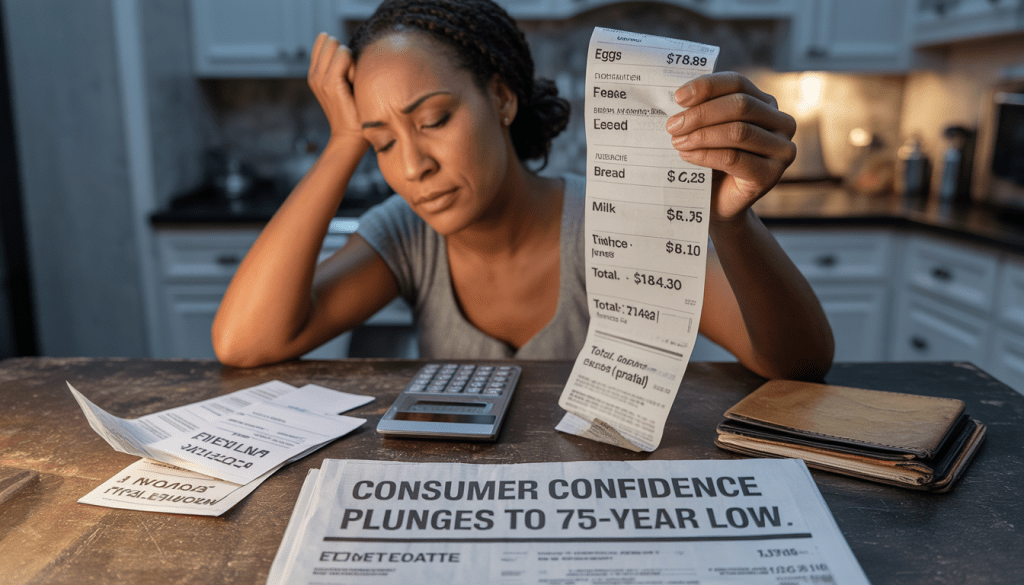
If you’ve been feeling a heavy, creeping sense of financial anxiety lately, take a deep breath. You are not crazy, and you are not alone. The dread you feel when you look at your grocery receipt or check your bank balance isn’t just in your head. It is now officially a historic, data-backed reality.
Consumer confidence has just plunged to its lowest point in 75 years. Let that sink in. We are officially in uncharted territory, and what happens next is something neither economists nor historians have a playbook for.
Worse Than 2008. Worse Than 2022.
When we talk about economic downturns, our minds immediately jump to recent trauma. We remember the housing market collapse of 2008. We remember the jarring inflation shock of 2022.
But this is different.
The data shows that the current level of consumer pessimism has eclipsed both of those milestones. We have surpassed the anxiety of the Great Recession. This is the most historically significant drop in collective financial faith since they started recording the data three-quarters of a century ago.
“This is no longer a standard market dip. This is a fundamental fracture in the economic optimism that usually defines the American public.”
The Psychology of the American Consumer
If you turn on the news, Wall Street analysts are busy crunching ticker symbols, debating interest rates, and analyzing corporate earnings. They are completely missing the real story.
This isn’t just about markets anymore; it’s about psychology.
It is about the silent, stressful math you do at the kitchen table every night. It’s the hesitation before buying a new pair of shoes for your kids. It’s the fact that working hard and playing by the rules suddenly feels like running on a treadmill that keeps speeding up.
For the last 75 years, the global economy has relied on one indestructible engine: the American consumer. Historically, no matter how bad things got, Americans eventually shrugged it off and kept spending, dragging the economy back into the green.
But for the first time, that engine has stalled. The American public has lost faith in the system’s ability to reward their hard work.
What Happens Next?
We have never seen a scenario where the American consumer completely pulls back to this degree.
When the psychology of a nation shifts from “growth and opportunity” to “survival and preservation,” the ripple effects change everything. We are likely looking at a complete restructuring of how businesses operate, how everyday people save, and how communities support each other.
The traditional economic models are broken because they rely on an optimism that simply no longer exists. We are writing the history books right now.
Share This With Someone Who Needs to Hear It
Right now, millions of people are sitting in silence, feeling like they are uniquely failing in a system that is actually failing them.
Think about your parents, your siblings, or your friends. Have they been expressing anxiety about the future? Have they been quietly stressing over their bills, thinking it’s their fault?
Send this to them right now. They need to know that their insecurity isn’t a personal failure. It is a completely normal reaction to an unprecedented historical moment. Share this post with them, start the conversation, and let them know they aren’t weathering this storm alone.
Want to actually take action instead of just reading?
Most people understand what they should do with money — the problem is execution. That’s why I created The $1,000 Money Recovery Checklist.
It’s a simple, step-by-step checklist that shows you:
and how to start building your first $1,000 emergency fund without overwhelm.
- where your money is leaking,
- what to cut or renegotiate first,
- how to protect your savings,
- and how to start building your first $1,000 emergency fund without overwhelm.
No theory. No motivation talk. Just clear actions you can apply today.
If you want a practical next step after this article, click the button below and get instant access.
>Get The $1,000 Money Recovery Checklist<
 Wealth Engine
Leave a comment