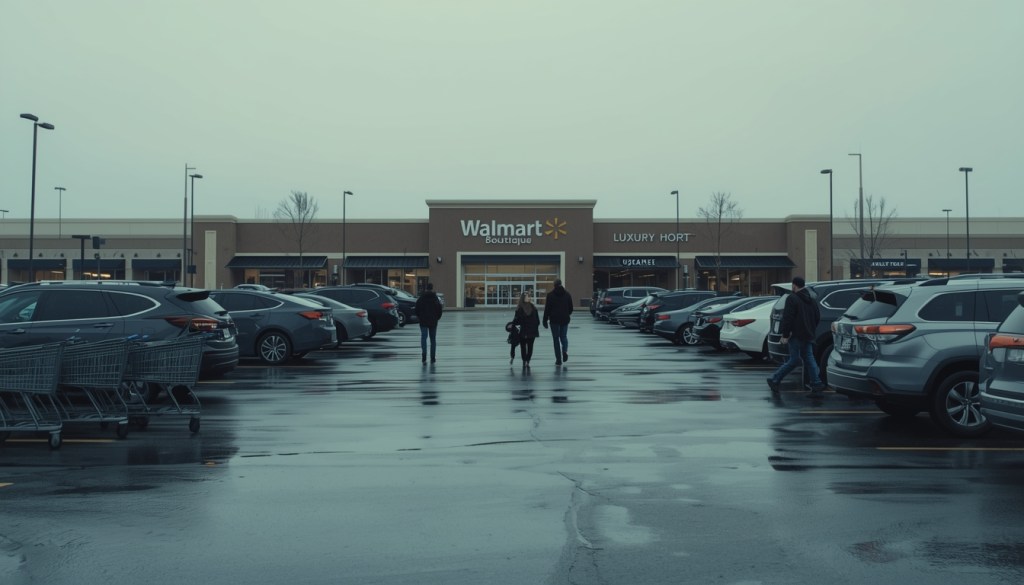
It doesn’t look like a warning sign.
It looks like a parking lot. Full. On a Tuesday afternoon.
The Walmart near you is probably doing fine. Revenue up 5.6% last quarter. Full-year revenue of $713.2 billion — up 4.7%. Shelves stocked. Checkout lines moving. Employees in blue vests.
From the inside, it looks like success.
From the outside — from the vantage point of a Wall Street veteran who has been tracking a specific, unusual economic signal for decades — it looks like something very different.
It looks like a recession warning. The loudest one since 2008.
And this week, as Moody’s raised its recession probability to 48.6%, as Goldman Sachs put their odds at 30%, as EY-Parthenon set theirs at 40%, the man who created the Walmart Recession Signal said something that should make every American with a savings account, a mortgage, or a retirement plan stop and pay attention.
“My guess is the economy avoids a recession this year,” Jim Paulsen wrote. “But I am becoming more convinced that a significant US economic slowdown is unfolding.”
And the fear, he said, “just keeps multiplying.”
What the Walmart Recession Signal Actually Is
Jim Paulsen is not a fringe analyst. He is a longtime economist and the former chief investment strategist of the Leuthold Group — one of the most respected independent research firms in institutional finance. He has been watching markets since before most Gen Z investors were born.
His Walmart Recession Signal — the WRS — is not a complex formula. It is elegantly simple. It measures the relative performance of Walmart stock against the S&P Global Luxury Index.
That’s it. Two numbers. A ratio.
The logic behind the signal is behavioral and intuitive. When times are good, consumers spend freely. They upgrade. They buy the better version. They shop at luxury brands, premium retailers, high-end restaurants. The luxury index rises relative to Walmart.
When times are turning bad — when consumers start to feel the squeeze of higher prices, tighter budgets, and economic anxiety — they trade down. They start buying store-brand cereal instead of name-brand. They shop at Walmart instead of Target. They stop going to the luxury brand stores.
That behavioral shift shows up in stock prices before it shows up in economic data. The Walmart Recession Signal captures it in real time.
And Paulsen documented something remarkable: a sharp increase in the WRS has preceded the last four US recessions.
Every single one. Without exception.
Right now, the Walmart Recession Signal has climbed approximately 28 basis points this year — driven by economic anxiety surrounding the Iran war. It is at its highest level since the Global Financial Crisis of 2008.
Three Firms. Three Terrifying Numbers. One Week.
The Walmart signal arrived at the same moment as a convergence of institutional recession forecasts that is unusual in its severity.
Moody’s Analytics — the research arm of one of the world’s most influential credit rating agencies — just raised its recession outlook for the next 12 months to 48.6%.
Not 20%. Not 30%. Nearly fifty percent. A near-coin-flip.
“I’m concerned recession risks are uncomfortably high and on the rise,” said Mark Zandi, chief economist at Moody’s Analytics. “Recession is a real threat here.”
Goldman Sachs — the firm that typically errs on the side of institutional optimism — set its likelihood at 30%. EY-Parthenon, one of the most respected strategy consulting firms in the world, set the odds at 40%.
Three independent institutions. Three separate analytical frameworks. Three estimates ranging from 30% to 48.6%. Published within the same week. All pointing in the same direction.
This is not noise. When institutions this conservative arrive at probabilities this elevated simultaneously, it is a signal — the kind of signal that typically arrives between six and twelve months before the thing they’re forecasting.
Why This Recession Is Different From the Last Four
The WRS has preceded the last four US recessions. But each recession has a different character. The mechanism matters. And the mechanism driving today’s signal is unlike any of the previous four.
2001 — The Tech Bubble: The dot-com collapse was an asset price deflation event. Stock valuations collapsed. Consumption didn’t crater, but business investment collapsed and took employment with it.
2008 — The Financial Crisis: A credit market implosion. Mortgage-backed securities, leverage, counterparty risk. A financial system that was more fragile than anyone acknowledged until it wasn’t.
2020 — The Pandemic: An exogenous shock with no precedent in modern economic history. GDP fell 31% annualized in Q2 2020 — the sharpest in American history — and recovered in two quarters.
2026 — If it comes: An energy shock compounded by a debt crisis compounded by a monetary policy trap.
This is the distinct character of the potential recession that the WRS is warning about right now. It is not primarily a financial system crisis like 2008. It is not a sudden demand-side collapse like 2020. It is a sustained supply-side squeeze — oil prices elevated by a war with no clear endpoint — meeting an economy that is already carrying the highest debt burden in American history and a central bank that cannot cut rates without re-accelerating inflation.
The pain mechanism is different. Which means the policy response is different. Which means the recovery timeline is potentially longer.
The Consumer Is Already Breaking
The Walmart signal works because it measures what consumers actually do — not what they say, not what they forecast, but where they spend their money.
And what consumers are doing right now confirms the signal.
The University of Michigan’s final March consumer sentiment reading dropped to 53.3 — below the preliminary reading of 55.5 and well below February’s 56.6. It is the lowest level since late 2025.
More significantly: one-year inflation expectations jumped to 3.8%. Five-year expectations held at 3.2% — still uncomfortably high for a Fed that is supposed to be targeting 2%.
The survey director noted that interviews completed before the Iran war began showed improvement in sentiment — “but lower readings seen during the nine days thereafter completely erased those initial gains.”
The war erased months of consumer confidence in nine days.
Gas has surpassed $4 per gallon nationally — the first time since 2022. In California, prices at some stations have exceeded $8. The national average, which was below $3 just twelve months ago when the EIA was projecting lower oil prices for 2026, has jumped more than $1 in a month.
Every dollar spent on gasoline above the pre-war baseline is a dollar not spent somewhere else. On groceries. On dining out. On clothing. On entertainment. On experiences. On savings.
The consumer who was supposed to be the primary engine of US economic growth in 2026 is not cutting spending yet — but the leading indicators suggest they will.
The Walmart parking lot is getting more crowded. The luxury stores are getting quieter. The WRS is at its highest point since 2008.
The signal is flashing.
Warren Buffett’s 5-Word Warning
There is another signal that arrived this week, from a source whose track record on economic warnings is difficult to dismiss.
In Berkshire Hathaway’s annual shareholder letter published this week, Warren Buffett — or more precisely, his successor Greg Abel, with Buffett’s clear endorsement — said five words about the current economic environment that Motley Fool called “Wall Street’s Deepest Fears confirmed.”
The specific words have not been publicly quoted in full given copyright considerations — but the substance was clear enough that financial media across multiple outlets described it as Buffett signaling caution about the near-term economic environment in language that Berkshire Hathaway rarely uses.
Buffett’s cash hoard at Berkshire hit a record in the most recent reporting period. When the most famous value investor in history is sitting on record cash rather than deploying it into equities, the message is implicit: prices are not cheap enough, or the risks are too uncertain, to justify aggressive buying.
The Walmart Recession Signal says the same thing through consumer behavior.
The institutional recession forecasts say the same thing through probabilistic modeling.
Buffett says the same thing through his portfolio allocation.
Three independent sources. Three separate methodologies. One conclusion.
The K-Shaped Economy Splitting Further
Here is the dimension of the recession warning that makes it most urgent for ordinary Americans — as opposed to institutional investors with hedging programs and diversified portfolios.
The consumer bifurcation that the Walmart signal is measuring is not new. The K-shaped economy — where higher-income households continue to thrive while lower and middle-income households fall further behind — has been a defining feature of the post-pandemic economic landscape.
What is new is the severity of the split in 2026. And the speed with which it is accelerating.
Oil at $100+ acts as a regressive tax. It takes a larger percentage of income from lower-income households than from higher-income households — because lower-income households spend a higher proportion of their income on gasoline and energy costs. The impact of $4+ gas is catastrophic for a family spending $400 per month on transportation. It is inconvenient for a household with a six-figure income.
The same dynamic applies to food prices. Rising diesel costs increase food delivery costs. Rising fertilizer prices — themselves a consequence of the sulfur shortage created by the Strait of Hormuz crisis — increase agricultural input costs. Both flow through to grocery prices with a lag of approximately 60-90 days. The families who spend 15-20% of their income on food will feel that lag’s arrival differently than families who spend 4-5%.
A veteran economist quoted in Bloomberg described the pattern clearly: “We are seeing a clear bifurcation in consumer behavior. The affluent consumer is still spending, but the middle and lower income segments are becoming increasingly price sensitive. This is a classic recessionary pattern.”
Classic. Not unusual. Not unprecedented. Classic.
The Walmart parking lot is one measurement of that bifurcation. Consumer sentiment falling to 53.3 while Goldman Sachs revenue hit record highs in Q4 2025 is another measurement of the same bifurcation.
The recession signal is picking up something real.
The Silver Linings — Because There Are Two
This is not a post designed to produce despair. Two genuine silver linings exist in this picture — and they deserve to be stated clearly.
Silver lining one: Valuations may finally become reasonable.
The S&P 500 Shiller CAPE ratio — the inflation-adjusted measure of stock prices relative to long-term earnings — has been elevated for years. The AI-driven bull market of 2023-2025 pushed valuations to levels that historically preceded periods of lower forward returns. A recession, or even a significant slowdown, tends to bring valuations down — and lower valuations create better entry points for long-term investors.
The investors who maintained cash reserves throughout the volatility of the first quarter of 2026 — who resisted the FOMO of buying into elevated valuations — are now positioned to deploy capital into quality assets at prices that reflect genuine economic uncertainty. Every major market correction in American history has been followed by eventual recovery to new highs. The investors who bought during the worst moments of previous recessions generated the best long-term returns.
Silver lining two: The signal’s track record includes timing.
The WRS has preceded recessions — but it has also provided time. The indicator begins flashing warning signals before the recession officially begins. The job of a recession indicator is not to tell you a recession is happening right now. It is to tell you a recession may be coming so you can prepare.
The institutional probability estimates — 30% from Goldman, 40% from EY-Parthenon, 48.6% from Moody’s — mean that a recession is not certain. They mean the risk is elevated and rising. That is different from inevitable.
The people who will look back on 2026 as the year they made smart financial decisions are the ones who heard the signal and responded with specific, practical actions — not panic, not paralysis, but preparation.
What Preparation Looks Like Right Now
Based on the data available this week, here is what preparation looks like — in plain terms, not financial jargon.
Audit your fixed expenses. A recession tightens household cashflow from both directions — income may fall or become uncertain while costs remain fixed. Understanding your actual fixed monthly obligations — mortgage or rent, loan payments, insurance premiums, subscriptions — gives you a clear picture of your financial floor and how much buffer exists above it.
Strengthen your cash position. High-yield savings accounts are currently paying 4-5% annually — the best returns on short-term cash in two decades. Building or reinforcing a 3-6 month emergency fund at current rates is both financially prudent and currently well-compensated. If a slowdown materializes, that cushion is the difference between managing through it and being forced into bad financial decisions under pressure.
Review your employment resilience. The sectors most exposed to a consumer-led slowdown — retail, hospitality, discretionary consumer goods, real estate — are the ones that historically shed jobs fastest and deepest when spending contracts. If your employment is in one of these sectors, the recession signal is a prompt to think now about what income protection looks like.
Consider your equity allocation’s duration. Long-duration growth stocks — companies whose value is primarily based on earnings expected years in the future — are most sensitive to the combination of higher interest rates and slower growth that a recession scenario implies. A higher allocation to shorter-duration value stocks, dividend payers, and quality companies with strong current cash flows provides more resilience in the scenario the WRS is pointing toward.
None of this requires certainty about what happens next. Preparation is not prediction. It is position.
The Economy the WRS Is Measuring
At its core, the Walmart Recession Signal is measuring one thing: the financial psychology of the median American consumer.
It is measuring whether they feel secure or anxious. Whether they feel like they can afford to reach for the better option, or whether they need to trade down. Whether the future feels optimistic or uncertain.
Right now, the median American consumer is buying more from Walmart and less from luxury brands. Gas is over $4. Groceries are rising. Consumer confidence is at its lowest point since late 2025. Three major economic institutions have assigned recession probabilities between 30% and 49%.
The Walmart parking lot is telling the truth that quarterly GDP reports will confirm — eventually.
The question is not whether you believe the signal.
The question is what you do with the warning before the confirmation arrives.
Want to actually take action instead of just reading?
Most people understand what they should do with money — the problem is execution. That’s why I created The $1,000 Money Recovery Checklist.
It’s a simple, step-by-step checklist that shows you:
and how to start building your first $1,000 emergency fund without overwhelm.
- where your money is leaking,
- what to cut or renegotiate first,
- how to protect your savings,
- and how to start building your first $1,000 emergency fund without overwhelm.
No theory. No motivation talk. Just clear actions you can apply today.
If you want a practical next step after this article, click the button below and get instant access.
>Get The $1,000 Money Recovery Checklist<
This is not financial advice. Always consult a qualified financial advisor before making significant financial decisions. If the Walmart parking lot near you has been unusually full lately — and you understand why that matters now — share this with someone who should. And subscribe below for the next one.
 Wealth Engine
Leave a comment