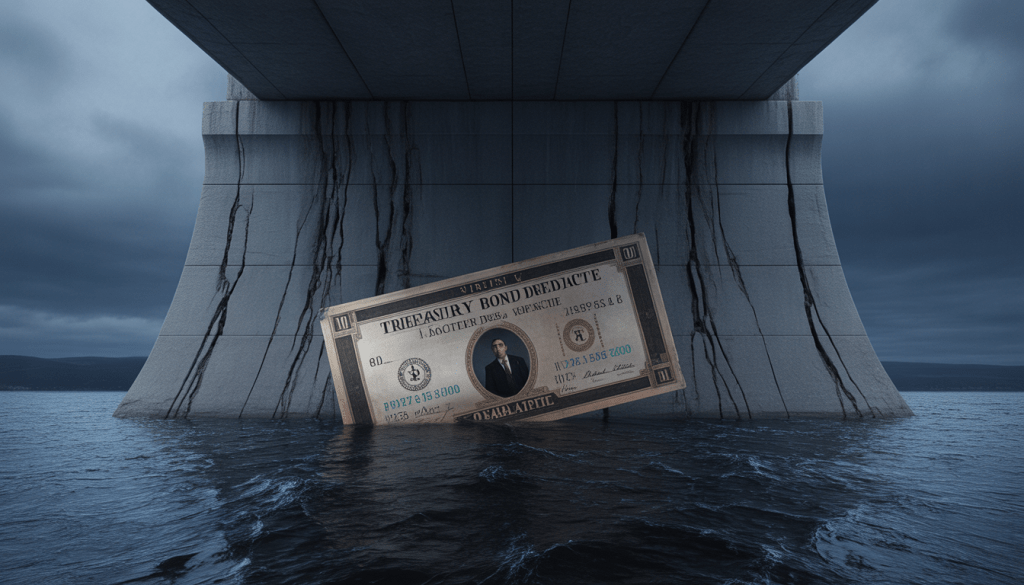
Most people have never thought about the bond market.
That’s understandable. Bonds are boring. They don’t have ticker symbols that trend on social media. They don’t have celebrity CEOs. They don’t go up 400% in a day like a drone IPO. They don’t generate the kind of headlines that make people stop scrolling.
But here is what the bond market is:
It is the foundation of the entire global financial system. Every mortgage rate, every car loan, every credit card, every government program, every pension fund, every bank’s balance sheet — all of it is priced relative to what the US Treasury bond market says money costs.
When the bond market works, nobody notices. When the bond market breaks, everything breaks with it. The 2008 financial crisis wasn’t a stock market crisis at its core. It was a credit market crisis — a bond market crisis — that caused the stock market to collapse as a consequence.
And this week, for the first time in years, the US Treasury bond market sent a signal that serious investors do not ignore.
Three consecutive Treasury auctions failed to attract normal demand. Three in a row. In a single week. The worst showing by three consecutive auctions since May 2024.
This is not a crisis. Yet. But it is a warning. And the people who understand what that warning means are already moving.
What Happened This Week — In Plain English
The US government spends significantly more than it collects in taxes. To cover the difference, it borrows money by issuing Treasury bonds — essentially IOUs that pay interest and are repaid after a set period. To sell those bonds, the Treasury holds auctions where investors bid for the right to lend the government money.
This week, the Treasury held three of those auctions:
- Tuesday: $69 billion in 2-year notes
- Wednesday: $70 billion in 5-year notes
- Thursday: a 7-year note auction
All three drew weak demand. All three “tailed” — meaning the government had to offer higher yields than the market expected to get the debt sold. The 2-year auction recorded the weakest demand since March 2025. The pattern across all three was, according to Bloomberg, the worst showing by three consecutive auctions in over a year.
Treasuries fell after a trio of US government auctions drew relatively poor demand, signaling investor fatigue with market volatility stemming from failed diplomatic attempts to end the US military operation in Iran.
In isolation, weak Treasury auctions happen. They are not automatically alarming. The mechanism exists to ensure the debt always gets sold — primary dealers, the select group of banks required to participate, absorb whatever investors don’t buy.
But the context surrounding this week’s auctions is what separates a routine data point from a genuine warning signal.
The $47 Trillion Problem Nobody Wants to Talk About
Here is the number that frames everything else.
The Treasury Department’s consolidated financial statements for fiscal 2025 show $6.06 trillion in total assets against $47.78 trillion in total liabilities as of September 30, 2025 — liabilities are 8 times greater than assets.
The US government is, by any conventional accounting standard, insolvent. Not bankrupt — sovereign governments can print their own currency in ways that private entities cannot. But the structural gap between what the government owns and what it owes has reached a level that would be catastrophic for any private institution.
The unfunded obligations — Social Security and Medicare commitments not yet reflected in official debt numbers — amounted to $88.4 trillion in fiscal 2025. The Congressional Budget Office calculates the Treasury paid $1.22 trillion in interest on the debt for fiscal 2025 alone.
Interest payments on the national debt are now the single largest line item in the federal budget — exceeding defense spending, exceeding Social Security transfers, exceeding every discretionary program combined. And that number is growing faster than the economy.
The CBO forecasts that interest costs are set to more than double to $2 trillion by fiscal 2035 from $970 billion in fiscal 2025.
A government paying $2 trillion per year in interest — in a world where oil is at $108 and climbing, where inflation is re-accelerating, where the Fed cannot cut rates — is a government with rapidly diminishing fiscal flexibility. Every dollar spent on interest is a dollar not available for defense, infrastructure, healthcare, disaster response, or economic stimulus.
This is the backdrop against which this week’s weak Treasury auctions occurred. And it is why serious investors are not treating those auctions as a routine data point.
The Iran War Made a Bad Situation Worse
The fiscal picture described above existed before February 28, 2026. The Iran war didn’t create the bond market’s structural problems. It accelerated them — and added a new dimension that the pre-war debt trajectory didn’t include.
The specter of stagflation caused by the Iran war has wiped out more than $2.5 trillion from the value of global bonds in March — on track for the biggest monthly loss in more than three years.
Here is the mechanism. When inflation expectations rise — as they have dramatically since oil spiked above $100 — investors demand higher yields on Treasury bonds to compensate for the erosion of purchasing power. Higher yields mean lower bond prices. Lower bond prices mean the value of existing bond holdings falls. The $2.5 trillion loss in global bond value this month is the direct consequence of oil at $108 and the inflation fears it is generating.
But higher yields also mean the government has to pay more to borrow. Every new Treasury auction conducted at higher yields locks in higher interest costs for the next 2, 5, 7, or 30 years. The debt service bill — already headed to $2 trillion annually by 2035 — is being revised upward in real time by every weak auction that forces higher yields.
According to Deutsche Bank strategist Steven Zeng, the biggest factor contributing to more than half of the 10-year yield’s climb is the rise in inflation expectations from the oil price shock — ultimately forcing the Fed to stay on hold with interest rates.
The Fed staying on hold means rates stay high. Rates staying high means bond prices stay depressed. Bond prices staying depressed means the next auction also faces weak demand. Weak demand forces even higher yields at the next auction. The cycle feeds itself.
This is what bond market analysts mean when they talk about a “doom loop” — and it is the scenario that keeps serious fixed income investors awake at night.
The Foreign Buyer Problem
There is a dimension to the Treasury auction weakness this week that the domestic financial press is not covering loudly enough.
The United States depends on foreign buyers — primarily China, Japan, and sovereign wealth funds from Gulf states — to absorb a significant portion of every Treasury auction. Foreign demand has historically been one of the pillars of the dollar’s reserve currency status: countries around the world wanted to hold dollar-denominated assets, and Treasury bonds were the safest and most liquid form of dollar asset available.
That pillar is under pressure from multiple directions simultaneously.
China’s Treasury holdings have been declining steadily for years as geopolitical tensions with the United States have grown. Japan, traditionally the largest foreign holder of US Treasuries, faces its own domestic interest rate pressures — as Japanese rates rise, holding low-yielding US bonds becomes less attractive relative to domestic alternatives. And the Gulf states — Saudi Arabia, the UAE, Qatar — are now embroiled in a conflict that directly involves the United States and has disrupted their own energy revenues.
Any “quiet quitting” by Chinese banks would add to growing concern that foreigners are exiting the Treasury market because of worries over the staggering size of US debt. Growing tensions with other countries on policies proposed by President Trump add to the risk.
If foreign demand for Treasury bonds declines meaningfully — not collapses, just declines — the auctions that were already producing weak results this week become harder to conduct at acceptable yields. Primary dealers absorb more. Yields rise more. The cost of financing the deficit goes up more. And the fiscal position deteriorates faster.
This is not a theoretical risk. It is a trend that is already visible in the data — and it is accelerating in the context of the Iran war.
What the Numbers Mean for Your Mortgage, Your Savings, and Your Retirement
Here is where the abstract becomes personal.
Mortgage rates: The 30-year fixed mortgage rate is directly linked to the 10-year Treasury yield. When Treasury yields rise — as they have this month — mortgage rates follow with a lag of approximately 2 to 4 weeks. Every 25 basis points of yield increase translates to roughly $30-40 per month in additional payments on a $400,000 mortgage. This week’s Treasury auction weakness pushed yields higher. That increase will appear in mortgage rate quotes by mid-April.
The buyers who were waiting for rates to come down before purchasing a home are watching rates move in the opposite direction. The owners with variable rate mortgages are watching their payments inch higher. The people who refinanced into fixed rates when they were available are the ones who made the right call — and the window to join them is narrowing.
Savings accounts and money market funds: This is the rare upside of the current bond market environment. High-yield savings accounts and money market funds are benefiting from elevated rates. If Treasury yields continue to rise — and the auction data suggests they may — the returns on short-duration cash instruments will remain elevated or improve further. Americans who have moved emergency funds and short-term savings into high-yield accounts are being paid to wait in a way that was impossible for most of the last fifteen years.
Retirement accounts: Bond funds — the “B” in a typical 60/40 stock and bond retirement portfolio — have lost significant value this month. The global bond market has shed $2.5 trillion in value during March. If you have a target-date fund or any bond allocation in your 401(k) or IRA, that allocation has declined in value. The magnitude of the decline depends on the duration of the bonds in the fund — longer-duration bonds are more sensitive to yield increases and have fallen more.
Credit card debt: Credit card rates follow the federal funds rate with a short lag. Rates at 22-24% are not declining in a world where the Fed cannot cut and Treasury yields are rising. Every dollar of credit card balance at those rates is a compounding emergency that no investment return is reliably beating.
The Signal Beneath the Signal
The bond market is sending a message this week. The message is not “the system is collapsing.” The system has enormous resilience — Treasury auctions have safety mechanisms, the Fed has tools, and the dollar’s reserve status provides buffers that no other currency enjoys.
The message is subtler and more important: the cost of ignoring the fiscal reality is beginning to show up in market prices.
For years, the United States ran enormous deficits without meaningful consequence in the bond market. Investors bought Treasuries regardless, because they were the safest asset in the world and the alternatives were worse. The bond market, as one strategist famously said, is the market that enforces fiscal discipline when politicians won’t — and for a long time, it was asleep.
This week, it stirred.
Three weak auctions in one week, against a backdrop of $47 trillion in liabilities, $108 oil, re-accelerating inflation, a Fed that cannot cut rates, and a war with no visible resolution — this is the bond market beginning to price the risk that has been building for years.
It may go back to sleep. Ceasefire talks could succeed. Oil could retreat. Inflation could cool. The fiscal situation could improve.
Or the stirring could continue. Yields could keep rising. Foreign buyers could keep retreating. Auction results could keep disappointing. And at some point — nobody knows exactly when — the gradual deterioration becomes a disorderly repricing that touches everything.
The 2022 UK gilt crisis — when a single ill-advised budget announcement caused British government bond yields to spike so rapidly that pension funds faced margin calls and the Bank of England had to intervene within days — is the model for what disorderly bond market repricing looks like in a developed economy. It happened in the UK. There is no law of physics preventing it from happening in the United States.
What Smart Money Is Doing Right Now
The institutional response to this week’s Treasury auction results has been consistent across the major macro funds.
Shortening duration. Reducing exposure to long-term bonds — which are most sensitive to yield increases — in favor of short-term Treasuries, money market instruments, and cash. The trade-off in yield is small relative to the reduction in price risk if yields continue rising.
Adding inflation protection. Treasury Inflation-Protected Securities — TIPS — adjust their principal for inflation. In a world where oil at $108 is pushing inflation expectations higher, TIPS provide direct protection against the scenario that is currently unfolding. Institutional TIPS demand has been notably elevated in recent weeks.
Increasing commodity exposure. Gold, silver, oil, and agricultural commodities historically perform well in the stagflation scenario that the bond market is beginning to price. The same macro environment that produces weak Treasury auctions — high inflation, stagnant growth, fiscal deterioration — produces strong commodity prices.
Reducing exposure to rate-sensitive equities. Technology stocks, real estate investment trusts, utilities, and other long-duration equity assets trade like bonds — they decline in value when yields rise. The portfolio rotation away from these sectors and toward energy, financials, and value stocks is the equity expression of the same thesis.
The Bottom Line for March 28, 2026
The bond market didn’t break this week. Three weak auctions are a warning, not a crisis.
But warnings deserve to be heard. And this one is coming from the most important market in the world, at a moment when the macro environment is as challenging as it has been in a generation.
The US government owes $47 trillion against $6 trillion in assets. It is paying $1.22 trillion per year in interest on that debt, a figure that will double by 2035. The war in Iran has added $2.5 trillion in bond market losses in a single month. The Fed cannot cut rates. Foreign demand for Treasuries is declining. And three consecutive auctions this week failed to attract normal interest at expected prices.
None of this is impossible to navigate. The United States has faced severe fiscal and bond market stress before and found its way through.
But finding the way through requires acknowledging the problem — and the bond market, this week, is acknowledging it louder than it has in years.
The question is whether anyone outside of the trading floors is listening.
Want to actually take action instead of just reading?
Most people understand what they should do with money — the problem is execution. That’s why I created The $1,000 Money Recovery Checklist.
It’s a simple, step-by-step checklist that shows you:
and how to start building your first $1,000 emergency fund without overwhelm.
- where your money is leaking,
- what to cut or renegotiate first,
- how to protect your savings,
- and how to start building your first $1,000 emergency fund without overwhelm.
No theory. No motivation talk. Just clear actions you can apply today.
If you want a practical next step after this article, click the button below and get instant access.
>Get The $1,000 Money Recovery Checklist<
This is not financial advice. Always consult a qualified financial advisor before making significant financial decisions. If this gave you a clearer picture of what’s happening in the most important market nobody watches — share it. The people you care about need to understand this. And subscribe below for the next one.
 Wealth Engine
Leave a comment