It happened at 7:03 a.m. Eastern Time.
President Trump opened Truth Social and typed in all caps that the United States and Iran had engaged in “very good and productive conversations” toward “a complete and total resolution” of hostilities in the Middle East. He ordered the Pentagon to pause all strikes on Iranian power plants and energy infrastructure for five days.
The post took approximately 45 seconds to read.
What happened in the next six minutes rewrote the financial positions of millions of people around the world.
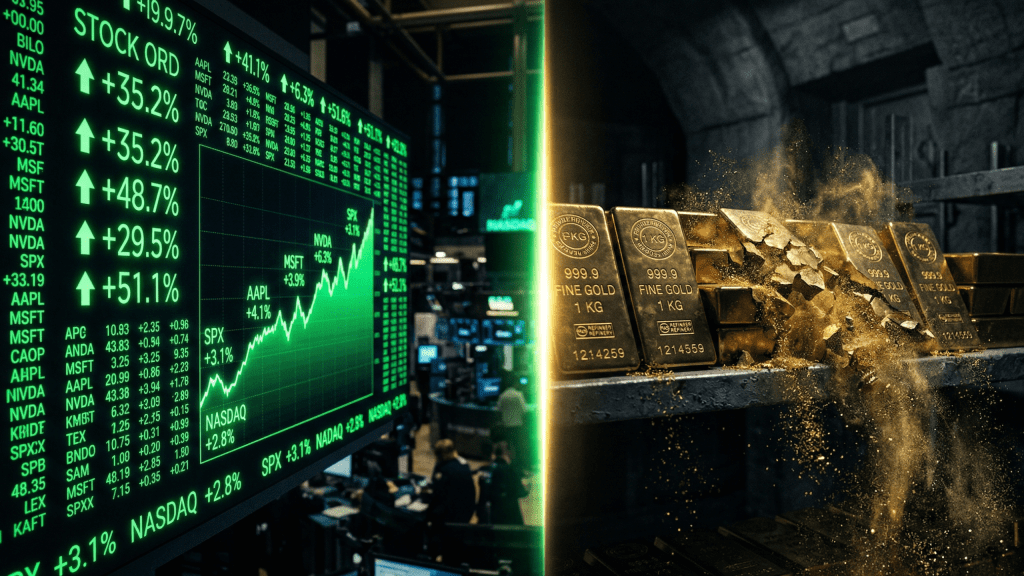
In the time it takes to walk from your car to your desk, $1.7 trillion was added to US stock market valuations. Oil plunged $17 a barrel — a 15% collapse — in a single session. Gold, which had been trading near $5,000 an ounce last week, crashed more than 10%. Silver, the metal that touched $121 in January and was still the subject of Wall Street’s most bullish analyst reports just last week, collapsed 15% — hitting circuit breakers on multiple international exchanges.
By the time you got your coffee, Iran had called Trump a liar. The foreign affairs spokesman for Iran’s parliament posted on social media: “No negotiations have been held with the US, and fake news is used to manipulate the financial and oil markets.”
By mid-morning, half the rally had evaporated. The Dow, which had briefly surged over 1,000 points on futures, closed up 631. Oil recovered some of its losses. Gold clawed back from its lows. Silver remained down nearly 15%.
This is what markets look like in March 2026. This is the world you are trying to navigate with your retirement account, your savings, and your financial future.
Here is exactly what happened today — who won, who lost, and what it means for what comes next.
The 48-Hour Countdown That Nobody Won
To understand today, you need the 72 hours that preceded it.
On Saturday, March 21, President Trump issued what financial markets interpreted as a final ultimatum to Tehran. Reopen the Strait of Hormuz unconditionally — or face the total destruction of Iran’s power grid and nuclear facilities. The 48-hour clock started ticking. Iran responded by threatening to mine the entire Persian Gulf and plunge the entire region into darkness if attacked.
By Sunday night, futures markets were pricing in a genuine catastrophe. Analysts who had been modeling $150 oil were revising toward $200. Some were modeling scenarios where global oil supply collapsed by 40% overnight. The Bushehr Nuclear Power Plant — Iran’s primary nuclear facility — was being discussed in institutional research notes as a potential strike target with consequences that extended well beyond oil prices.
The market spent Sunday night staring into an abyss.
Then at 7:03 a.m. Monday, Trump posted. And the abyss briefly disappeared.
The Anatomy of a $1.7 Trillion Six-Minute Trade
What happened between 7:03 and 7:09 a.m. Eastern is one of the most compressed wealth transfers in the history of financial markets.
Algorithmic trading systems — the automated programs that execute the majority of volume on modern exchanges — read Trump’s Truth Social post within seconds of publication. Before any human analyst had finished the first paragraph, billions of dollars in trades had already been executed.
The playbook was immediate and brutal:
Sell oil. Every barrel of Brent crude that had been priced at a “war premium” — the additional cost reflecting the risk of Hormuz closure — was instantly worth less. Brent had touched $113 a barrel in early trading as markets priced in total war. Within minutes of the Trump post, it was falling toward $96. By mid-session it had lost more than 14%.
Buy stocks. The sectors that suffer most from high oil — airlines, transportation, consumer discretionary, technology — reversed instantly. The S&P 500 futures, which had been pointing to another day of losses, flipped to gains of nearly 3% within the first minute of algorithmic repricing.
Sell gold. The entire “fear trade” that had driven gold from $2,000 two years ago to nearly $5,600 at its January peak was predicated on geopolitical risk, dollar uncertainty, and the threat of a global energy crisis. A ceasefire signal — even a fragile one — removed the most acute version of that risk. Gold plunged from $4,800 to briefly touch $4,100 — a $700 swing in a single session.
Sell silver harder. Silver, which had attracted enormous retail and institutional flows as both a precious metal and an industrial commodity, collapsed 15% to approximately $66 per ounce. At its January peak of $121.88, silver had been one of the most crowded trades in the commodity market. Today it demonstrated exactly what happens when a crowded trade reverses: everyone tries to exit the same door simultaneously.
Who Made Money Today
Stock investors who held through the crisis. The S&P 500 closed up 1.15%. The Nasdaq gained 1.38%. The Dow added 631 points. Anyone who had resisted the urge to sell during the worst weeks of the Iran conflict and held diversified equity exposure was rewarded today — at least partially.
Airline and transportation stocks. The sectors most directly hammered by $100+ oil experienced the sharpest reversals. Airlines, shipping companies, and logistics operators — whose operating costs are directly tied to fuel prices — saw significant gains as oil collapsed. These were the most hated sectors in the market three weeks ago. Today they were among the best performers.
Short-term options traders who anticipated volatility. The investors who positioned for extreme market moves — in either direction — through options strategies profited from the sheer magnitude of today’s swings. The VIX, the market’s volatility index, moved dramatically in both directions across the session, creating extraordinary opportunities for traders who understood the setup.
Cash holders. Anyone sitting in high-yield cash instruments through the crisis — earning 4-5% annualized while equity and commodity markets swung violently — did not make dramatic gains today. But they also did not experience the stomach-churning losses that leveraged commodity positions suffered. In a market this volatile, not losing is its own form of winning.
Who Got Crushed Today
Gold bulls who bought near the top. Gold touched $5,594 on January 29. Anyone who established large gold positions in January or February — chasing the war premium at or near peak prices — experienced a 20%+ loss from peak to today’s trough. At the intraday low of $4,100, those positions were down $1,494 per ounce from the January high. Today’s single-session loss of 10%+ compounded losses that had already been building.
Silver investors who believed the $309 thesis. Two weeks ago, Bank of America’s silver analyst maintained a $135-$309 price target. Silver was trading around $81. The war premium was supporting prices. Today, silver is at $66 — down nearly half from its $121 January peak, down 45% from its $117 level on February 28 when the Iran war began. The structural thesis — six consecutive years of supply deficits, industrial demand from solar and EVs and AI — has not changed. But momentum traders who built leveraged positions on the war premium experienced catastrophic losses today regardless of the fundamental story.
Energy sector investors. The domestic oil producers, energy infrastructure companies, and upstream operators that had been the smartest trade of the crisis suddenly became some of the worst performers of the session. The “war premium” that had inflated their earnings and stock prices evaporated within minutes of Trump’s post. Companies trading at crisis-elevated valuations were immediately repriced toward a world where oil returns to $70-80 — the scenario that emerges if talks succeed.
Defense contractors — partially. Defense stocks had been among the strongest performers of the crisis. Today’s peace signal caused some profit-taking, though the sector held up better than energy because experienced defense investors understand that a ceasefire does not cancel procurement contracts already in motion.
The Part That Should Make You Very Nervous
Here is what most of the bullish coverage of today’s rally is not telling you.
Iran called the talks fake news within hours of Trump’s announcement.
Iran’s parliament spokesman explicitly stated: “No negotiations have been held with the US, and fake news is used to manipulate the financial and oil markets and escape the quagmire in which the US and Israel are trapped.”
Iran’s Supreme Defense Council simultaneously threatened to deploy naval mines across the Persian Gulf if attacked — threatening to extend disruption beyond the Strait of Hormuz to the entire Persian Gulf region.
Israel continued strikes on Iran even as Trump was touting peace talks — raising the question of whether the United States and Israel are actually operating with aligned objectives.
Trump himself, when asked who would jointly control the Strait of Hormuz, said: “Maybe me.” That answer — from a sitting US president about one of the world’s most geopolitically sensitive waterways — suggests that the parameters of any potential deal are far from settled.
Krishna Guha at Evercore captured the ambiguity precisely: “It is impossible to tell whether this signals genuine progress towards an off-ramp for the war, or Trump zig-zagging to buy time and keep oil from breaking out towards $150.”
The prediction market odds of a ceasefire by April 30 surged above 65% on Trump’s post — then faded back toward 50% as Iran’s denials registered.
The five-day pause is real. What happens on day six is completely unknown.
What This Market Is Teaching Anyone Paying Attention
March 2026 has produced more compressed, violent, and consequential market moves than any equivalent period in recent memory. The lessons are arriving fast and at significant cost to anyone who wasn’t prepared.
Lesson 1: Geopolitical risk premium is the most dangerous thing to buy near peak crisis. The investors who loaded up on gold at $5,500, silver at $120, and energy stocks at their war-premium highs learned today what happens when the catalyst for those premiums suddenly softens. The underlying assets are not necessarily wrong. The timing and leverage of the position determines whether a correct thesis makes or loses money.
Lesson 2: In a headline-driven market, reaction speed is irrelevant for most investors. The algorithms that repriced $1.7 trillion in six minutes are not something retail investors can compete with on speed. The attempt to trade these headlines in real time is a competition most individuals will lose. The only viable alternative is having a pre-determined framework — knowing in advance what you own, why you own it, and at what price you will buy or sell — so that you are not making emotional decisions when the headlines hit.
Lesson 3: A five-day ceasefire is not a peace deal. The market’s initial reaction treated Trump’s post as if it resolved the fundamental conflict. It did not. The Strait of Hormuz remains effectively closed. Iran’s military posture has not changed. The underlying dispute over nuclear infrastructure, maritime sovereignty, and regional power has not advanced toward resolution. The five-day pause is a pause. Markets that price it as something more will be vulnerable to a painful correction if talks collapse.
Lesson 4: The most crowded trades are the most dangerous. Gold and silver had attracted extraordinary retail and institutional flows over the past three months. Crowded trades — positions where everyone is on the same side — are vulnerable to violent reversals precisely because everyone tries to exit simultaneously when the catalyst shifts. Today’s silver collapse was not primarily about silver’s fundamentals. It was about the mechanics of a crowded trade unwinding.
Lesson 5: Cash is not a losing position in a volatile market. The investors who spent the crisis building cash positions in high-yield accounts — earning 4-5% while the war premium inflated and deflated commodity prices — did not participate in today’s rally fully. But they also did not participate in the preceding weeks of losses, or in today’s violent commodity selloff. In a market this uncertain, optionality — the ability to act when prices make sense rather than when emotion demands action — is worth more than most investors price it.
What Happens in the Next Five Days
Here is the scenario map that serious investors are working from right now.
Scenario A — Talks succeed, Hormuz reopens: Oil falls toward $75-80. Equity markets continue to recover. Gold and silver remain under pressure as the fear premium exits. Energy stocks give back more of their war-premium gains. Tech, consumer, and transportation stocks lead the next leg of the rally. This is the scenario the market is partially pricing in after today.
Scenario B — Talks collapse, strikes resume: Oil spikes back above $100, potentially toward $130-150. Equity markets give back today’s gains and then some. Gold and silver reverse and reclaim losses. Energy stocks recover. The Fed faces an impossible choice between fighting oil-driven inflation and supporting growth. This scenario has not been priced out — it remains a live possibility that Iran’s denials today make more, not less, likely.
Scenario C — Rolling pauses, indefinite uncertainty: The five-day window extends into another five days, then another. The Strait remains partially disrupted. Oil stays elevated but below crisis peaks. Markets trade sideways in extreme volatility. This is the scenario Macquarie and several other institutional analysts consider most likely — and it is the scenario that is most difficult for investors to navigate because it provides no clear resolution to act against.
The only certainty in this market is that the next five days will produce headlines that move prices significantly. Whether those moves are up or down depends on decisions being made in rooms that no investor has access to.
The One Thing That Hasn’t Changed
All of this — the $1.7 trillion rally, the gold crash, the oil plunge, the Iran denials — happened in a single Monday session. By Tuesday morning, the calculus may have shifted again.
What has not changed is the underlying reality that drove this entire crisis: the global economy built a critical infrastructure — energy, supply chains, financial markets — with single points of failure. The Strait of Hormuz. The dollar system. The concentration of semiconductor manufacturing. The dependence on global supply chains for everything from medications to microchips.
Every crisis exposes a fragility. This one exposed several simultaneously.
The investors who will look back on 2026 as the year that made them wealthy are not the ones who traded today’s headlines correctly. They are the ones who identified the structural shifts underneath the headlines — the assets that benefit from energy security investment, from supply chain reshoring, from the AI infrastructure buildout, from the demographic wealth transfer — and positioned for those shifts with patience and conviction.
Today’s market gave back some gains and created new ones in the span of a morning.
The structural story is playing out on a timeline measured in years, not hours.
That is the market worth understanding.
That is the one that actually changes your financial life.
Want to actually take action instead of just reading?
Most people understand what they should do with money — the problem is execution. That’s why I created The $1,000 Money Recovery Checklist.
It’s a simple, step-by-step checklist that shows you:
and how to start building your first $1,000 emergency fund without overwhelm.
- where your money is leaking,
- what to cut or renegotiate first,
- how to protect your savings,
- and how to start building your first $1,000 emergency fund without overwhelm.
No theory. No motivation talk. Just clear actions you can apply today.
If you want a practical next step after this article, click the button below and get instant access.
>Get The $1,000 Money Recovery Checklist<
This is not financial advice. Always consult a qualified financial advisor before making investment decisions. If today’s market chaos gave you whiplash and this helped make sense of it — share it. And subscribe below for the next one.
 Wealth Engine
Leave a comment