It happened today. March 17, 2026.
A small company based in Austin, Texas — with offices in Kyiv, Ukraine and Warsaw, Poland — walked onto the Nasdaq this morning and did something nobody expected.
Swarmer Inc. priced its IPO at $5 per share. Raised $15 million. A modest debut by any measure. The kind of listing that normally gets two sentences in a financial roundup buried at the bottom of a tech newsletter.
By the end of the day, the stock had closed at $31. At its peak, it touched $40 — a 700% gain from the opening price in a single trading session. Multiple circuit breakers fired. The exchange halted trading several times as the system struggled to process the velocity of the move.
At its peak, Swarmer’s market capitalization approached $500 million — for a company that reported $309,920 in total revenue last year.
Read that again. Three hundred and nine thousand dollars in annual revenue. Half a billion dollar valuation at peak. In one day.
This is not a story about one stock. This is a story about what the market is pricing in — and why the investors who understand what Swarmer actually does are not surprised by this at all.
What Swarmer Actually Does — And Why It Matters
Forget the ticker. Forget the stock price. Understand the technology first, because the technology is the story.
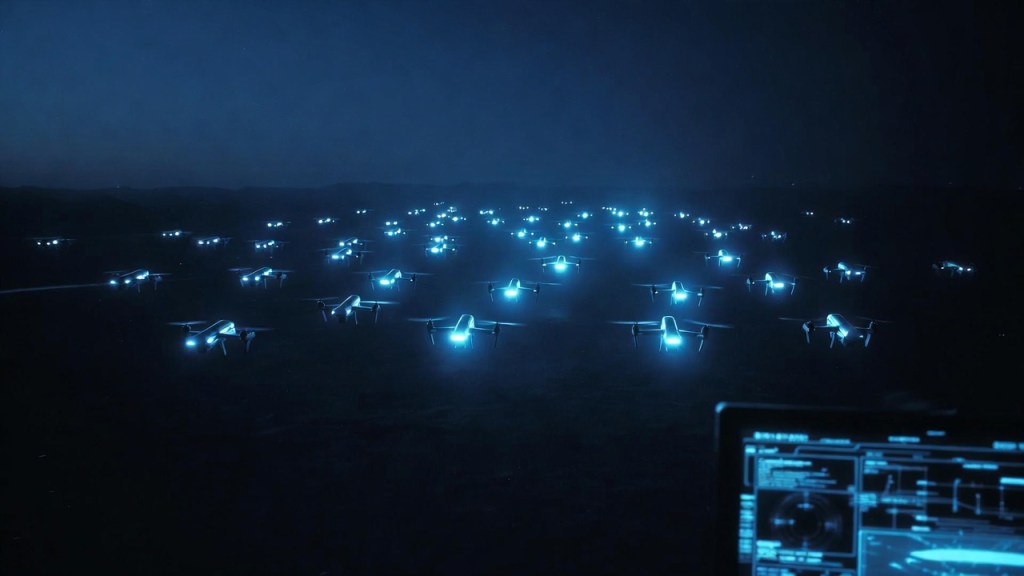
Swarmer develops software that enables militaries and defense integrators to deploy, coordinate, and control large drone swarms across air, ground, and maritime domains. The company is software-first and hardware-agnostic — meaning their system works with drones built by any manufacturer. They are not selling the aircraft. They are selling the brain.
Their core product stack consists of three systems. STYX is the AI command and control layer — real-time mission planning and execution. MINAS is the autonomy and collaboration engine — the software that lets dozens or hundreds of drones make coordinated decisions without human input for each individual unit. TRIDENT is the embedded operating system that runs directly on the drones themselves — providing networking, encryption, and real-time data handling in contested environments.
Over 100,000 real-world combat missions have been executed by drones equipped with TRIDENT OS. Not simulations. Not test flights. Combat missions. In Ukraine. Right now.
This is not a company selling a promise. It is a company with a product that has already been battle-tested in the largest drone warfare theater in history — and is scaling that technology to every military that is watching what is happening in Ukraine and drawing the obvious conclusions about what modern warfare now requires.
The Man Behind the Company — And What It Signals
Swarmer’s non-executive chairman is Erik Prince — the founder of Blackwater, the private military contractor that became one of the most controversial and consequential defense companies of the post-9/11 era.
Prince’s involvement is not a footnote. It is a signal to the defense establishment and institutional investors about the seriousness of what Swarmer is building. Love him or hate him, Prince has spent three decades at the intersection of military technology, private defense contracting, and geopolitical power. His presence in the Swarmer chair communicates something specific to defense insiders: this is not a startup cosplaying as a defense company. This is a defense operation using startup capital markets to scale.
When someone with that network endorses a technology with his name attached, the defense procurement community pays attention in ways that no marketing campaign can replicate.
Why Today Was Not a Fluke
The easy dismissal of today’s move is that it was retail mania — unsophisticated investors piling into a shiny story without understanding the fundamentals. And to be fair, there is always some of that in a first-day 520% gain.
But the broader context makes the dismissal too simple.
Kratos Defense has risen approximately 72% year-to-date and more than 280% over the past year. Red Cat Holdings has also delivered significant returns in 2026. AeroVironment commands analyst price targets averaging $383. The entire defense technology sector has been on a sustained run that precedes today’s Swarmer debut by many months.
IPO pops are nearing 10-year highs in 2026, with tech companies leading the way. The capital markets are not indiscriminately rewarding every new listing — they are specifically and aggressively rewarding companies at the intersection of AI, defense, and autonomous systems.
Swarmer didn’t create this moment. It arrived perfectly positioned for a moment that was already building.
The Defense Budget Nobody Is Talking About
Here is the structural story beneath today’s IPO.
Discussions around expanding the US defense budget to as much as $1.5 trillion have provided a tailwind for companies operating in drone and autonomous technologies.
The US currently spends approximately $900 billion annually on defense. A move to $1.5 trillion would represent the largest single expansion of American military spending in peacetime history — and the majority of that new spending is being directed toward exactly the technologies Swarmer represents: autonomous systems, AI-powered command and control, drone swarms, unmanned maritime and ground vehicles.
This is not abstract future spending. NATO allies, responding to Russia’s invasion of Ukraine and the broader deterioration of European security, have collectively committed to defense spending increases that represent hundreds of billions in new procurement over the next five years. Every one of those countries is watching drone warfare transform the battlefield in real time and writing checks accordingly.
The military drone market is projected to grow at over 12% CAGR through 2030. That number was calculated before the Iran conflict that began in late February 2026 accelerated every timeline on every defense procurement plan in every allied nation simultaneously.
The money is committed. The procurement cycles are running. The companies positioned to capture that spending are being repriced by capital markets right now.
The Ukraine Factor — And Why It Changes Everything
There is something unprecedented happening in the Swarmer story that has no historical parallel in defense technology investing.
Swarmer’s software has been deployed in active combat in Ukraine since 2023. Over 100,000 real-world combat missions have been executed on their platform. That operational dataset — the accumulated learning from a hundred thousand live missions in a real war — is not something that any competitor can replicate in a laboratory or a simulation environment.
Every iteration of their AI model has been trained on actual battlefield data. Every edge case their autonomy system has encountered has been a real edge case, with real consequences, in a real contested environment. The gap between Swarmer’s operational experience and any competitor that hasn’t been in Ukraine is not a marketing advantage. It is a genuine technical moat built from real-world use at a scale that no defense contractor in history has achieved this quickly.
Defense procurement officers around the world understand this. When you are evaluating autonomous drone software for your military, you are choosing between a system tested in a wind tunnel and a system tested in a war. The choice is not difficult.
This is why the institutional interest in Swarmer exists beyond the retail mania. This is why Erik Prince lent his name to it. This is why today happened.
The Risks Are Real — And Need to Be Said Clearly
This is the part of the story that the 520% gain tends to drown out. It needs to be heard.
Swarmer reported revenue of $309,920 for the year ended December 31, 2025 — roughly a 6% decline from the previous year. Its net loss widened to approximately $8.5 million, more than four times higher than its loss in 2024.
Revenue is declining. Losses are accelerating. The company is burning cash at a rate that its $15 million IPO proceeds will not sustain for long without new contract wins.
One customer — SMS — accounted for substantially all 2024-2025 revenue, and Swarmer does not expect new orders from this customer going forward.
Read that carefully. The company’s primary revenue source has ended. The $16.3 million in firm commitments and $16.8 million in MOUs they are projecting forward are not yet contracts. They are expectations.
A company with declining revenue, accelerating losses, a single-customer concentration risk that has now evaporated, and a market capitalization at peak today of nearly $500 million is priced for perfection in a business that is nowhere near perfect.
The gap between the technology’s promise and the company’s current financial reality is significant. Investors who bought at $40 today are betting on execution that has not yet happened at scale in a commercial context. History is full of technologies that were genuinely transformative and companies that captured none of the value because they couldn’t execute the business side.
This risk is real. Anyone buying Swarmer on the back of today’s move without understanding the financial picture is speculating, not investing.
The Bigger Picture — The Drone Economy Is Just Beginning
Whether Swarmer specifically executes on its promise or not, today is a signal about something larger.
The world just received a live demonstration — in Ukraine, and now in the Iran conflict — of what autonomous drone swarms do to conventional military power. The answer is: they transform it completely. Low-cost autonomous systems are neutralizing assets that cost a hundred times more. The economics of warfare are being inverted.
Every military on earth is drawing the same conclusion simultaneously: autonomous drone capabilities are not optional. They are existential. And the race to develop, procure, and deploy them is happening on a timeline measured in months, not years.
This creates an investment landscape that is, in some ways, the defense equivalent of the early internet. The infrastructure is being built. The doctrine is being written in real time. The companies that are positioned early — with proven technology, operational data, and the right relationships — have the potential to define a sector that will be funded at extraordinary scale for the next decade.
Today’s Swarmer debut is a data point in that larger story. The 520% gain is noise. The underlying demand signal is what matters.
And the underlying demand signal is one of the clearest in the global economy right now.
What the Smart Money Does With This Information
The worst possible response to today’s Swarmer move is to chase it. The stock that went up 520% today has already priced in an enormous amount of the near-term optimism. Buying at $31 on the close is not the same trade as buying at $5 at open — and buying at $5 at open was itself a speculative position in a company with $309,000 in annual revenue.
The better response is to use today as a research catalyst.
The defense drone sector has multiple publicly traded names that have not yet experienced Swarmer-level attention. Kratos Defense is up 280% over the past year but still has analyst coverage that suggests further upside. AeroVironment has targets averaging $383. Red Cat Holdings, Joby Aviation, and a handful of other autonomous systems companies are operating in adjacent spaces with their own versions of the same structural tailwind.
The sector is real. The demand is real. The spending is committed. The question for investors is not whether to pay attention to this space — it is which companies within it have the combination of technology, financial durability, and execution capability to capture the value that the market is beginning to assign to the category.
Today answered that question for the overall sector.
It opened the next set of questions for specific companies within it.
Those questions are worth asking carefully — before the next 520% day makes everyone wish they had.
This is not financial advice. Always do your own research and consult a qualified financial advisor before making investment decisions. If this gave you a useful lens for understanding what just happened today — share it. And subscribe below for the next one.
Want to actually take action instead of just reading?
Most people understand what they should do with money — the problem is execution. That’s why I created The $1,000 Money Recovery Checklist.
It’s a simple, step-by-step checklist that shows you:
and how to start building your first $1,000 emergency fund without overwhelm.
- where your money is leaking,
- what to cut or renegotiate first,
- how to protect your savings,
- and how to start building your first $1,000 emergency fund without overwhelm.
No theory. No motivation talk. Just clear actions you can apply today.
If you want a practical next step after this article, click the button below and get instant access.
>Get The $1,000 Money Recovery Checklist<
 Wealth Engine
Leave a comment