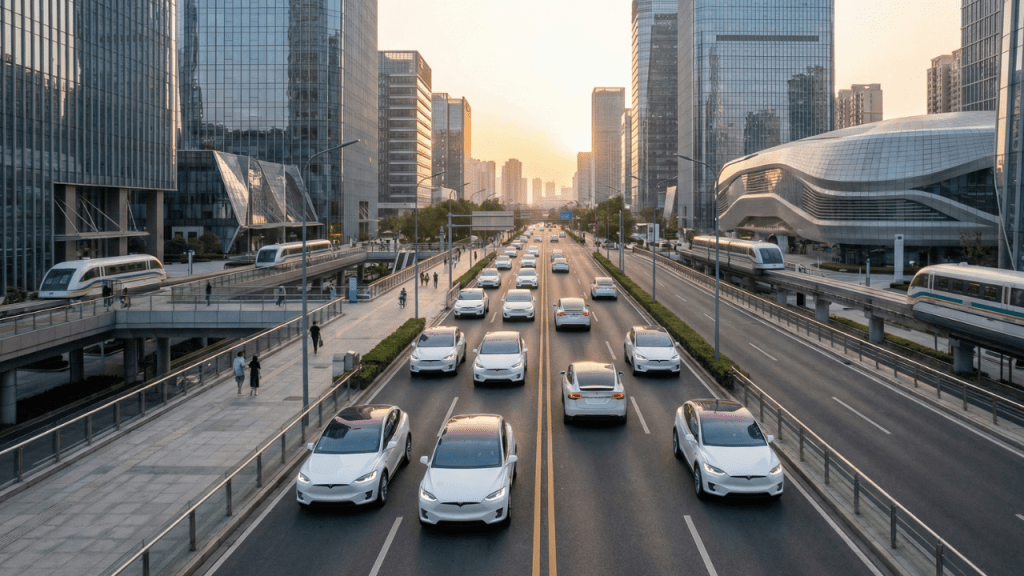
A Bold Vision for Autonomous Transportation
The autonomous vehicle industry continues to generate significant interest among investors and analysts, with Tesla remaining at the forefront of this technological revolution. Recent financial analysis has painted an exceptionally optimistic picture of the company’s potential in the robotaxi sector, suggesting revenue figures that could fundamentally transform the business landscape by the mid-2030s.
Wall Street research has produced forecasts indicating that Tesla’s autonomous ride-hailing operations could generate substantial revenue streams within the next decade. These projections are based on specific assumptions about market penetration, competitive positioning, and pricing strategies that warrant careful examination by investors considering exposure to this emerging sector.
Current Market Snapshot: Tesla’s Trading Position
As of the latest trading session, Tesla shares were changing hands at $396.97, representing a daily decline of $9.04, or approximately 2.23%. The company’s market capitalization stands at an impressive $1.4 trillion, reflecting investor confidence in both current operations and future growth prospects.
The stock has demonstrated considerable volatility over the past year, with a 52-week trading range spanning from $214.25 to $498.83. This wide range illustrates the ongoing debate among market participants regarding appropriate valuation levels. Trading volume reached 2.9 million shares, below the average volume of 74 million, suggesting a relatively quiet session. The company maintains a gross margin of 18.03%, a key profitability metric that investors monitor closely.
The $250 Billion Revenue Projection: Breaking Down the Analysis
Financial research from Wolfe Research, conducted by analyst Emmanuel Rosner, has projected that Tesla’s robotaxi division could achieve annual revenues of $250 billion by 2035. This ambitious forecast rests on several critical assumptions that investors must understand when evaluating the credibility and likelihood of such an outcome.
Key Assumptions Behind the Forecast
The projection incorporates three fundamental variables that drive the revenue model. First, the analysis assumes that autonomous vehicles will capture 30% penetration of the overall transportation market by 2035. This represents a significant shift in consumer behavior and technological adoption, requiring substantial progress in both vehicle capabilities and public acceptance of self-driving technology.
Second, the model presumes Tesla will secure 50% market share within the autonomous vehicle sector. This would position the company as the dominant player in a highly competitive field, successfully defending against challenges from traditional automakers, technology companies, and emerging startups all vying for position in this lucrative market.
Third, the revenue calculation employs a pricing assumption of $1 per mile traveled. This rate would need to remain competitive while providing sufficient margins to cover operational expenses, vehicle depreciation, maintenance, insurance, and generate acceptable returns for shareholders.
Valuation Implications
Under this revenue scenario, the research suggests Tesla’s robotaxi business alone could support an equity valuation of $2.75 trillion. When discounted to present value using appropriate financial modeling techniques, this translates to approximately $900 billion in current terms, or roughly $250 per share attributable solely to the autonomous ride-hailing operations.
The analysis further notes that additional value drivers exist beyond the core robotaxi business. The development of Optimus humanoid robots and potential licensing arrangements for Full Self-Driving technology could provide supplementary revenue streams that enhance overall company valuation. These opportunities represent upside potential not fully captured in the base case robotaxi projections.
Near-Term Challenges: Investment Requirements and Profitability Pressures
While the long-term outlook appears favorable in this analysis, the same research identifies significant near-term headwinds that investors must navigate. Building a large-scale autonomous vehicle fleet requires substantial capital investment, which will likely pressure earnings in the immediate future.
2026 Expansion Plans and Associated Costs
Tesla reportedly plans to launch robotaxi services in seven additional markets during the first half of 2026. This aggressive expansion strategy necessitates rapid fleet growth, with vehicle counts expected to increase from approximately 250 units to 7,200 units over this period. Such dramatic scaling requires significant financial resources for vehicle acquisition, technology integration, regulatory compliance, and operational infrastructure.
The financial impact of this expansion is projected to include losses of approximately $500 million attributable to robotaxi operations. These losses reflect the classic challenge of scaling a capital-intensive business: substantial upfront investments must be made before revenue generation reaches levels sufficient to achieve profitability. Investors accustomed to Tesla’s automotive margins must prepare for a period of reduced overall profitability as resources are redirected toward autonomous vehicle deployment.
Development Costs for Optimus
Simultaneously, Tesla continues investing heavily in the development of Optimus, its humanoid robot project. While this initiative holds long-term promise for automation across various industries, it represents another significant cost center that will impact near-term financial performance. The dual challenge of funding both robotaxi expansion and Optimus development creates meaningful pressure on earnings that could affect stock performance in 2026 and potentially beyond.
Critical Consideration #1: Understanding Current Valuation Dynamics
Investors evaluating Tesla must recognize that the stock currently trades at approximately 192 times forward earnings, a multiple that significantly exceeds broader market averages and most automotive industry peers. This elevated valuation metric indicates that market participants have already incorporated substantial expectations for future growth and profitability improvement into the current share price.
Implied Expectations
The $1.4 trillion market capitalization reflects considerable optimism about Tesla’s ability to successfully execute its autonomous vehicle strategy and potentially other initiatives like Optimus. In essence, the market has already “priced in” a meaningful degree of success for these ventures. This creates an asymmetric risk profile: positive developments that merely meet expectations may not drive significant stock appreciation, while any setbacks or delays could trigger substantial price declines.
Core Business Challenges
Adding complexity to the valuation discussion, Tesla’s traditional electric vehicle business faces headwinds that could constrain growth. The overall EV market has encountered challenges, including slower-than-expected adoption rates in some regions and intensifying competition from both established manufacturers and new entrants. Additionally, the expiration of government incentives, such as the $7,500 federal tax credit in the United States, removes a significant purchasing motivator for potential customers.
These pressures on the core automotive business make the successful development of alternative revenue streams even more critical to justifying current valuation levels. Investors must assess whether robotaxi operations can develop quickly enough and achieve sufficient scale to offset any deceleration in traditional vehicle sales growth.
Critical Consideration #2: Execution Risks and Competitive Dynamics
While Tesla appears to hold a first-mover advantage in the autonomous vehicle space, translating this position into sustained market leadership requires successfully navigating numerous challenges that could derail or delay the optimistic revenue projections.
Technological Hurdles
Achieving truly unsupervised full self-driving capability represents an enormous technical challenge. Despite significant progress, autonomous vehicle technology must demonstrate consistent safety and reliability across diverse weather conditions, road types, and traffic scenarios before gaining regulatory approval and consumer trust. Any accidents or safety incidents involving Tesla’s robotaxis could trigger regulatory scrutiny, negative publicity, and public resistance that impedes expansion plans.
The transition from supervised to fully autonomous operation is not merely an incremental improvement but rather a qualitative leap requiring system reliability that exceeds human driving performance across all conditions. Meeting this threshold consistently and provably represents a significant technological barrier that may take longer to overcome than current timelines suggest.
Regulatory Environment
Regulatory approval for autonomous vehicle operations varies dramatically across jurisdictions, creating a complex patchwork of requirements that Tesla must navigate. Each new market requires separate certification processes, ongoing compliance monitoring, and adaptation to local regulatory frameworks. Changes in regulations, new safety standards, or political shifts could create unexpected obstacles to expansion plans.
Furthermore, insurance requirements, liability frameworks, and data privacy regulations specific to autonomous vehicles remain in flux in many regions. This regulatory uncertainty creates risk that operational costs could exceed expectations or that market entry could face delays beyond management’s control.
Competitive Pressures
Tesla does not operate in a vacuum. Major technology companies, traditional automakers, and specialized autonomous vehicle startups are all pursuing similar opportunities in the robotaxi market. Competitors like Waymo, Cruise, and others have demonstrated autonomous capabilities and are actively deploying vehicles in select markets. Chinese companies are also advancing rapidly in this space, potentially challenging Tesla in key international markets.
The assumption that Tesla will capture 50% market share in autonomous vehicles requires the company to not only maintain technological leadership but also to out-execute numerous well-funded competitors over an extended period. Market share gains typically require advantages in technology, cost structure, service quality, or network effects that prove sustainable against competitive responses.
Capital Requirements and Operational Scaling
Building and maintaining a fleet of 7,200 vehicles by mid-2026, and eventually scaling to hundreds of thousands of units required to generate $250 billion in annual revenue, demands exceptional operational excellence. The company must develop robust systems for vehicle maintenance, charging infrastructure, customer service, and fleet management at unprecedented scale.
Each vehicle in the fleet requires regular servicing, cleaning, inspection, and eventual replacement. The economics of robotaxi operations depend critically on vehicle utilization rates, operational efficiency, and cost control across these activities. Achieving profitability at scale while competing on price represents a significant operational challenge that many ride-hailing companies have struggled to solve even with human drivers.
Why Tesla Commands a Premium Valuation
Despite these risks and challenges, investors continue assigning Tesla a substantial valuation premium relative to traditional automotive companies. This premium reflects several factors that distinguish Tesla in the market’s perception.
Leadership and Vision
CEO Elon Musk has cultivated a devoted following among investors who believe in his ability to achieve ambitious goals that others dismiss as unrealistic. Musk’s track record with Tesla and SpaceX demonstrates a willingness to pursue transformational objectives and an ability to overcome significant obstacles. This reputation creates investor confidence that translates into higher valuation multiples.
First-Mover Advantage
Tesla’s early commitment to autonomous driving technology has allowed the company to accumulate vast amounts of real-world driving data from its fleet of vehicles equipped with Full Self-Driving hardware. This data advantage potentially accelerates machine learning improvements and creates a competitive moat that new entrants would find difficult to replicate quickly.
Sector Growth Potential
The autonomous transportation market represents a massive economic opportunity, with some estimates suggesting it could become a multi-trillion-dollar industry. Investors willing to accept near-term volatility in exchange for exposure to this transformational trend may rationally pay premium valuations for companies positioned to capture significant market share.
Investment Implications: Balancing Opportunity and Risk
The contrasting perspectives within the same analytical framework highlight the complexity facing Tesla investors. On one hand, the long-term revenue potential from robotaxis could justify substantial appreciation from current levels if execution proceeds according to optimistic scenarios. On the other hand, significant near-term challenges, elevated current valuation, and numerous execution risks create meaningful downside potential if progress disappoints expectations.
Considerations for Growth-Oriented Investors
Investors with high risk tolerance and long-term time horizons may find Tesla’s growth prospects compelling. The potential for robotaxi revenue to reach $250 billion by 2035 represents a transformational opportunity that could deliver exceptional returns. For these investors, near-term earnings pressure and valuation concerns may be acceptable trade-offs for exposure to a potentially industry-defining business model.
This investment approach requires conviction that Tesla will successfully navigate technological challenges, maintain competitive advantages, achieve regulatory approvals across multiple markets, and execute operational scaling without major setbacks. It also requires willingness to endure significant volatility as the market reassesses progress periodically.
Considerations for Value-Conscious Investors
Investors focused on valuation metrics and near-term profitability may find current price levels challenging to justify. The 192 times forward earnings multiple leaves little room for error, and any disappointments in robotaxi development, increased competition, or regulatory setbacks could trigger substantial price corrections. Additionally, the near-term earnings pressure from fleet expansion costs creates headwinds that could persist for several quarters.
From this perspective, waiting for either lower entry prices or clearer evidence of successful robotaxi scaling might represent a more prudent approach. Alternative investment opportunities in the autonomous vehicle ecosystem might offer better risk-reward profiles for investors seeking exposure to the sector without accepting Tesla’s specific execution risks.
The Road Ahead: Monitoring Key Milestones
Several developments in coming months and years will help investors assess whether Tesla is on track to achieve the optimistic robotaxi revenue projections or facing challenges that could require revised expectations.
Near-Term Catalysts
The planned expansion into seven new markets during the first half of 2026 represents a critical test of Tesla’s ability to scale robotaxi operations. Success in obtaining regulatory approvals, deploying vehicles efficiently, and achieving acceptable utilization rates in these markets would provide important validation of the business model and potentially accelerate the timeline for broader deployment.
Conversely, delays in market launches, regulatory pushback, safety incidents, or lower-than-expected customer adoption would suggest the path to $250 billion in revenue may face more obstacles than currently anticipated. Investors should monitor fleet growth metrics, vehicle utilization statistics, and operational cost trends as indicators of execution progress.
Technology Milestones
Progress toward fully unsupervised autonomous operation represents perhaps the most critical variable in determining Tesla’s robotaxi success. Demonstrations of consistent performance across diverse conditions, reductions in intervention rates, and expansion of operating domains without safety incidents would strengthen confidence in the technology’s readiness for large-scale deployment.
Financial Performance Indicators
While near-term losses are expected from robotaxi expansion, investors should track the trajectory of these losses and the company’s commentary on the path to profitability. Clear milestones for when robotaxi operations are expected to break even and eventually contribute meaningfully to overall company profits would help validate the long-term revenue projections and justify the investment requirements.
Conclusion: A High-Stakes Opportunity Requiring Careful Evaluation
Tesla’s robotaxi opportunity presents one of the most compelling yet challenging investment propositions in today’s market. The potential for $250 billion in annual revenue by 2035 could transform the company and deliver exceptional returns to shareholders who maintain conviction through the development phase. However, this optimistic scenario requires successful execution across multiple dimensions: technology, regulation, operations, and competition.
Current valuation levels reflect substantial optimism already embedded in the stock price, creating an asymmetric risk profile where disappointments could trigger significant downside while successes may already be anticipated. Near-term earnings pressure from expansion costs and Optimus development add complexity for investors seeking consistent financial performance.
Ultimately, Tesla represents a growth-oriented investment suited for those willing to accept elevated volatility and execution risk in exchange for exposure to a potentially transformational business model. Investors should size positions appropriately for their risk tolerance, maintain realistic expectations about the challenges ahead, and monitor progress against key milestones to assess whether the optimistic long-term vision is materializing as hoped.
The coming years will reveal whether Tesla can translate its first-mover advantage and technological capabilities into the dominant market position required to achieve these ambitious revenue targets, or whether competition, regulation, and operational challenges will constrain outcomes to more modest levels.
Stock Data Summary (as of February 5, 2026, 3:58 PM ET):
- Current Price: $396.97
- Daily Change: -$9.04 (-2.23%)
- Market Capitalization: $1.4 trillion
- 52-Week Range: $214.25 – $498.83
- Trading Volume: 2.9 million shares
- Average Volume: 74 million shares
- Gross Margin: 18.03%
- Forward P/E Ratio: ~192x
Disclaimer: This article is for informational purposes only and does not constitute investment advice. Investors should conduct their own research and consider their individual circumstances before making investment decisions.
Want to actually take action instead of just reading?
Most people understand what they should do with money — the problem is execution. That’s why I created The $1,000 Money Recovery Checklist.
It’s a simple, step-by-step checklist that shows you:
and how to start building your first $1,000 emergency fund without overwhelm.
- where your money is leaking,
- what to cut or renegotiate first,
- how to protect your savings,
- and how to start building your first $1,000 emergency fund without overwhelm.
No theory. No motivation talk. Just clear actions you can apply today.
If you want a practical next step after this article, click the button below and get instant access.
>Get The $1,000 Money Recovery Checklist<
 Wealth Engine
Leave a comment