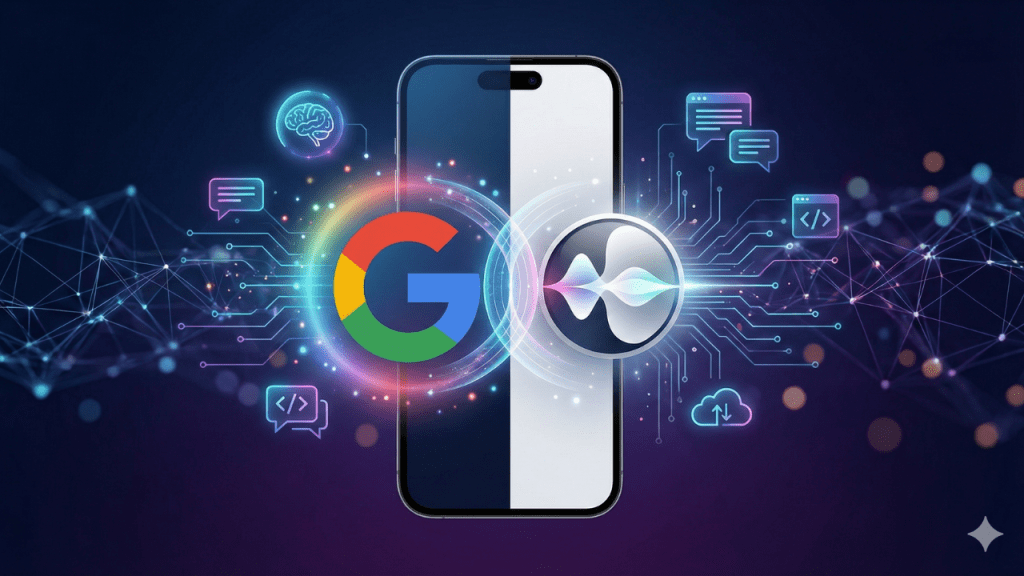
The artificial intelligence industry witnessed a seismic shift with the recent announcement that Google Gemini will become the foundational AI model powering the next generation of Apple’s Siri. This partnership between two of the world’s most influential technology companies represents more than just a business collaboration—it signals a potential transformation in the AI competitive landscape that could position Alphabet as the undisputed leader in artificial intelligence.
The Strategic Partnership That Changes Everything
The collaboration between Alphabet and Apple marks a dramatic turn in the AI narrative. Just a few years ago, Alphabet appeared to be trailing behind OpenAI following the explosive launch of ChatGPT. The search giant seemed caught off guard by the rapid consumer adoption of conversational AI. However, this new partnership demonstrates how quickly fortunes can change in the technology sector.
According to market data from January 20, 2026, Alphabet’s stock (NASDAQ: GOOG) is trading at $322.20 with a market capitalization of $4.0 trillion, reflecting investor confidence in the company’s AI strategy. Apple (NASDAQ: AAPL) stands at $246.12, and while both stocks experienced some decline on the announcement day—with Alphabet down 2.46% and Apple down 3.68%—the long-term implications of this partnership could be transformative for both companies.
While specific financial terms remain undisclosed, industry reports suggest the collaboration could generate billions of dollars in revenue for Alphabet over the coming years. The agreement is structured as a cloud computing partnership, with Apple’s foundational AI models leveraging both Gemini and Google’s cloud infrastructure.
Apple’s AI Struggles Created an Unprecedented Opportunity
To understand the significance of this partnership, we need to examine Apple’s position in the AI race. The company’s virtual assistant Siri has been a source of frustration for users and investors alike for years. When ChatGPT launched and quickly gained mainstream adoption, it exposed just how far behind Apple had fallen in AI development.
The company announced its Apple Intelligence features with much fanfare, promising to bring advanced AI capabilities to iPhone users. However, these features faced multiple delays, disappointing both consumers and the investment community. Apple initially attempted to address its AI shortcomings by partnering with OpenAI, allowing Siri to redirect complex queries to ChatGPT when unable to handle them independently.
This stopgap solution proved insufficient for several reasons. Reports indicate that OpenAI was not interested in remaining Apple’s primary AI partner long-term, as the company pursues its own hardware ambitions and seeks to build direct relationships with consumers rather than operating as a backend service provider for other platforms.
The result is a comprehensive redesign of Siri that will offer iPhone users a more personalized, capable virtual assistant powered by Google Gemini. This represents a complete reversal from Apple’s traditional approach of building core technologies in-house, highlighting just how critical the company views advanced AI capabilities for its future competitiveness.
Gemini’s Rapid Ascent in the AI Market
Google Gemini has experienced remarkable growth in recent months, demonstrating the kind of user adoption that validates Alphabet’s massive investments in artificial intelligence. Current data shows Gemini has surpassed 650 million monthly active users, up substantially from approximately 450 million just six months earlier. This 44% increase in half a year represents one of the fastest adoption rates for any AI product in history.
The AI model already powers numerous Google services, most notably Google Search, which processes 2 billion monthly queries through its AI Mode. This integration demonstrates how Gemini is being woven into the fabric of Google’s existing product ecosystem, creating multiple touchpoints with users and reinforcing the model’s capabilities through continuous real-world usage.
Gemini’s presence extends across hundreds of Android phone models worldwide. With Android commanding an installed base measured in billions of devices globally, the potential audience for Gemini as a primary AI agent is staggering. Users across diverse geographic markets and economic segments are increasingly encountering Gemini as their default AI interface, creating powerful network effects and data advantages for continued model improvement.
The Scale Advantage: Billions of Devices Running Gemini
The true strategic value of the Apple partnership becomes clear when considering device distribution at scale. Apple’s iOS ecosystem encompasses more than 1 billion active devices worldwide, representing some of the most engaged and economically valuable users in technology. These users tend to be early adopters of new features, heavy app users, and willing to pay for premium services.
When combined with Android’s multi-billion device installed base, Gemini will potentially become the default AI model on a majority of smartphones globally. This ubiquity creates a fundamentally different competitive dynamic than the current AI landscape, where users must actively download and engage with specific AI applications.
The convenience factor cannot be overstated. If Gemini is already integrated into both Android and iOS devices as the underlying intelligence powering virtual assistants and other AI-enhanced features, the friction preventing users from trying competing AI services drops dramatically. Why download and learn a separate AI chatbot when your phone already has advanced AI capabilities built in?
This positioning directly challenges OpenAI’s current market leadership. While ChatGPT boasts approximately 900 million weekly active users—a remarkable achievement—this user base requires active engagement with a standalone application or website. Gemini’s integration into the operating system level of billions of devices creates passive exposure and usage opportunities that could eventually translate into dominant market share.
Cloud Computing Revenue: The Financial Engine
Beyond user metrics and market positioning, the Apple partnership has significant implications for Alphabet’s cloud computing business, which has become an increasingly important revenue driver. In the third quarter preceding this announcement, Alphabet’s cloud division generated over $15 billion in revenue, representing 34% year-over-year growth.
The structure of the Apple agreement as a cloud computing partnership positions this revenue stream for further acceleration. As Apple’s foundation AI models run on Google’s cloud infrastructure, every Siri interaction on iOS devices potentially generates cloud computing revenue for Alphabet. Given the billions of iOS devices in use and the frequency with which users interact with virtual assistants, the cumulative revenue impact could be substantial.
Financial analysts from various institutions have suggested the multi-year agreement could deliver billions of dollars to Alphabet, though exact figures remain speculative without official disclosure from either company. The Financial Times reported on the cloud computing structure of the deal, emphasizing how this arrangement benefits Alphabet’s fastest-growing business segment while simultaneously addressing Apple’s AI deficiencies.
This dual revenue model—combining potential subscription revenue from Gemini Advanced users with cloud infrastructure fees from Apple—creates multiple paths for monetization. It also reduces dependence on advertising revenue, diversifying Alphabet’s business model in ways that could appeal to investors seeking more balanced revenue streams.
Competitive Implications for OpenAI and Microsoft
The Alphabet-Apple partnership reshapes the competitive landscape in ways that extend beyond these two companies. OpenAI, despite its current user base leadership, faces a more challenging path to maintaining dominance. The company’s strategy has relied heavily on ChatGPT’s first-mover advantage and superior capabilities compared to early alternatives.
However, as Google’s AI models have improved—with Gemini demonstrating capabilities competitive with or exceeding ChatGPT in various benchmarks—the differentiation has narrowed. If users can access comparable AI capabilities through their device’s native interface, OpenAI must work harder to justify the additional friction of using a separate service.
Microsoft’s significant investment in OpenAI and integration of ChatGPT into its products adds another dimension to this competition. The partnership between Microsoft and OpenAI mirrors the Alphabet-Apple collaboration in some ways, but with key differences. Microsoft lacks the mobile device presence that Apple and Google command, limiting its ability to make AI ubiquitous in users’ daily lives through smartphone integration.
The enterprise market remains a battleground where Microsoft maintains advantages through its dominant position in productivity software and business infrastructure. However, as consumer AI preferences solidify around models integrated into mobile ecosystems, these preferences could eventually influence enterprise adoption patterns as well.
Investment Considerations and Market Outlook
For investors evaluating Alphabet’s prospects, this partnership represents a validation of the company’s AI strategy after years of substantial investment. The company has poured billions of dollars into AI research, infrastructure, and talent acquisition. Seeing these investments translate into a partnership with Apple—a company notorious for its selective approach to technology partnerships—signals market recognition of Gemini’s capabilities.
Several factors warrant monitoring as this partnership develops. First, adoption metrics for the Gemini-powered Siri will indicate whether users embrace the enhanced capabilities or remain skeptical given Siri’s historical limitations. Apple’s brand strength could drive rapid adoption, but user expectations will be high given the years of disappointment with previous iterations.
Second, the financial terms and revenue recognition from this partnership will eventually become clearer through Alphabet’s quarterly earnings reports. Investors should watch for commentary on cloud computing growth specifically attributed to strategic partnerships, as well as any disclosure about Gemini’s contribution to overall revenue.
Third, competitive responses from OpenAI, Microsoft, Amazon, and other AI players will shape the market dynamics. These companies will not passively accept a potential Alphabet-Apple dominance and will likely announce partnerships, product enhancements, or strategic initiatives designed to counter this collaboration.
Fourth, regulatory scrutiny could emerge as a factor. Both Alphabet and Apple face ongoing antitrust examinations in various jurisdictions. A partnership that potentially consolidates AI market power across the two most popular mobile operating systems might attract attention from competition authorities, particularly in the European Union where regulatory oversight of big tech remains aggressive.
The Broader AI Market Transformation
This partnership reflects broader trends in the AI industry’s evolution. The initial phase of the generative AI era was characterized by standalone applications and direct consumer relationships. Companies like OpenAI built user bases by offering capable AI chatbots accessible through web browsers and mobile apps.
The next phase appears to be integration and infrastructure, where AI capabilities become embedded into existing platforms and operating systems rather than existing as separate experiences. This shift favors companies with established platform positions—like Google with Android and now Apple through partnership—over pure-play AI companies that lack these distribution advantages.
The importance of compute infrastructure also becomes more apparent. Training and running large language models requires massive computational resources, favoring companies with extensive cloud infrastructure. Alphabet’s cloud capabilities not only support its own AI development but now also serve as the foundation for Apple’s AI ambitions, creating a mutually reinforcing advantage.
Data advantages compound over time in AI development. As Gemini processes billions of queries across Android and iOS devices, the model gains exposure to diverse use cases, languages, and user intents. This data helps refine the model’s capabilities in ways that smaller competitors cannot match, potentially creating a widening capability gap over time.
Looking Ahead: The Path to AI Leadership
Alphabet’s journey from apparent AI laggard to potential industry leader demonstrates how quickly competitive positions can shift in emerging technology markets. The company’s fundamental strengths—search expertise, cloud infrastructure, research capabilities, and now platform partnerships—position it well for the AI era.
The collaboration with Apple removes one of the major uncertainties that has shadowed Alphabet’s AI strategy: distribution and adoption. While Gemini was growing rapidly, questions remained about whether it could achieve the ubiquity necessary to generate economic returns commensurate with the massive investments required. The Apple partnership provides a clear path to billions of users, potentially accelerating the timeline to AI profitability.
For Apple, the partnership represents a pragmatic recognition that building world-class AI capabilities in-house would require years of effort and uncertain outcomes. By partnering with Alphabet, the company can quickly enhance Siri’s capabilities and meet user expectations for AI-powered features, buying time to develop longer-term AI strategies.
The broader technology industry will be watching this collaboration closely as a potential template for how established platform companies navigate the AI transition. Rather than every company building complete AI stacks independently—an enormously expensive and duplicative approach—strategic partnerships may enable faster innovation and better user experiences.
Conclusion: A New Chapter in AI Competition
The announcement that Google Gemini will power the next generation of Apple’s Siri represents far more than a typical technology partnership. It signals a potential inflection point in the AI industry, where distribution, infrastructure, and integration matter as much as raw model capabilities.
Alphabet appears positioned to leverage this partnership into AI market leadership, combining Gemini’s growing capabilities with unprecedented device distribution spanning both Android and iOS ecosystems. The financial implications, both in direct revenue from the partnership and indirect benefits to cloud computing and other services, could be substantial.
However, challenges remain. Execution will be critical—users must embrace the enhanced Siri and find value in Gemini-powered features. Competitors will respond with their own strategic initiatives. Regulatory scrutiny may intensify. And the technology itself continues evolving rapidly, with no guarantee that today’s leading models will maintain their positions.
What seems clear is that Alphabet has transformed its AI narrative from laggard to leader in a remarkably short time. The company that seemed caught off guard by ChatGPT has responded with investments, innovations, and now partnerships that position it at the center of the AI revolution. For investors, technology enthusiasts, and anyone interested in the future of artificial intelligence, this partnership between Alphabet and Apple will be worth watching closely as it unfolds in the months and years ahead.
The AI race is far from over, but with Gemini potentially powering billions of devices across competing mobile ecosystems, Alphabet has positioned itself with advantages that will be difficult for competitors to overcome. The question is no longer whether Alphabet can compete in AI, but rather whether anyone can prevent it from dominating.
Want to actually take action instead of just reading?
Most people understand what they should do with money — the problem is execution. That’s why I created The $1,000 Money Recovery Checklist.
It’s a simple, step-by-step checklist that shows you:
and how to start building your first $1,000 emergency fund without overwhelm.
- where your money is leaking,
- what to cut or renegotiate first,
- how to protect your savings,
- and how to start building your first $1,000 emergency fund without overwhelm.
No theory. No motivation talk. Just clear actions you can apply today.
If you want a practical next step after this article, click the button below and get instant access.
>Get The $1,000 Money Recovery Checklist<
 Wealth Engine
Leave a comment