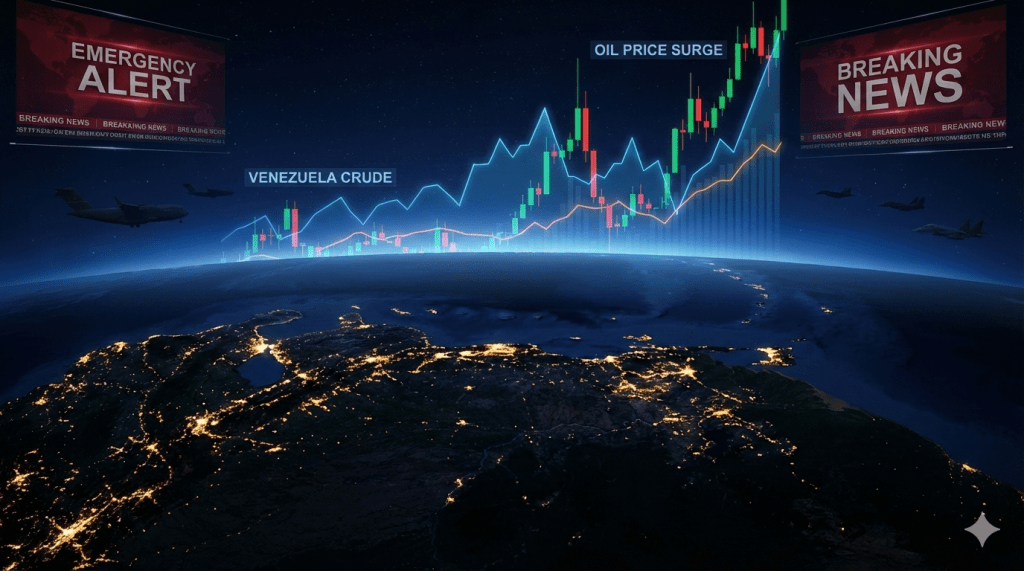
A Sitting President. A Military Operation. And Markets That Will Never Be The Same.
Yesterday at 2:03 AM Venezuelan time, the impossible became real.
Over 150 U.S. military aircraft descended on Venezuela in what Pentagon officials are calling “Operation Absolute Resolve.” Delta Force operators stormed the presidential palace in Caracas. By sunrise, Nicolás Maduro—a sitting head of state—was in U.S. custody aboard the USS Iwo Jima, headed for a Brooklyn federal courthouse.
This wasn’t a covert extraction. This wasn’t a negotiated surrender. This was the United States executing the most audacious military operation against a foreign leader since Manuel Noriega in 1989.
And if you’re an investor, a trader, or anyone with exposure to emerging markets, energy, or Latin American assets—everything just changed.
What We Know Right Now (The Facts, No Speculation)
Let’s cut through the noise. Here’s what’s been officially confirmed in the last 24 hours:
The Operation Itself: Over 150 aircraft participated in a coordinated strike that overwhelmed Venezuelan air defenses. Special operations forces secured the presidential palace while Maduro was reportedly in residence. The entire operation lasted under 90 minutes from initial contact to extraction.
Current Status: Maduro is in U.S. custody and has been transported to New York. The Department of Justice has unsealed multiple indictments related to drug trafficking, corruption, and crimes against humanity that have been prepared for years.
Immediate Market Response: Within the first trading hours after news broke, crude oil futures spiked 4.2% on supply concerns. Venezuelan sovereign bonds plunged toward distress pricing. Emerging market credit spreads widened across Latin America. The U.S. dollar surged as global investors fled to safety.
International Reaction: Mixed. Some Latin American governments have condemned the action as a violation of sovereignty. Others have remained conspicuously silent. Spain has issued formal diplomatic protests. Meanwhile, the U.S. has indicated it will work with “democratic forces” inside Venezuela to establish a transitional government.
Why This Matters More Than Any Other Geopolitical Event This Decade
Here’s the brutal truth: Venezuela sits on the world’s largest proven oil reserves. Larger than Saudi Arabia. Larger than Russia.
For years, those reserves have been effectively offline—locked away by mismanagement, corruption, and international sanctions. Venezuelan production has collapsed from 3 million barrels per day to barely 700,000.
Now, suddenly, there’s a scenario where Western energy companies could gain legal access to those assets. Where sanctioned oil could flow again under international oversight. Where one of the world’s great petroleum prizes becomes available for the first time in over a decade.
That’s why oil traders are scrambling right now. That’s why every emerging market desk on Wall Street canceled their weekend plans. That’s why your portfolio just got a lot more complicated.
The Three Scenarios Every Investor Must Understand
Market strategists are converging on three realistic paths forward. Your investment decisions in the next 72 hours should account for all three.
Scenario A: Managed Transition (Base Case—55% Probability)
In this scenario, the U.S. and international allies facilitate a transitional government in Venezuela. The Organization of American States provides legitimacy. Conditional licensing allows Venezuelan oil to return to global markets under strict oversight.
What happens: The initial oil price spike fades within 2-3 weeks as markets realize supply will gradually normalize. Venezuelan debt remains in default but begins restructuring negotiations. Major Western energy companies start preliminary talks about operational agreements.
Investment implications: Short-lived volatility creates buying opportunities in quality emerging market assets that sold off in the panic. Energy service companies with international experience become attractive. Commodity positions should be staged gradually as the situation stabilizes.
What to watch: Official U.S. Treasury guidance on licensing. IMF/World Bank technical missions to Caracas. Statements from Chevron and other majors about operational readiness.
Scenario B: Prolonged Instability (Downside Tail—30% Probability)
The power vacuum triggers internal conflict. Venezuelan military factions split. Neighboring countries close borders. Humanitarian crisis deepens. International sanctions remain or intensify. Oil infrastructure suffers additional damage or sabotage.
What happens: Oil volatility persists for months. Emerging market assets face sustained selling pressure. Regional currencies weaken significantly. Gold and U.S. Treasuries surge as safe havens. No institutional capital flows into Venezuelan reconstruction for 12-18 months.
Investment implications: Defense wins. Raise cash significantly. Increase allocations to volatility hedges, gold, and dollar-denominated quality assets. Avoid all Latin American credit except the highest quality. Short or hedge existing EM equity positions.
What to watch: Military movements inside Venezuela. Refugee flows into Colombia and Brazil. UN Security Council debates. Any reports of infrastructure attacks or oil field sabotage.
Scenario C: Rapid Reconstruction (Bull Case—15% Probability)
The U.S. moves with unexpected speed to establish a friendly transitional government. Major energy companies receive expedited licensing. International capital mobilizes quickly for reconstruction. Venezuelan oil production recovers faster than anyone expects.
What happens: After an initial spike, oil prices actually decline as markets price in significant new supply hitting the market within 12-18 months. Energy service contractors see explosive growth. Venezuelan bonds stage a dramatic recovery. Regional markets boom on reduced uncertainty.
Investment implications: Energy service companies and oilfield contractors become the trade of the decade. Selective exposure to reconstructed Venezuelan corporate debt after legal clarity. Regional banks and infrastructure plays benefit from stabilization. Commodity positions should be trimmed or hedged.
What to watch: Major announcements from Halliburton, Schlumberger, or similar contractors. Fast-track OFAC licensing decisions. World Bank reconstruction funding commitments. Statements about timelines from U.S. Energy Secretary.
Your 72-Hour Tactical Playbook (What To Do Right Now)
Time matters in situations like this. The investors who act decisively in the next three days will be positioned differently than those who wait and watch. Here’s your move-by-move guide:
Immediate Actions (Next 24 Hours)
Hedge your EM exposure. If you have meaningful exposure to emerging market equities or credit, now is the time to add downside protection. Short-dated put options on EM ETFs are relatively cheap right now. Don’t wait for volatility to spike further.
Raise quality in fixed income portfolios. This is not the environment for yield chasing. Trim speculative credit. Reduce exposure to weaker Latin American sovereigns. Rotate into U.S. Treasuries, investment-grade corporate bonds, or high-quality municipal debt.
Do NOT bottom-fish Venezuelan bonds yet. I know the discounts look tempting. Sovereign debt trading at 15 cents on the dollar seems like a gift. It’s not. Not yet. Legal recognition of existing debt is completely unclear. Creditor hierarchies are undefined. You could be buying bonds that get restructured into worthlessness or years of litigation.
Stage commodity positions carefully. If you want crude oil exposure (and the case for it is reasonable), do not chase the current spike. Set technical levels. Use dollar-cost averaging. Plan for 3-4 entry points over the next two weeks. Volatility will give you better prices.
Medium-Term Positioning (Next 2-4 Weeks)
Watch DOJ filings obsessively. Every legal filing, every indictment update, every statement from the U.S. Attorney’s office will provide crucial signals about how the U.S. plans to handle Venezuelan assets, creditors, and reconstruction. These documents will tell you when institutional capital can legally flow back in.
Monitor OFAC licensing guidance. The Office of Foreign Assets Control at the Treasury Department will issue specific licenses that determine who can legally do business with Venezuelan entities. The first companies to receive licenses will have enormous first-mover advantages.
Track multilateral institution activity. IMF technical missions. World Bank assessment teams. Inter-American Development Bank statements. These organizations move slowly, but when they mobilize, they signal that serious reconstruction capital is coming.
Build your watch list now. Research energy service contractors with Latin American experience. Identify regional banks with Venezuelan exposure that are currently oversold. Know which commodity producers have the operational capability to enter Venezuela quickly if licensing permits. Have your positions ready to deploy when conditions clarify.
The Signals That Will Tell You Which Scenario Is Playing Out
Markets hate uncertainty. They hate it more than they hate bad news. Right now, we’re in maximum uncertainty. The scenario that ultimately plays out will reveal itself through specific signals. Here’s what to watch:
Official U.S. policy announcements on Venezuelan oil exports. If the State Department or Treasury issues guidance about licensing within 7-10 days, that signals Scenario A (managed transition). If we hear nothing for weeks, that suggests Scenario B (prolonged instability).
Venezuelan military unity or fracture. If senior military officials quickly recognize a transitional government, stability becomes more likely. If we see reports of military commanders refusing orders or controlling different regions, instability is here.
International diplomatic recognition. Count how many countries formally recognize whatever transitional authority emerges. If the number hits 30-40 within two weeks, markets will price in legitimacy. If recognition remains contested and slow, risk stays elevated.
Oil infrastructure status reports. Any news about the operational status of Venezuelan refineries, ports, and oil fields will be critical. Sabotage, strikes, or infrastructure collapse extends the crisis. Rapid securing of facilities by U.S.-backed forces signals faster normalization.
Creditor committee formation. If major international banks and bondholders quickly form a coordinated creditor committee to negotiate restructuring, that’s bullish for eventual debt recovery. If creditors fragment into competing groups or litigation, it’s bearish for years.
Why This Is Different From Every Other LatAm Crisis
I’ve covered emerging market volatility for over a decade. Currency crises. Sovereign defaults. Political upheavals. Commodity crashes. I’ve seen it all.
This is different.
This isn’t a country mismanaging its economy into crisis. This isn’t a populist leader getting voted out. This isn’t even a military coup.
This is the world’s largest oil reserves suddenly, dramatically, coming back into play. This is a geopolitical chessboard getting flipped over. This is every energy strategy, every LatAm allocation, every commodity thesis getting stress-tested in real time.
The investors who understand this—who recognize that we’re in a genuine regime change, not just another bout of volatility—will be positioned for the opportunities that emerge.
The investors who treat this like just another dip to buy or another headline to ignore will get run over.
The Uncomfortable Truth About Tail Risk
Here’s what nobody wants to admit: events like this are exactly why we talk about “tail risk” in portfolio theory. They’re the scenarios that sit out in the improbable edges of the distribution curve. The events we intellectually acknowledge but emotionally discount.
Until they happen.
Yesterday morning, the probability of a U.S. military operation to capture a sitting foreign president was functionally zero in most analysts’ models. Today, it’s historical fact.
That’s the nature of tail events. They seem impossible until they’re inevitable. They seem unthinkable until they’re on CNBC.
The question isn’t whether you predicted this specific event. Nobody did. The question is whether your portfolio can survive and adapt when the impossible becomes real.
Final Thoughts: Act Decisively, But Act Smart
Look, I’m not going to pretend I have all the answers here. Nobody does. This situation is evolving in real time, and some of the most important developments haven’t happened yet.
But here’s what I know for certain: the investors who will come out ahead aren’t the ones with perfect information. They’re the ones who understand the scenarios, respect the risk, and position accordingly.
That means hedging what needs to be hedged. Raising quality where appropriate. Staging positions to take advantage of opportunities without overcommitting to any single outcome.
It means staying disciplined when markets are screaming. It means doing the boring work of reading DOJ filings and OFAC guidance while everyone else is arguing on Twitter about geopolitics.
Most importantly, it means recognizing that this is one of those moments—rare, uncomfortable, consequential—when the investment landscape shifts beneath our feet.
The markets tomorrow won’t look like the markets yesterday. Your portfolio strategy tomorrow shouldn’t look like your strategy yesterday either.
Welcome to the new normal. Let’s navigate it together.
Want to actually take action instead of just reading?
Most people understand what they should do with money — the problem is execution. That’s why I created The $1,000 Money Recovery Checklist.
It’s a simple, step-by-step checklist that shows you:
and how to start building your first $1,000 emergency fund without overwhelm.
- where your money is leaking,
- what to cut or renegotiate first,
- how to protect your savings,
- and how to start building your first $1,000 emergency fund without overwhelm.
No theory. No motivation talk. Just clear actions you can apply today.
If you want a practical next step after this article, click the button below and get instant access.
👉 Get The $1,000 Money Recovery Checklist
A legal and execution caution: This analysis is for educational and informational purposes. Nothing here constitutes financial advice, and every investment situation is unique. Consult with licensed financial advisors, legal counsel, and compliance teams before executing any trades, especially in situations involving international sanctions, emerging market assets, or distressed debt. The legal and operational risks in Venezuelan-related investments are substantial and may exceed the potential returns for most investors.
 Wealth Engine
Leave a comment