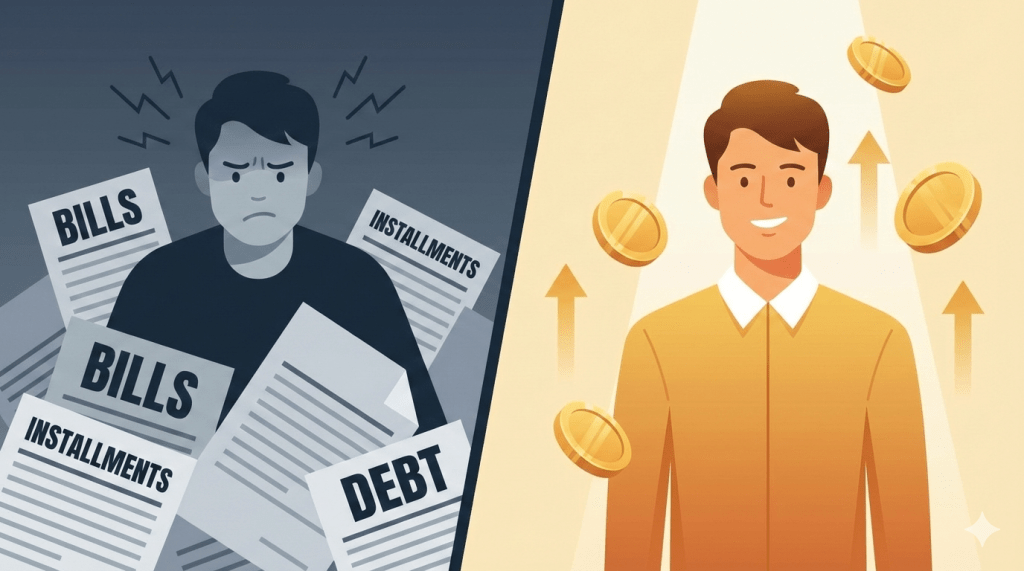
And why everyone thinks they’re doing it right
You work hard. Wake up early, meet your obligations, pay your bills on time. On paper, you’re doing everything “right.” But when you look at your bank account at the end of the month, that uncomfortable feeling returns: where did all the money go?
Here’s the brutal truth: You’re not poor because you earn too little. You’re poor because you have poor people’s habits.
And the worst part? These habits are considered completely “normal” by society. They’re the same ones your parents had, your friends have, that the media glorifies. They’re so common you don’t even realize they’re silently sabotaging your financial life.
Today I’m going to expose the 5 financial habits that seem harmless but are keeping you in the same place year after year. And more importantly, I’ll show you exactly what to do to change this game.
Brace yourself. Some of these truths are going to hurt.
Habit #1: “I’ll Save Whatever’s Left at the End of the Month”
This is probably the most common and most destructive habit of all. Let me guess your financial strategy: you receive your salary, pay the bills, make your monthly expenses and, if there’s anything left over, you save it. Right?
Wrong. Completely wrong.
Know how many times money actually “is left over” at the end of the month with this strategy? Almost never. And it’s not a coincidence. It’s pure mathematics combined with behavioral psychology.
Why This Doesn’t Work
When you decide to save “whatever’s left,” you’re telling your brain that saving is optional. It’s the last item on the priority list. And here’s the problem: expenses always expand to fill available income. It’s Parkinson’s Law applied to personal finances.
Made $3,000? You’ll spend $3,000. Got a raise and now make $5,000? You’ll magically find ways to spend $5,000. That restaurant that was “too expensive” suddenly becomes “reasonable.” That trip that “wasn’t possible” now “fits the budget.”
Let me show you a real example:
John makes $4,500 per month:
- Rent: $1,200
- Utilities (electric, water, internet): $400
- Groceries: $800
- Transportation: $500
- Entertainment/Restaurants: $600
- Clothes and miscellaneous: $500
- “Small expenses”: $500
Total: $4,500. Zero left over.
Is John doing something wrong? In his view, no. He’s paying his bills, not buying extravagant things, just “living normally.”
But here’s the truth nobody tells you: the rich do exactly the opposite.
What the Rich Do Differently
Warren Buffett, one of the richest men in the world, has a famous quote: “Do not save what is left after spending; spend what is left after saving.”
Sounds like wordplay, but it’s a financial revolution.
The rich pay themselves FIRST. Before rent. Before groceries. Before anything else. They treat savings as a non-negotiable bill, as if it were the most important payment of the month.
Here’s what John’s life would look like using this strategy:
John 2.0 makes $4,500 per month:
- INVESTMENT (20%): $900 ← FIRST
- Rent: $1,200
- Utilities: $350 (renegotiated internet)
- Groceries: $700 (started meal planning)
- Transportation: $450 (found carpool options)
- Entertainment: $500 (cut excess, maintained quality)
- Miscellaneous: $400
Total: $4,500. Still balances, but now with $900/month invested.
“But I can’t cut anything!” Yes, you can. You’ve just never had a strong enough reason. When saving becomes a priority, you get creative.
The Math That Will Shock You
$900 per month seems like little? Let’s do the math:
- In 1 year: $10,800 saved
- In 5 years with 10% annual interest: $69,629
- In 10 years: $175,704
- In 20 years: $618,660
Yes. Over HALF A MILLION dollars just by prioritizing savings before expenses.
What if you start with $300? In 20 years you’ll still have $206,220. It’s the difference between having a dignified retirement or depending on children and government.
The action: Tomorrow, when you receive your next paycheck, transfer 10-20% to an investment account BEFORE anything else. Treat this as a bill that cannot be late. Because it can’t.
Habit #2: “Small Expenses Don’t Make a Difference”
“It’s just a coffee.” “It’s only $15, it won’t make me rich.” “Everyone eats out once in a while.”
Sound familiar? They should. These are the most common justifications for small daily expenses that, alone, really don’t make a difference. But here’s the problem: they’re never alone.
The Latte Effect
There’s a concept in personal finance called the “Latte Effect,” coined by author David Bach. The idea is simple: small daily expenses, when added up over time, represent fortunes.
Let’s do an exercise. Grab paper and pen (or open your phone notes) and let’s add up your “insignificant expenses”:
Typical workday:
- Coffee at the café: $12
- Morning snack: $8
- Lunch: $25
- Afternoon coffee: $6
- Uber because “it was raining”: $15
- Beer after work: $20
Daily total: $86
“But I don’t do this every day!” Okay, let’s be generous. Let’s say you do this 15 days per month (weekdays only).
$86 x 15 days = $1,290 per month $1,290 x 12 months = $15,480 per year
Almost $16,000 per year on “insignificant expenses.”
And here comes the part that hurts: if you invested that $1,290 per month at 10% annually:
- In 10 years: $252,432
- In 20 years: $887,251
- In 30 years: $2,470,387
Yes, you read that right. Two and a half million dollars. At the cost of “insignificant” coffees, snacks and ubers.
The False Economy of “I Deserve It”
“But I work hard! I deserve a decent coffee!”
Of course you deserve it. Nobody’s saying you should live like a monk. The question isn’t IF you deserve it, but HOW MUCH it’s costing relative to your future.
Are you working to live today or to build freedom tomorrow? Because these small expenses are, literally, your future being consumed in the present.
Think of it this way: every $10 you spend today is $100 you won’t have in 20 years (with compound interest). Every $15 coffee is $150 of future. Every $20 uber is $200 of your retirement.
Still think it’s insignificant?
What to Do (Without Becoming Miserable)
I’m not saying cut ALL small pleasures. I’m saying be CONSCIOUS about them.
Practical strategy:
- Record ALL expenses for 30 days. All of them. Apps like Mint or YNAB help.
- Identify patterns. Which category is bleeding money?
- Establish limits. Example: $200/month for coffees and snacks. Done? Bring from home.
- Automate alternatives. Buy good coffee and a thermos. Costs $150 once and saves $300/month.
The difference between rich and poor isn’t in the big expenses. It’s in the small ones, repeated a thousand times.
Habit #3: “Hard Work = More Money”
This is capitalism’s best-told lie. Since childhood they taught you: study, work hard, be dedicated and you’ll get rich.
Lie.
Look around you. Who works harder: the construction worker who gets up at 5am or the businessman who wakes at 9am? The nurse doing three shifts or the investor playing golf on Wednesdays?
Hard work doesn’t make you rich. SMART work makes you rich.
The Time x Money Trap
When you have a traditional job, you’re trapped in a fatal equation: Money = Hours Worked x Hourly Rate
This equation has a natural ceiling. You only have 24 hours in a day. Even if you worked all of them (which is impossible), there’s a maximum limit to how much you can earn.
The rich understand a different equation: Money = Value Created x Scalability
See the difference:
Time x Money Model:
- You work 8 hours = earn $200
- Work 16 hours = earn $400
- Don’t work = earn $0
- Get sick = earn $0
- Take vacation = earn $0
Value x Scalability Model:
- You create a product once = sell infinitely
- You build a system = works without you
- You invest in assets = generate passive income
- You don’t work = keep earning
- Get sick = keep earning
- Take vacation = keep earning
Practical Examples
Maria is a traditional graphic designer:
- Charges $500 per logo
- Makes 20 logos per month
- Earns $10,000/month
- To earn more, needs to work more hours
Ana is also a designer, but thinks differently:
- Created an online design course: $197
- Sold to 100 people: $19,700
- Created logo templates: $29 each
- Sold 300 templates: $8,700
- Earns $28,400 with no hourly limit
Same profession. Different mindsets. Completely opposite results.
The 4 Money Quadrants
Robert Kiyosaki, in “Rich Dad Poor Dad,” divides people into 4 quadrants:
- E (Employee): Trades time for money. Security in exchange for freedom.
- S (Self-employed): Owns their business, but still trades time for money. More freedom, but no scalability.
- B (Business owner): Has systems that work without them. Free time + money.
- I (Investor): Money working to generate more money. Total freedom.
Most people spend their entire lives in quadrant E, complaining they work hard and earn little. And they’re right! But they don’t realize the problem isn’t how much they work, it’s HOW they work.
How to Escape the Trap
Short Term (still employed):
- Develop skills that pay more (programming, digital marketing, sales)
- Seek promotions or strategic job changes
- Negotiate raises based on results, not time
Medium Term:
- Create parallel income sources (freelancing, info-products, affiliates)
- Start investing part of income (even if little)
- Build something that can be sold without your constant presence
Long Term:
- Transition from quadrant E to S, then to B
- Accumulate assets that generate passive income
- Reinvest profits to accelerate growth
The hard truth: you’ll NEVER get rich selling your time. But you can get rich selling your value multiplied by systems.
Habit #4: “I’ll Invest When I Earn More”
“When I make $5,000, then I’ll start investing.” “I’ll wait to receive that extra money to start.” “Not now, when things improve I’ll start.”
This is the favorite phrase of people who will die poor. Sorry for the harshness, but it’s the truth.
Know when you’ll start investing while waiting to “earn more”? Never.
Why You’ll Never Start
There’s a psychological phenomenon called “lifestyle inflation.” It works like this:
- You earn $2,000: “It’s tough, when I make $3,000 I’ll save”
- Get a raise, now make $3,000: “Now I have more bills, when I make $5,000 I’ll save”
- Another raise, $5,000: “I need a better car, when I make $8,000 I’ll save”
- And so on, until you’re making $20,000 and still investing nothing
The problem isn’t how much you earn. It’s your mindset about money.
Poor people wait to have money to start investing. Rich people invest to have money.
The Truth About Starting
Know how much you need to start investing? $50.
No, I’m not joking. With $50 you can:
- Buy fractional shares
- Invest in REITs
- Start with Treasury bonds
- Enter some ETFs
“But $50 won’t make me rich!” You’re right. But know what $50 does? Creates the habit.
And habit is EVERYTHING.
The Power of Compound Habit
Let’s compare two real scenarios:
Peter, 25 years old, waits for “the right moment”:
- Ages 25-35: invests $0 (waiting to improve)
- Ages 35-55: invests $500/month
- Total invested: $120,000
- At 55, with 10% p.a.: $368,420
Carlos, 25 years old, starts small:
- Ages 25-30: invests $100/month
- Ages 30-35: invests $300/month
- Ages 35-55: invests $500/month
- Total invested: $132,000
- At 55, with 10% p.a.: $502,147
Carlos invested only $12,000 more, but ended up with $133k more than Peter. Why? Compound interest + time.
The earlier you start, the less you need to invest to reach the same place.
“But I Barely Have Enough for Bills”
If you truly don’t have even $50 left over per month, your problem isn’t investment. It’s management. Go back to Habit #1 and redo your priorities.
But in most cases, the truth is more uncomfortable: you HAVE the money. You’re just choosing to spend it on other things.
Netflix: $15 Spotify: $10 Delivery once a week: $80 Beer on weekends: $40
There. Found $145 to start investing.
“But that’s quality of life!” Is it? Or is it temporary comfort that’s killing your future quality of life?
How to Start TODAY
Not tomorrow. Not next month. TODAY.
- Open an account at a brokerage (Robinhood, Fidelity, Vanguard – any works)
- Transfer $50 (the price of one delivery)
- Buy anything: a piece of stock, a fund, doesn’t matter
- Done. You’re an investor.
Next week, another $50. Next month, try $100. In 6 months, maybe $200.
The amount doesn’t matter at first. The habit does.
Habit #5: “It’s Just a Small Installment”
Let me guess your purchase history:
- TV in 12 interest-free installments
- Phone in 10 interest-free installments
- Couch in 18 interest-free installments
- Online course in 6 interest-free installments
- Clothes in 3 interest-free installments
All “interest-free.” All with “small installments that fit the budget.” And at the end of the month you have 8 different bills and don’t know where your money went.
Welcome to the consumer industry’s biggest psychological hack.
The “Interest-Free” Illusion
First, let’s destroy a myth: there’s no free lunch. When the store offers “12 interest-free installments,” do you really think the retailer is being nice? Of course not.
The “interest” is already built into the price. That $3,000 TV in 12 installments? Cash probably goes for $2,400. You’re paying $600 in interest, they just don’t call it interest.
But the real problem isn’t even that. The problem is psychological.
The Mental Trick of Installments
Your brain processes like this:
Cash: $3,000 → “Wow, that’s too expensive, I can’t buy it”
12x of $250 → “Ah, just $250? I can manage that!”
But here’s the truth: you can’t afford either if you don’t have the $3,000.
The difference is that, with installments, you fool yourself into thinking you can. And then this happens:
- January: buy TV (12x $250)
- February: buy phone (10x $180)
- March: buy couch (18x $200)
- April: buy laptop (8x $280)
Suddenly, in May, you have:
- TV installment: $250
- Phone installment: $180
- Couch installment: $200
- Laptop installment: $280
- Total: $910 in installments
And that’s just in 4 months of “small installments.” Now multiply by a full year of consumption. Two TVs, three phones in the family, clothes, courses, subscriptions…
Congratulations. You now work to pay installments. Your salary is already committed before it even hits your account.
The Dark Mathematics
Let’s do a real calculation of how much installments are costing you:
Scenario A (you today):
- Income: $4,000/month
- Fixed installments: $1,200
- Free money: $2,800
- Ability to invest: $0 (there’s always something to installment)
Scenario B (if you stopped installments):
- Income: $4,000/month
- Installments: $0
- Free money: $4,000
- Investing the $1,200 that went to installments: In 10 years = $252,432
The difference between being poor and upper middle class is simply stopping installment buying.
The Demonic Power of Revolving Credit
Now let’s make it worse. You’ve installment-bought so much it doesn’t fit in the budget anymore. But an “unmissable opportunity” appears. What do you do?
Put it on the credit card without worrying. “I’ll pay later.”
Then the bill arrives: $2,500. You have $1,800. Pay the minimum ($500) and “revolve” the rest.
Congratulations, you’ve just entered financial hell.
Revolving credit charges between 10% and 15% interest PER MONTH. Not per year. Per month.
That $2,000 you revolved? In 6 months becomes $3,500. In 1 year, $6,000. You’ll pay THREE TIMES the original amount.
And the worst: while paying this debt, you can’t invest anything. The compound interest that could work IN YOUR FAVOR is working AGAINST you.
The Golden Rule
If you can’t buy it cash, you can’t buy it.
“But I’ll never be able to buy anything!” False. You will, it’ll just take a little longer. And you know what will happen while you wait?
- You’ll realize you didn’t need it that much
- Better and cheaper versions will appear
- You’ll find used/refurbished for half the price
- Your cash negotiating power is infinitely greater
And most importantly: you’ll be building wealth instead of destroying it.
How to Break the Cycle
If you’re already drowning in installments:
- Make a complete list: All installments, with amounts and end dates
- Freeze new installments: Nothing new enters until current ones are zeroed
- Accelerate what you can: If you get extra money, throw it at installments to shorten
- Prioritize those with interest: Credit card and store credit come first
- Celebrate each payoff: When an installment ends, transfer that amount to investments
In 12-18 months you’ll be free. And then, for the first time, you’ll taste what having real money feels like.
The Truth Nobody Wants to Hear
After all this, here comes the hard part. The part that will make you want to close this tab and pretend you didn’t read it.
You’re not poor by bad luck. You’re poor by choice.
Not because you consciously chose to be poor. But because every day you choose poor person habits instead of rich person habits.
Choose to spend before investing. Choose to ignore small leaks. Choose to trade time for money. Choose to wait for “the right moment.” Choose to installment everything.
And then complain that “the system is unfair,” that “the rich just get richer,” that “there’s no opportunity.”
There is. You’re just not taking advantage of it.
What to Do Now
Information without action is just entertainment. You read this far, which means something resonated. But now what?
Here’s your action plan for the next 30 days:
Week 1: Diagnosis
- Write down ALL expenses for 7 days
- Identify the 3 biggest leaks
- Calculate how much you’re paying in installments
Week 2: Reorganization
- Set up automatic transfer of 10% of salary to investments
- Cancel one unnecessary subscription
- Negotiate one bill (internet, phone, insurance)
Week 3: Execution
- Open investment account if you don’t have one
- Make first investment (even if $50)
- Start paying cash for everything new
Week 4: Consolidation
- Review progress
- Adjust what’s not working
- Plan next month with new habits
The Final Challenge
This post will change nothing in your life. Zero. You know why?
Because reading doesn’t change anything. Action changes.
99% of people who read this will do nothing. They’ll nod, think “interesting,” and continue with the same habits tomorrow.
Are you going to be part of the 99% or the 1%?
The 1% who, in 5 years, will look back and say: “Thank God I started that day.”
The choice, as always, is yours.
What habit hit you hardest? Comment below. And if this content helped you, share it with someone who needs to read this today.
Want to actually take action instead of just reading?
Most people understand what they should do with money — the problem is execution. That’s why I created The $1,000 Money Recovery Checklist.
It’s a simple, step-by-step checklist that shows you:
- where your money is leaking,
- what to cut or renegotiate first,
- how to protect your savings,
- and how to start building your first $1,000 emergency fund without overwhelm.
No theory. No motivation talk. Just clear actions you can apply today.
If you want a practical next step after this article, click the button below and get instant access.
 Wealth Engine
Leave a comment