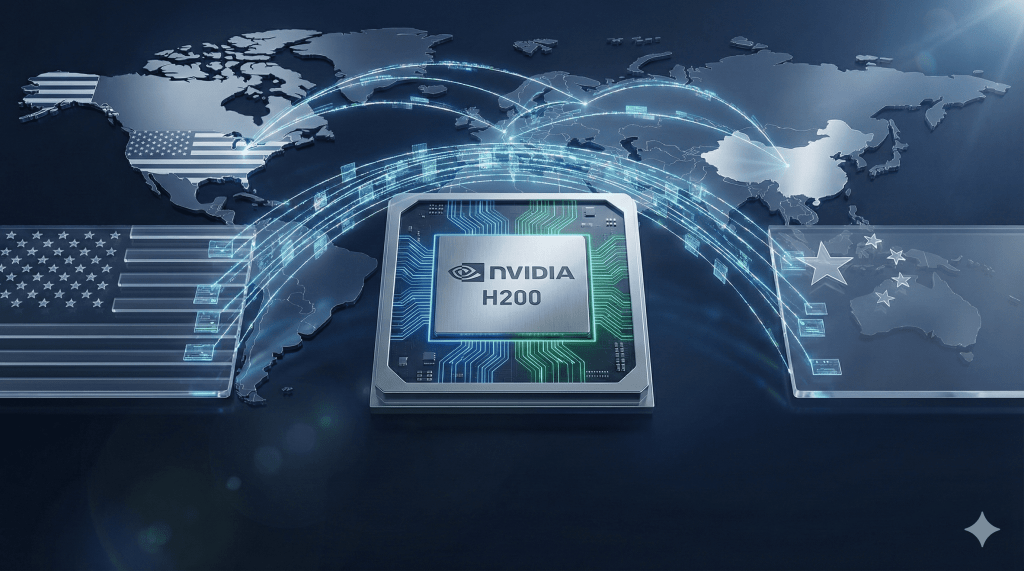
The semiconductor industry witnessed a significant policy shift as the Trump Administration announced the lifting of export restrictions on Nvidia’s H200 AI processors for sales to China. This decision marks a notable reversal in U.S.-China tech trade relations, though the ultimate impact remains uncertain due to potential regulatory constraints from Beijing.
Policy Change Details
The announcement came directly from President Trump via Truth Social, where he confirmed that approved customers in China would be permitted to purchase Nvidia’s H200 graphics processing units. The policy includes a notable provision: the U.S. government will receive a 25% share from each transaction. This revenue-sharing approach represents an unprecedented structure in semiconductor export policy.
The approval extends beyond Nvidia to include other American chip manufacturers such as Advanced Micro Devices and Intel. The Department of Commerce is currently finalizing the implementation framework for this new export arrangement.
Understanding the H200 Processor
The H200 represents part of Nvidia’s Hopper architecture series, designed specifically for artificial intelligence workloads. These processors excel at handling the massive computational requirements of machine learning models, data center operations, and AI training applications. The H200 offers substantial improvements over previous generations in memory bandwidth and processing capabilities.
However, it’s important to note that newer architectures have already succeeded the H200. Nvidia’s Blackwell chips are currently available, with the Rubin processor line scheduled for upcoming release. These next-generation products were explicitly excluded from the current export approval, suggesting a strategic approach to technology transfer and competitive positioning.
Nvidia’s Official Response
The company issued a statement welcoming the policy change, emphasizing the importance of allowing American chip manufacturers to compete in global markets. Nvidia highlighted that the arrangement to sell H200 processors to vetted commercial customers represents a balanced approach that serves American economic interests while maintaining appropriate oversight through Department of Commerce screening processes.
The company framed the decision as supporting domestic job creation and manufacturing capabilities, aligning with broader “America First” economic policies.
Chinese Regulatory Landscape
Despite the U.S. approval, significant obstacles may limit the practical impact of this policy change. Reports indicate that Chinese authorities are preparing restrictions on the deployment and use of imported AI chips within their jurisdiction.
Beijing has been actively promoting domestic semiconductor alternatives, encouraging companies to prioritize locally manufactured processors whenever feasible. This push for technological self-sufficiency stems from broader national security concerns and economic development strategies focused on reducing dependence on foreign technology suppliers.
The specific mechanisms under consideration include:
Government approval requirements: Companies seeking to purchase H200 processors may need to obtain explicit authorization from Chinese regulators before completing transactions.
Conditional usage frameworks: Authorities may impose restrictions on how imported chips can be deployed, potentially limiting their application to specific use cases or requiring parallel investment in domestic alternatives.
Policy coordination: Multiple agencies, including the National Development and Reform Commission and the Ministry of Industry and Information Technology, are involved in formulating these regulatory approaches, suggesting a comprehensive and coordinated policy framework.
Financial Implications for Nvidia
The financial stakes are substantial. When export restrictions were initially imposed on the H20 chip (an earlier generation processor specifically modified for Chinese export compliance), Nvidia estimated quarterly revenue losses of approximately $8 billion. Given that the H200 represents a more advanced and premium-priced product, the potential revenue opportunity likely exceeds this figure significantly.
Nvidia has assessed the total addressable market in China at approximately $50 billion, underscoring the region’s importance to the company’s growth trajectory. China represents one of the world’s largest markets for AI infrastructure, driven by massive investments in technology development, surveillance systems, autonomous vehicles, and enterprise AI applications.
However, realizing this revenue potential depends entirely on whether Chinese regulatory frameworks ultimately permit meaningful adoption of these processors. If Beijing implements strict approval processes or usage limitations, the practical market opportunity may prove far smaller than the theoretical maximum.
Market Context and Stock Valuation
As of the announcement date, Nvidia stock was trading at $184.83, with a market capitalization of $4.5 trillion. The company has experienced remarkable growth, with its 52-week trading range spanning from $86.62 to $212.19, reflecting both the explosive growth in AI demand and periodic market volatility.
From a valuation perspective, Nvidia trades at approximately 25 times forward sales expectations. This multiple, while elevated in absolute terms, appears reasonable within the context of the company’s dominant market position, technological leadership, and the secular growth trajectory of artificial intelligence infrastructure spending.
The company maintains impressive operational metrics, including a gross margin of 70.05%, demonstrating strong pricing power and operational efficiency despite intense competitive pressure and supply chain complexities.
Strategic Considerations
Several strategic factors warrant attention when evaluating this development:
Competitive dynamics: Allowing H200 exports while restricting newer architectures creates a defined competitive window. Chinese companies gain access to advanced AI capabilities while American manufacturers maintain a technological edge through next-generation products.
Revenue diversification: For Nvidia, China access reduces geographic concentration risk and provides additional demand support at a time when data center spending patterns in other regions may face cyclical pressures.
Geopolitical positioning: The 25% government revenue share represents a novel approach to technology export policy, potentially serving as a template for future arrangements across various industries and trading partners.
Timing factors: The H200 is already being superseded by newer architectures, raising questions about how long this approval window remains commercially relevant before Chinese customers prioritize domestic alternatives or the approved products become obsolete.
Industry Implications
This policy shift affects the broader semiconductor ecosystem beyond Nvidia alone. The inclusion of AMD and Intel in the approval framework suggests a sector-wide approach rather than company-specific treatment. This creates opportunities for multiple American chip designers while maintaining consistent oversight and revenue-sharing arrangements.
For Chinese technology companies, the decision provides access to proven AI infrastructure, potentially accelerating development timelines for projects that have faced capability constraints due to previous export restrictions. However, these benefits may be limited if domestic regulatory requirements create practical barriers to adoption.
Looking Ahead: Key Uncertainties
Several critical unknowns will determine whether this policy change translates into meaningful business impact:
Implementation timeline: How quickly will the Department of Commerce finalize vetting procedures and approval processes? Delays in implementation could reduce the commercial relevance of H200 access.
Chinese regulatory finalization: What specific conditions will Beijing ultimately impose? Stringent approval requirements or usage limitations could substantially reduce market accessibility.
Demand patterns: Given that newer chip architectures are available, how much demand exists for H200 processors specifically? Chinese companies may prefer to wait for approved access to more current technology or accelerate domestic alternative development.
Competitive response: How will this affect Chinese semiconductor companies’ development priorities and investment allocations? Easier access to foreign chips might reduce urgency for domestic alternatives, or it might galvanize additional investment to avoid dependence.
Investment Perspective
For investors evaluating Nvidia, this development represents a potential positive catalyst, though one surrounded by significant execution and regulatory uncertainty. The company’s fundamental business remains robust, driven by insatiable demand for AI infrastructure across multiple geographic markets and application domains.
The China opportunity, if fully realized, could represent meaningful upside to current financial projections. However, prudent analysis suggests maintaining measured expectations until regulatory frameworks crystallize and actual transaction volumes become observable.
Nvidia’s valuation multiples incorporate aggressive growth assumptions, though the company has consistently demonstrated the ability to exceed expectations through execution excellence and market expansion. The current 25x forward sales multiple implies confidence in sustained revenue growth and margin stability.
Conclusion
The lifting of H200 export restrictions represents a significant policy development in U.S.-China technology relations and creates potential opportunities for Nvidia and other American semiconductor companies. However, the practical impact depends entirely on forthcoming Chinese regulatory decisions that remain undefined.
Investors should view this as a potentially positive development while recognizing that substantial uncertainty remains regarding actual market accessibility and revenue realization. The semiconductor industry continues to navigate complex geopolitical dynamics that create both opportunities and constraints.
For Nvidia specifically, the company’s success has been built on technological leadership, operational excellence, and the secular growth trajectory of artificial intelligence adoption. China access represents one potential growth driver among many, rather than a make-or-break factor for the company’s long-term prospects.
As regulatory details emerge and transaction data becomes available, a clearer picture will develop regarding whether this policy change translates into the substantial revenue opportunity it theoretically represents, or whether practical limitations reduce it to a marginal benefit. Until then, cautious optimism combined with close monitoring of implementation developments represents the most appropriate analytical stance.
Market data referenced: NVDA trading at $184.83 with market cap of $4.5T as of December 9, 2025. 52-week range: $86.62 – $212.19. The information presented is for educational purposes and does not constitute investment advice. Readers should conduct their own research and consult with financial professionals before making investment decisions.
 Wealth Engine
Leave a comment