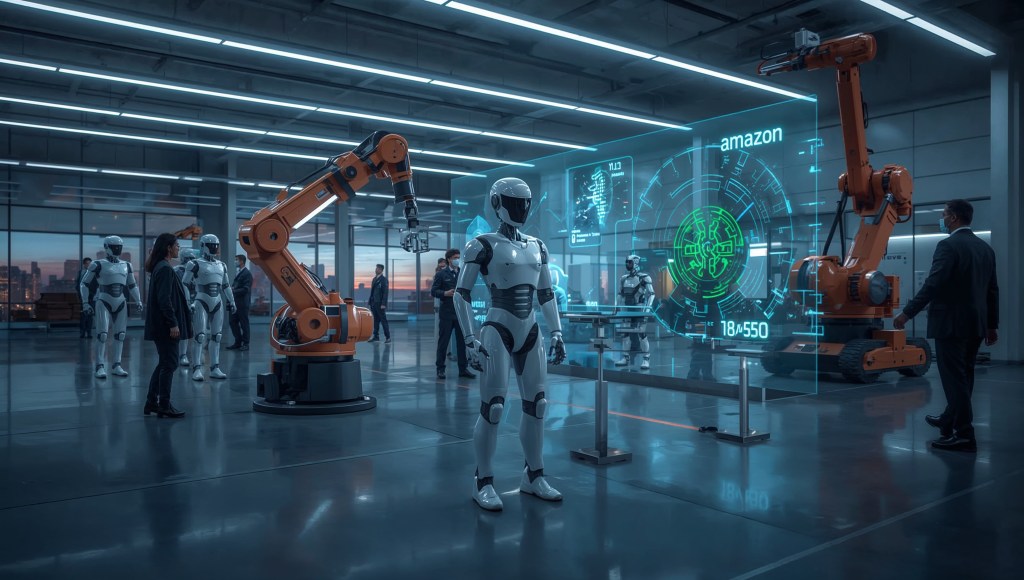
The robotics industry is on the cusp of a massive transformation. With market projections reaching $130 billion by 2035, we’re witnessing a fundamental shift from AI chatbots to physical robots that actually perform tasks in the real world. This isn’t science fiction anymore – it’s a rapidly evolving reality that’s reshaping industries from logistics to manufacturing.
The Robotics Market Explosion: Understanding the Numbers
Recent analysis from Goldman Sachs has revealed stunning growth projections for the robotics sector. The investment bank has tripled its forecast for the humanoid robot market alone, now expecting it to reach $38 billion by 2035. Even more impressive, the industrial robotics segment could soar to $94 billion during the same period. These aren’t speculative numbers pulled from thin air – they’re based on concrete developments in AI technology that have made robots approximately ten times more cost-effective to train than just a few years ago.
The convergence of artificial intelligence, advanced manufacturing capabilities, and economies of scale is creating perfect conditions for exponential growth. What was once the domain of specialized industrial applications is now expanding into everyday business operations, from warehouse logistics to customer service applications.
Tesla’s Bold Vision: The $20,000 Humanoid Robot
Tesla (NASDAQ: TSLA), currently trading at $423.79 with a market cap of $1.5 trillion, is making perhaps the most audacious bet in the robotics space. The company’s CEO has claimed that their Optimus humanoid robot could eventually represent 80% of Tesla’s future value – a statement that initially sounds hyperbolic but deserves serious consideration given the company’s track record of transforming ambitious visions into market realities.
The Economics of Optimus
The key to Tesla’s strategy lies in aggressive cost targeting. While competitors like Figure and Boston Dynamics are pricing their humanoid robots well above $100,000, Tesla is aiming for a revolutionary $20,000 to $30,000 price point. This isn’t just incremental improvement – it’s a complete paradigm shift that could transform humanoid robots from rare, specialized equipment into scalable business tools that companies can deploy en masse.
If Tesla achieves this pricing target, it would represent a cost reduction of approximately 70% compared to current market alternatives. This dramatic price difference could open entirely new markets and applications that simply aren’t economically viable at current price points. Imagine restaurants, retail stores, and small manufacturing facilities being able to afford robotic assistants – markets that are completely inaccessible with six-figure robot prices.
Vertical Integration Advantage
Tesla’s approach to robotics leverages its existing technological ecosystem in powerful ways. The neural networks that guide Tesla’s autonomous vehicles can be adapted for robotic navigation and decision-making. The battery technology developed for electric vehicles provides efficient, proven power systems for humanoid robots. Perhaps most importantly, Tesla’s manufacturing infrastructure, designed to produce vehicles at scale, can be repurposed for robot production at volumes that specialized robotics companies simply cannot match.
This vertical integration strategy means Tesla doesn’t need to build everything from scratch. They’re essentially repurposing billions of dollars in existing research, development, and infrastructure investments. The same Gigafactories that revolutionized electric vehicle production could soon be churning out humanoid robots at unprecedented scales.
Current Progress and Challenges
As of 2025, Tesla has produced several hundred Optimus units, falling short of their ambitious 5,000-robot goal. This gap between aspiration and execution is typical for the company – they often miss initial deadlines but eventually deliver transformative products. The recent deployment of Optimus robots in Tesla’s own diner operations, while appearing as a publicity stunt to some observers, actually serves a crucial function: generating real-world operational data that no laboratory simulation can replicate.
Leadership turnover within the Optimus program has raised some concerns about execution capabilities. However, Tesla has weathered similar challenges in its automotive division and emerged stronger. The company’s ability to attract top talent and iterate rapidly remains a key competitive advantage.
Investment Implications
With Tesla shares up approximately 5.5% year-to-date and trading at 166 times forward earnings, the market is clearly pricing in significant execution risk. This valuation assumes near-perfect execution of the company’s robotics vision. However, if Optimus delivers even a fraction of its promised potential, the upside could dwarf Tesla’s current automotive business.
Investors should consider that Tesla’s robotics venture represents a high-risk, high-reward proposition. The company’s track record suggests they can achieve seemingly impossible goals, but the timeline is always uncertain. Those considering Tesla as a robotics play should be prepared for volatility and have a long-term investment horizon.
Amazon’s Pragmatic Approach: A Million Robots Already at Work
While Tesla chases moonshot goals, Amazon (NASDAQ: AMZN), trading at $218.35, has quietly built the world’s largest operational robotic fleet. With more than one million robots currently deployed across its fulfillment network, Amazon isn’t speculating about the future of robotics – they’re living it every single day.
The Power of Practical Implementation
Amazon’s approach to robotics stands in stark contrast to the flashy demonstrations and bold promises common in the industry. These aren’t prototypes or proof-of-concept machines; they’re production systems that move millions of packages daily, directly contributing to the company’s bottom line. This practical, results-oriented approach has allowed Amazon to iterate and improve their robotic systems based on real-world performance data rather than theoretical models.
The company’s recent rollout of DeepFleet technology has improved travel efficiency by approximately 10%. While this might seem like a modest gain, when applied across Amazon’s massive global logistics network, it translates to enormous cost savings and productivity improvements. A 10% efficiency gain across millions of daily operations compounds into billions of dollars in value creation.
Diverse Robotic Capabilities
Amazon’s robotic fleet isn’t monolithic – it’s a carefully orchestrated ecosystem of specialized machines. The Hercules robots can lift an impressive 1,250 pounds, handling heavy-duty tasks that would be dangerous or impossible for human workers. Meanwhile, Proteus units are designed to navigate safely alongside human workers, demonstrating that effective automation doesn’t require complete human replacement.
This diversified approach allows Amazon to optimize each aspect of their operations with purpose-built solutions. Rather than trying to create a single, all-purpose robot, they’ve developed specialized tools that excel at specific tasks. This strategy has proven more practical and immediately valuable than pursuing general-purpose humanoid robots.
The Human-Robot Collaboration Model
One of the most important insights from Amazon’s robotics deployment is that automation shifts work rather than eliminates it. Next-generation fulfillment facilities operate an order of magnitude more robots than older sites, yet they also employ more skilled technicians for maintenance, programming, and system optimization. This creates a positive feedback loop where increased automation drives demand for higher-skilled, better-paying jobs.
Amazon’s model provides a template for how robotics can enhance rather than replace human workers. By handling repetitive, physically demanding tasks, robots free human workers to focus on problem-solving, quality control, and customer service – areas where human judgment and creativity remain irreplaceable.
Creating an Unassailable Competitive Moat
Amazon’s million-robot advantage isn’t just about the hardware – it’s about the integrated ecosystem they’ve built around it. The company has developed proprietary software, management systems, and operational processes that maximize the value of their robotic investments. Competitors can buy robots, but they can’t easily replicate decades of operational experience and optimization.
This creates a formidable competitive moat. While competitors showcase impressive demonstrations, Amazon embeds robotics into daily operations with a discipline that few can match. Every package delivered, every efficiency gained, and every lesson learned strengthens their position in the automated logistics space.
Nvidia’s Platform Strategy: Powering the Entire Ecosystem
Nvidia (NASDAQ: NVDA), trading at $177.59, has positioned itself as the indispensable infrastructure provider for the robotics revolution. Rather than building robots themselves, they’re creating the software and hardware platform that makes advanced robotics possible – a strategy that could capture value regardless of which specific robot designs ultimately succeed.
The Isaac Ecosystem
Nvidia’s robotics platform centers around their Isaac ecosystem, a comprehensive suite of tools that addresses every aspect of robotic development and deployment. Isaac GR00T provides foundation models for training humanoid robots, dramatically reducing the time and cost required to develop sophisticated robotic behaviors. Isaac Lab and Isaac Sim offer powerful simulation environments where robots can be trained and tested in virtual worlds before deployment in physical environments.
The Jetson Thor platform brings high-performance edge computing to robotics, enabling robots to process complex AI models in real-time without relying on cloud connectivity. This is crucial for applications requiring instant decision-making and operation in environments with limited or unreliable network access.
Becoming the Industry Standard
Nvidia’s strategy mirrors their successful domination of AI training through CUDA. By creating indispensable tools that developers rely on, they ensure continued demand for their hardware products. Major robotics companies from Boston Dynamics to Agility Robotics are building on Nvidia’s platform, even as they develop proprietary systems for specific capabilities.
This platform approach provides Nvidia with multiple revenue streams. They sell the chips that power robotic intelligence, the software tools that developers use to create robotic applications, and the simulation platforms where robots are trained and tested. It’s a comprehensive ecosystem play that captures value at every level of the robotics stack.
The Network Effect Advantage
As more developers build on Nvidia’s platform, the ecosystem becomes increasingly valuable. Each new tool, library, and optimization created by the community benefits all users, creating a powerful network effect. This makes it increasingly difficult for competitors to challenge Nvidia’s position – developers won’t switch to alternative platforms that lack the rich ecosystem of tools and community support.
Financial Perspective
Trading at approximately 50 times earnings, Nvidia’s valuation already reflects high expectations for continued growth. However, if robotics adoption scales toward the trillion-dollar forecasts some analysts project, Nvidia’s platform-style business model could generate returns that justify or even exceed current valuations.
The beauty of Nvidia’s position is that they don’t need to predict which specific robotic applications or designs will succeed. Whether the future belongs to humanoid robots, specialized industrial machines, or something we haven’t imagined yet, they’ll likely be powered by Nvidia’s technology.
The Transformation of Work: Implications for Society and Business
The robotics revolution isn’t just about technology – it’s about fundamental changes in how work gets done and value gets created. The developments at Tesla, Amazon, and Nvidia represent different approaches to this transformation, each with profound implications for businesses and workers.
From Automation to Augmentation
The traditional narrative around robotics has focused on job displacement, but the reality emerging from companies like Amazon is more nuanced. Rather than wholesale replacement of human workers, we’re seeing a shift toward human-robot collaboration. Robots handle repetitive, dangerous, or physically demanding tasks, while humans focus on creative problem-solving, relationship building, and complex decision-making.
This augmentation model could lead to significant productivity gains without the massive unemployment that some fear. However, it does require substantial investment in retraining and education to help workers develop the skills needed to work alongside robotic systems.
The Democratization of Robotics
If Tesla achieves its cost targets for humanoid robots, we could see a democratization of robotic technology similar to what happened with personal computers and smartphones. Small businesses that could never afford six-figure industrial robots might suddenly have access to affordable robotic assistants. This could level the playing field between large corporations and smaller competitors, spurring innovation and entrepreneurship.
New Business Models and Opportunities
The availability of affordable, capable robots will enable entirely new business models. Robots-as-a-Service (RaaS) could become as common as Software-as-a-Service (SaaS), allowing businesses to scale their robotic workforce up or down based on demand. We might see specialized robotic staffing agencies, robotic system integrators, and entirely new categories of businesses built around robotic capabilities.
Investment Strategies for the Robotics Revolution
For investors looking to capitalize on the robotics boom, these three companies offer distinct risk-reward profiles and exposure to different aspects of the market.
The High-Risk, High-Reward Play: Tesla
Tesla represents the most aggressive bet on robotics transformation. If they succeed in delivering sub-$30,000 humanoid robots at scale, the returns could be extraordinary. However, the execution risk is significant, and the current valuation leaves little room for error. This is suitable for investors with high risk tolerance and strong conviction in Tesla’s ability to execute.
Consider Tesla if you believe in transformative, disruptive innovation and can stomach significant volatility. The company’s track record of eventually delivering on ambitious promises, despite delays and setbacks, suggests patience could be rewarded.
The Steady Executor: Amazon
Amazon offers a more conservative approach to robotics investment. They’re already generating real returns from their robotic investments, with proven economics and operational excellence. While the upside might be more limited than Tesla’s moonshot potential, the downside risk is also considerably lower.
Amazon is appropriate for investors who prefer companies with demonstrated execution capabilities and clear paths to profitability. The robotics initiative enhances their core business rather than representing a speculative venture.
The Platform Player: Nvidia
Nvidia provides perhaps the most diversified exposure to the robotics revolution. Their platform strategy means they benefit regardless of which specific companies or technologies ultimately dominate. However, their current valuation already prices in significant growth expectations.
Consider Nvidia if you want exposure to the broader robotics ecosystem without betting on specific implementations or companies. Their position as the “picks and shovels” provider for the robotics gold rush offers a compelling risk-adjusted opportunity.
Challenges and Considerations
While the robotics revolution presents enormous opportunities, several challenges could impact the pace and nature of adoption.
Technical Hurdles
Despite significant progress, robotics still faces substantial technical challenges. Creating robots that can operate reliably in unstructured environments, handle unexpected situations, and interact safely with humans remains difficult. While AI has accelerated progress, we’re still far from general-purpose robots that can match human versatility.
Regulatory and Ethical Considerations
As robots become more prevalent in workplaces and public spaces, regulatory frameworks will need to evolve. Questions about liability, safety standards, and worker protections will require careful consideration. Companies operating in this space will need to navigate an evolving regulatory landscape that could impact development timelines and deployment strategies.
Social Acceptance
The success of the robotics revolution depends not just on technical capabilities but on social acceptance. Workers concerned about job displacement, consumers worried about privacy, and communities grappling with economic transformation all represent stakeholders whose concerns must be addressed.
The Road Ahead: 2025-2035
The next decade will be crucial for the robotics industry. We’re likely to see continued rapid advancement in capabilities, dramatic cost reductions, and widespread deployment across industries. The companies that successfully navigate this transformation – whether through bold innovation like Tesla, pragmatic execution like Amazon, or platform dominance like Nvidia – will likely generate substantial returns for investors.
However, the path won’t be smooth. Expect volatility, setbacks, and surprises along the way. Technologies that seem promising today might prove impractical, while unexpected breakthroughs could accelerate adoption beyond current projections.
Conclusion: Positioning for the Future
The robotics revolution represents one of the most significant investment opportunities of the next decade. With the market projected to reach $130 billion by 2035, early positioning in the right companies could generate substantial returns. Tesla, Amazon, and Nvidia each offer unique approaches to capturing value from this transformation.
Tesla’s ambitious humanoid robot program represents a high-risk, high-reward bet on revolutionary cost reduction and mass deployment. If successful, their Optimus platform could fundamentally transform labor economics across multiple industries.
Amazon’s practical approach, with over a million robots already deployed, demonstrates the immediate value of robotic automation. Their proven ability to integrate robotics into complex operations at scale provides a more certain, if perhaps less spectacular, investment opportunity.
Nvidia’s platform strategy positions them to benefit from the entire robotics ecosystem’s growth. By providing essential tools and infrastructure, they capture value regardless of which specific implementations succeed.
The key for investors is to understand their own risk tolerance, investment timeline, and conviction in various technological approaches. The robotics revolution is not a matter of if, but when and how. Companies that successfully navigate this transformation will likely define the next era of technological advancement and economic growth.
As we stand on the brink of this robotic transformation, one thing is clear: the convergence of AI, advanced manufacturing, and ambitious vision is creating unprecedented opportunities. Whether through Tesla’s moonshot ambitions, Amazon’s relentless execution, or Nvidia’s ecosystem dominance, the path to a robotic future is being paved today. Investors who recognize and act on this opportunity could find themselves at the forefront of one of the most significant technological shifts of our lifetime.
The $130 billion robotics market isn’t just a number – it’s a transformation of how humanity works, creates value, and solves problems. The companies leading this charge today are likely to shape the economy of tomorrow. For those willing to embrace the uncertainty and excitement of this emerging market, the rewards could be transformative.
 Wealth Engine
Leave a comment